Bluecollarjobs.com Brand

5 Best Welding Job Board Sites for Local & Travel Jobs 2026

5 Best Welding Job Board Sites for Local & Travel Jobs 2026

Finding the right welding job board can mean the difference between scrolling through hundreds of irrelevant listings and landing a position that actually matches your skills, certs, and preferred location. Whether you’re a structural welder looking for local shop work or chasing travel gigs with per diem, general job sites bury trade-specific roles under piles of office and retail postings.

That’s exactly why specialized platforms exist. At bluecollarjobs, we connect skilled tradespeople with employers who need their expertise, and welding is one of the trades where demand continues to outpace supply. We know what makes a job board worth your time: salary transparency, clear certification requirements, and filters that actually matter to someone working with their hands.

Below, we break down the 5 best welding job board sites in 2026 for finding local, travel, and per diem welding positions across the United States.

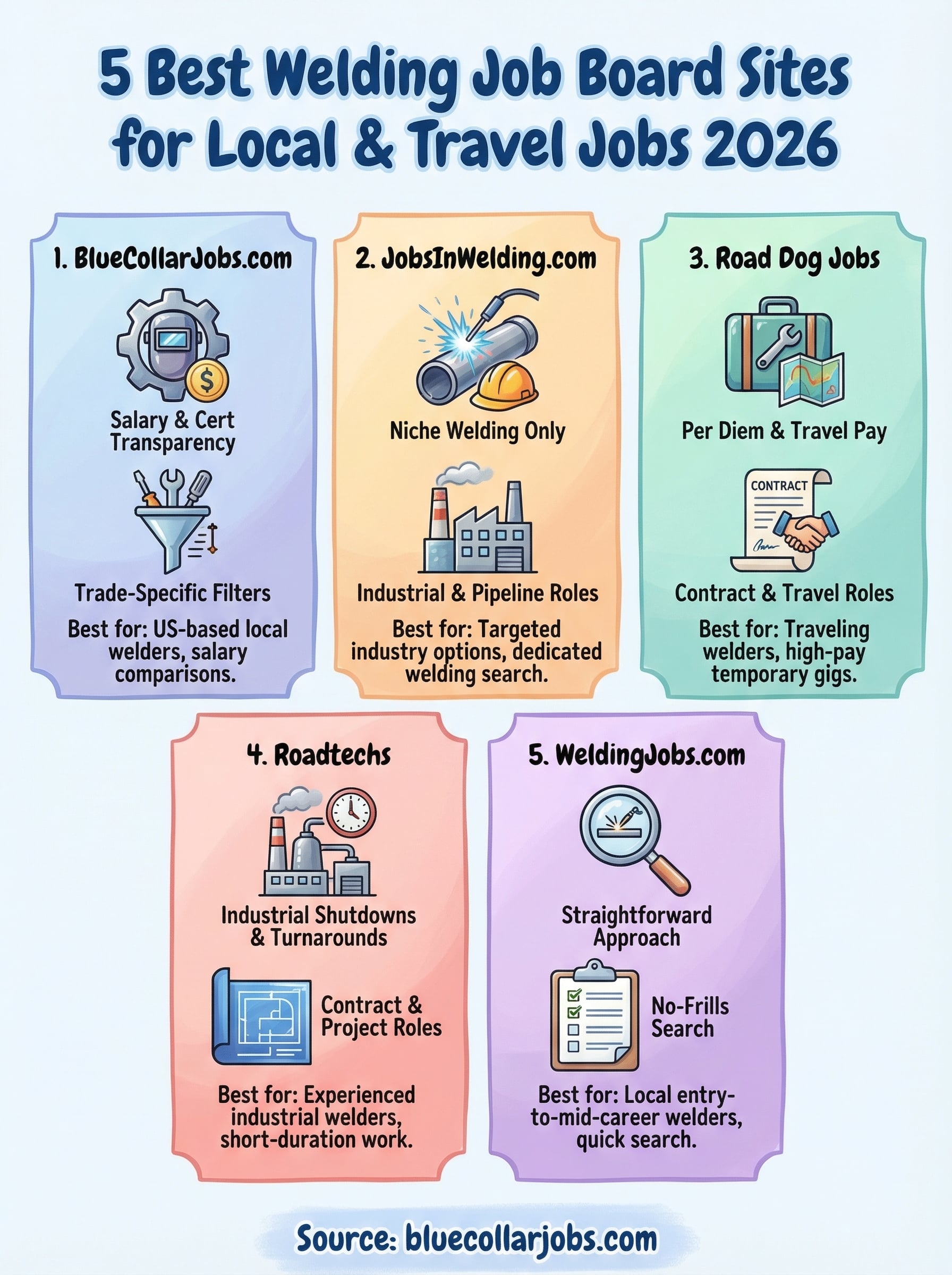
1. BlueCollarJobs.com

BlueCollarJobs.com is a trade-specific job board built entirely for skilled workers in the US, and welding is a core category. Unlike general platforms, every listing connects to a manual or technical trade, so you never have to sort through office jobs or retail postings to find what you need.
1. BlueCollarJobs.com

What it’s good at

This platform stands out as a focused welding job board by putting salary ranges and certification requirements front and center on every listing. You know before you click whether a position fits your credentials and pay expectations.

Salary transparency built into every listing saves you from chasing roles that don’t match your license level or target income.

Every position is also categorized by experience tier, from Apprentice and Helper up to Journeyman, Master, and Management, so you can zero in on roles that match where you are in your career right now.

How the search works

The search function lets you filter results by trade, state, and experience level. Below are the three main filters you’ll use:

  • Trade: Select welding specifically within the skilled trades category
  • Location: Filter by US state, with strong coverage in Texas, Florida, and California
  • Experience level: Range from entry-level Apprentice through Journeyman, Master, and Foreman roles

Best for

BlueCollarJobs.com suits US-based welders who want local or regional positions without digging through unrelated listings. It works especially well if you hold a specific certification or license, since those credentials are built directly into the search filters rather than buried in job descriptions.

You’ll also find it useful for comparing salary ranges across states before committing to a relocation or travel assignment.

Pricing and account details

For job seekers, browsing and applying is completely free with no account required to view listings. Employers post through structured pricing tiers designed to attract serious candidates, which keeps the board free of low-effort or speculative postings.

2. JobsInWelding.com

JobsInWelding.com is a niche welding job board built specifically for the welding trade, covering positions across the US in industries like manufacturing, construction, and oil and gas. Because the site focuses exclusively on welding, every listing you see is directly relevant to your trade.

What it’s good at

The platform collects listings from a wide range of industries, giving you exposure to positions you won’t always find on broader trade boards. It’s particularly strong for industrial and pipeline welding roles, which tend to be higher-paying and harder to locate on general sites.

If you specialize in a specific process like TIG or MIG, this board’s industry depth gives you more targeted options than most general platforms.

How the search works

You can filter by job title and location, which keeps the process straightforward. Results display employer name and posting date, so you can prioritize fresh listings without digging through outdated openings.

Best for

JobsInWelding.com works well for welders targeting industrial sectors and those open to positions across multiple states. It suits you if you want a dedicated welding-only search experience without trade crossover from unrelated skilled work.

Pricing and account details

Job seekers browse for free with no registration required. Employers pay to post listings, which helps maintain listing quality and relevance across the board.

3. Road Dog Jobs

Road Dog Jobs focuses on traveling tradespeople, making it a strong option if you’re a welder who moves between projects and wants per diem or travel-pay roles rather than permanent local positions. This welding job board caters specifically to the traveling craft worker community across the United States.
3. Road Dog Jobs

What it’s good at

Road Dog Jobs excels at surfacing per diem, travel, and contract welding positions that most general boards don’t categorize separately. If you’re chasing higher pay by moving between job sites, the platform targets exactly that niche.

Traveling welders often earn significantly more than local shop rates, and Road Dog Jobs keeps those high-paying travel roles in one place.

How the search works

You can search by trade and location, with listings clearly marked for contract length and travel requirements. Results load quickly and display key compensation details upfront, so you can assess a role without clicking through multiple pages.

Best for

Road Dog Jobs suits experienced welders comfortable with travel assignments and those targeting pipeline or industrial shutdown work. It’s less useful if you’re strictly looking for permanent local positions.

Pricing and account details

Job seekers use the platform for free. Employers and contractors pay to post, which keeps the listing quality focused on serious, funded projects.

4. Roadtechs

Roadtechs is a long-running platform focused on industrial and craft workers who take on contract and project-based roles across the US. The site has built a strong reputation among traveling tradespeople, including welders who move between refineries, power plants, and industrial shutdowns.

What it’s good at

Roadtechs specializes in industrial shutdown and turnaround work, which is where some of the highest-paying welding contracts originate. If you work in pipe welding or structural applications tied to refineries or chemical plants, this platform surfaces those roles consistently.

Shutdown and turnaround contracts often pay premium rates for short bursts of intense work, making them worth targeting if your schedule allows.

How the search works

The platform lets you search by trade classification and location, with listings organized around project type and duration. You can also set up alerts for new postings that match your credentials, so fresh contract opportunities reach you before the competition.

Best for

Roadtechs works best for experienced pipeline and industrial welders who want contract positions at refineries or power plants. This welding job board suits you if you hold advanced certifications and prefer high-pay, short-duration assignments over permanent local roles.

Pricing and account details

Job seekers register and browse for free. Employers and project contractors pay to post, which keeps listings tied to real, funded industrial projects rather than exploratory or unfilled openings.

5. WeldingJobs.com

WeldingJobs.com takes a straightforward approach to matching welders with open positions across the United States. The site focuses on welding-specific listings without mixing in unrelated trades, making it a clean, distraction-free option when you want to move quickly through your job search.

What it’s good at

This welding job board pulls together openings from multiple industries including fabrication, manufacturing, and construction. The site keeps the search experience simple, which works in your favor when you already know your target role and just need to see what’s available in your area.

Simplicity matters when you’re applying to multiple positions at once and need to move efficiently through listings.

How the search works

You search by keyword and location, and results display job title, employer, and posting date clearly. The process takes minimal clicks to get from search to application, which reduces friction when you’re actively pursuing multiple openings.

Best for

WeldingJobs.com fits welders who want a no-frills search experience focused purely on welding roles. It works well for entry-level through mid-career welders looking for local positions without specialized filters.

Pricing and account details

Job seekers browse at no cost. Employers pay to post positions, keeping listings relevant and current.
welding job board infographic

Next Steps

Each welding job board on this list serves a different type of welder. If you work locally and want salary transparency with trade-specific filters, BlueCollarJobs.com gives you that without the noise of general job sites. If you travel between projects or target industrial shutdowns, Road Dog Jobs and Roadtechs are worth bookmarking alongside your main search.

The fastest way to find a match is to start with your certification level and preferred location, then run searches on two or three of these platforms simultaneously. You’ll quickly see which boards have the most active listings in your specialty and region.

If you’re ready to browse current welding positions filtered by state and experience level right now, search welding jobs on BlueCollarJobs.com and apply directly to employers who list salary ranges and certification requirements up front. No account needed to start.
Electrician Salary By State: 5 Highest-Paying States (2026)

Electrician Salary By State: 5 Highest-Paying States (2026)

What you earn as an electrician depends heavily on where you work. Electrician salary by state can vary by $30,000 or more per year, a gap that makes location one of the biggest factors in your earning potential.

Whether you’re a licensed journeyman weighing a relocation, an apprentice planning your career path, or a master electrician curious about what the market looks like in 2026, knowing which states pay the most matters. But raw salary numbers only tell part of the story. Cost of living, union presence, and experience level all shift what that paycheck actually means for your day-to-day life.

We built bluecollarjobs to help skilled tradespeople find real opportunities with transparent pay. Below, we break down the five highest-paying states for electricians in 2026, along with the key factors that drive those numbers up or down.

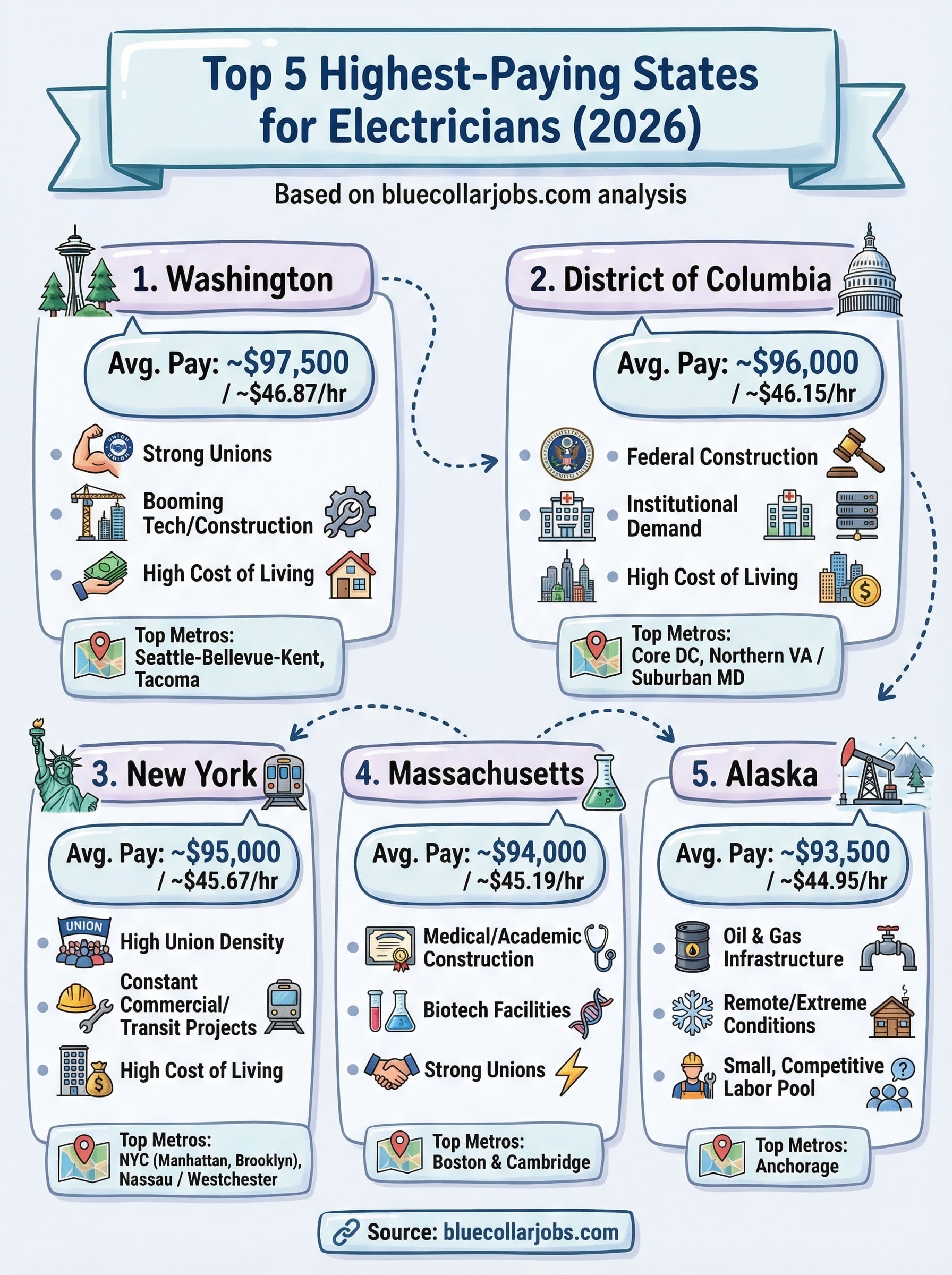
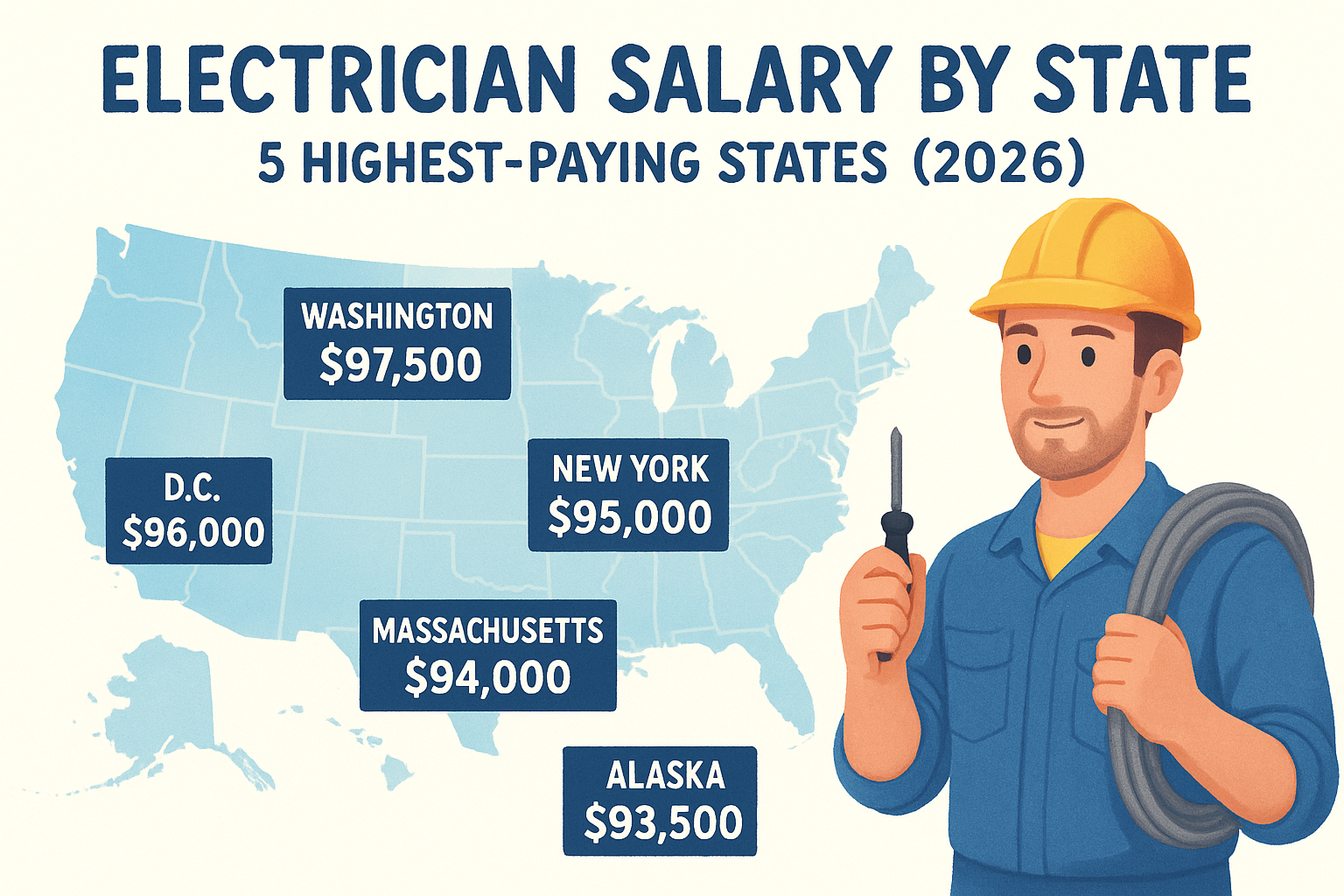
1. Washington

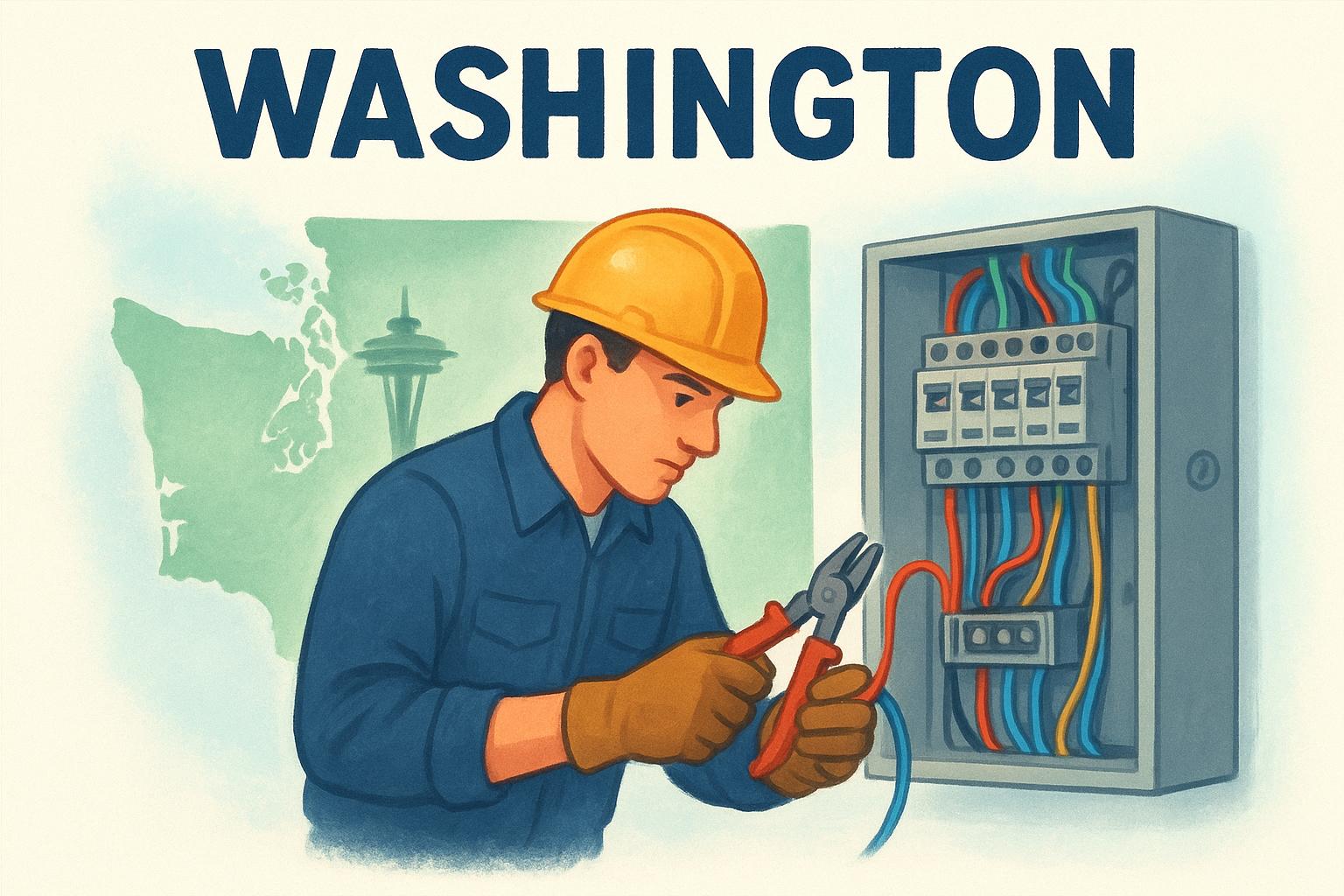
Washington sits at the top of any honest electrician salary by state comparison. The state’s combination of strong union infrastructure, a booming tech-driven construction market, and high cost of living has pushed electrician wages well above the national average.

1. Washington

Average electrician pay in 2026

Washington electricians earn a mean annual wage of around $97,500, or roughly $46.87 per hour, based on Bureau of Labor Statistics data projected into 2026. Entry-level apprentices typically start near $55,000, while licensed journeymen and masters in high-demand metros routinely clear $110,000 or more.

Experience Level Estimated Annual Pay
Apprentice $52,000 – $62,000
Journeyman $90,000 – $110,000
Master / Foreman $110,000 – $130,000+

What drives pay in Washington

Washington’s economy runs on large-scale commercial and industrial construction, fueled by ongoing Amazon, Microsoft, and Boeing projects that require constant electrical infrastructure work. Union density in the state runs significantly higher than the national average, and union contracts set wage floors that lift earnings across the board, including for non-union shops competing for the same workers.

Where the best-paying metros are

Seattle leads the state, with metro-area electricians averaging closer to $105,000 annually. Tacoma and Bellevue also pay well, driven by data center expansion and high-density residential development. If top-tier wages are your goal, positioning yourself in the Puget Sound region gives you the clearest path to them.

  • Seattle-Bellevue-Kent: Highest average wages in the state
  • Tacoma-Lakewood: Strong commercial demand, solid union presence
  • Spokane: Lower cost of living, but wages trail the western metros by a notable margin

Union and licensing notes

Washington issues state electrical licenses through the Department of Labor and Industries. Most high-paying work flows through IBEW locals, particularly Local 46 in Seattle. Getting your journeyman card and connecting with a union hall significantly improves your access to the best-paying commercial and industrial projects.

Union membership in Washington can add $15,000 or more annually when you factor in full benefits and pension contributions.

Job outlook and how to find openings on Blue Collar Jobs

Washington’s market for electricians stays strong heading into 2026, driven by sustained construction activity and grid modernization work statewide. You can search current openings filtered by trade, experience level, and location directly on bluecollarjobs.com, where salary ranges are displayed upfront on every listing.

2. District of Columbia

The District of Columbia ranks near the top of any electrician salary by state comparison, and the numbers make the case clearly. Dense federal construction, a compact footprint, and one of the highest costs of living in the country push wages to levels that rival Washington state.

Average electrician pay in 2026

DC electricians earn a mean annual wage of around $96,000, or approximately $46.15 per hour. Journeymen on federal contracts regularly clear $105,000, while apprentices entering the market start near $55,000.

Experience Level Estimated Annual Pay
Apprentice $53,000 – $63,000
Journeyman $88,000 – $108,000
Master / Foreman $108,000 – $125,000+

What drives pay in the District of Columbia

Federal projects and large-scale institutional construction keep demand for electricians consistent year-round. Hospitals, government buildings, and data centers all require ongoing electrical work, and contractors pay a premium to get licensed tradespeople on-site fast.

Where the best-paying metros are

The core district offers the highest rates, but Northern Virginia and suburban Maryland also pay well above national averages. Arlington and Bethesda generate strong demand from both federal agencies and private commercial development.

Union and licensing notes

DC issues journeyman and master licenses through the DC Department of Consumer and Regulatory Affairs. IBEW Local 26 covers a large share of commercial work in the area and negotiates contracts that lift wage floors across the broader metro market.

Joining IBEW Local 26 connects you to the highest-tier federal and commercial projects in the metro.

Job outlook and how to find openings on Blue Collar Jobs

Federal infrastructure investment keeps DC’s market consistently active heading into 2026. Search current openings with upfront salary ranges on bluecollarjobs.com, filtered by trade and experience level.

3. New York

New York ranks third in this electrician salary by state comparison. High union density, relentless construction demand across the five boroughs, and a cost of living that keeps pushing wages higher combine to put earnings well above the national average.

Average electrician pay in 2026

New York electricians earn a mean annual wage of approximately $95,000, or around $45.67 per hour. Journeymen working union commercial contracts in New York City routinely exceed $110,000, while apprentices start near $52,000.

Experience Level Estimated Annual Pay
Apprentice $50,000 – $62,000
Journeyman $88,000 – $112,000
Master / Foreman $110,000 – $130,000+

What drives pay in New York

New York City generates constant demand for electrical labor through large-scale commercial development, transit upgrades, and utility grid modernization. Outside the city, industrial facilities upstate and ongoing infrastructure projects keep demand steady across the full state.

Where the best-paying metros are

New York City leads by a wide margin, with Manhattan and Brooklyn pulling the highest rates. Nassau County and Westchester also pay above the state average, while Buffalo and Albany trail but still outperform most of the country.

Union and licensing notes

New York licenses electricians at the city and state level, with NYC maintaining its own licensing board. IBEW Local 3 in New York City is one of the largest union locals in the country, and membership unlocks the best-paying commercial and industrial projects in the state.

IBEW Local 3 membership can push your total compensation well past $120,000 annually when full benefits are included.

Job outlook and how to find openings on Blue Collar Jobs

New York’s market stays active heading into 2026, driven by transit expansion and data center buildout. Search current electrician openings with salary ranges displayed upfront on bluecollarjobs.com.

4. Massachusetts

Massachusetts holds a strong position in this electrician salary by state comparison. The state combines a high concentration of medical and academic construction, a well-organized union presence, and a cost of living that keeps wages well above the national average.

Average electrician pay in 2026

Massachusetts electricians earn a mean annual wage of approximately $94,000, or roughly $45.19 per hour. Journeymen on commercial contracts in Boston regularly clear $105,000, while apprentices entering the market start near $50,000.

Experience Level Estimated Annual Pay
Apprentice $49,000 – $60,000
Journeyman $86,000 – $108,000
Master / Foreman $106,000 – $125,000+

What drives pay in Massachusetts

The state’s dense network of universities, hospitals, and biotech facilities keeps demand for licensed electricians steady year-round. Institutions like Harvard, MIT, and major hospital systems run continuous capital construction projects that require skilled electrical crews on-site.

Where the best-paying metros are

Boston and Cambridge lead the state, driven by ongoing medical and academic expansion. Worcester and Springfield also pay above the national average, though both trail the Boston metro by a noticeable margin.

Union and licensing notes

Massachusetts licenses electricians through the Board of State Examiners of Electricians. IBEW Local 103 in Boston covers a large share of commercial work and negotiates contracts that set strong wage floors across the market.

Union membership in Massachusetts frequently adds $12,000 or more annually once full benefits and pension contributions are included.

Job outlook and how to find openings on Blue Collar Jobs

The market stays consistently active heading into 2026, with biotech campus buildouts and grid modernization driving steady hiring. Search current electrician openings with salary ranges displayed upfront on bluecollarjobs.com.

5. Alaska

Alaska rounds out this electrician salary by state list, and its position here surprises some people. Geographic isolation, extreme working conditions, and a small but competitive labor pool push wages into top-five territory, even without the dense urban construction markets you find in the other states on this list.

5. Alaska

Average electrician pay in 2026

Alaska electricians earn a mean annual wage of approximately $93,500, or roughly $44.95 per hour. Journeymen working on industrial and oil-field projects frequently clear $105,000, while apprentices entering the market start near $50,000.

Experience Level Estimated Annual Pay
Apprentice $48,000 – $60,000
Journeyman $85,000 – $108,000
Master / Foreman $104,000 – $125,000+

What drives pay in Alaska

Oil and gas infrastructure accounts for a significant share of high-wage electrical work in the state. Projects in remote locations demand licensed electricians willing to work in difficult conditions, and contractors pay a clear premium to fill those roles consistently.

Where the best-paying metros are

Anchorage leads the state for overall volume of work and average wages. Fairbanks also pays well, driven by military base projects and industrial facilities servicing the interior.

Union and licensing notes

Alaska licenses electricians through the Division of Corporations, Business and Professional Licensing. IBEW Local 1547 covers commercial and industrial work statewide.

IBEW Local 1547 membership connects you directly to the highest-paying industrial and infrastructure projects across Alaska.

Job outlook and how to find openings on Blue Collar Jobs

Alaska’s market stays active into 2026, with energy sector investment and infrastructure maintenance driving consistent demand. Search current electrician openings with salary ranges displayed upfront on bluecollarjobs.com.

electrician salary by state infographic

Your next move

The five states on this electrician salary by state breakdown all offer strong earning potential, but the right fit depends on your license status, experience level, and tolerance for cost of living. Washington and New York reward union members heavily. Alaska pays a premium for remote project work. Massachusetts and DC keep demand steady through institutional and federal construction.

Your next step is straightforward. Check what’s currently hiring in the states that match your situation, and look for listings that show salary ranges upfront so you’re not guessing what a role actually pays. Relocating for a $20,000 pay bump only makes sense if you know the numbers before you move.

Browse current openings by trade, experience level, and state directly on bluecollarjobs.com. Every listing displays salary ranges clearly, so you can compare real opportunities without digging through vague job descriptions.

5 Best Sites for Plumbing Jobs With Per Diem in 2026

5 Best Sites for Plumbing Jobs With Per Diem in 2026

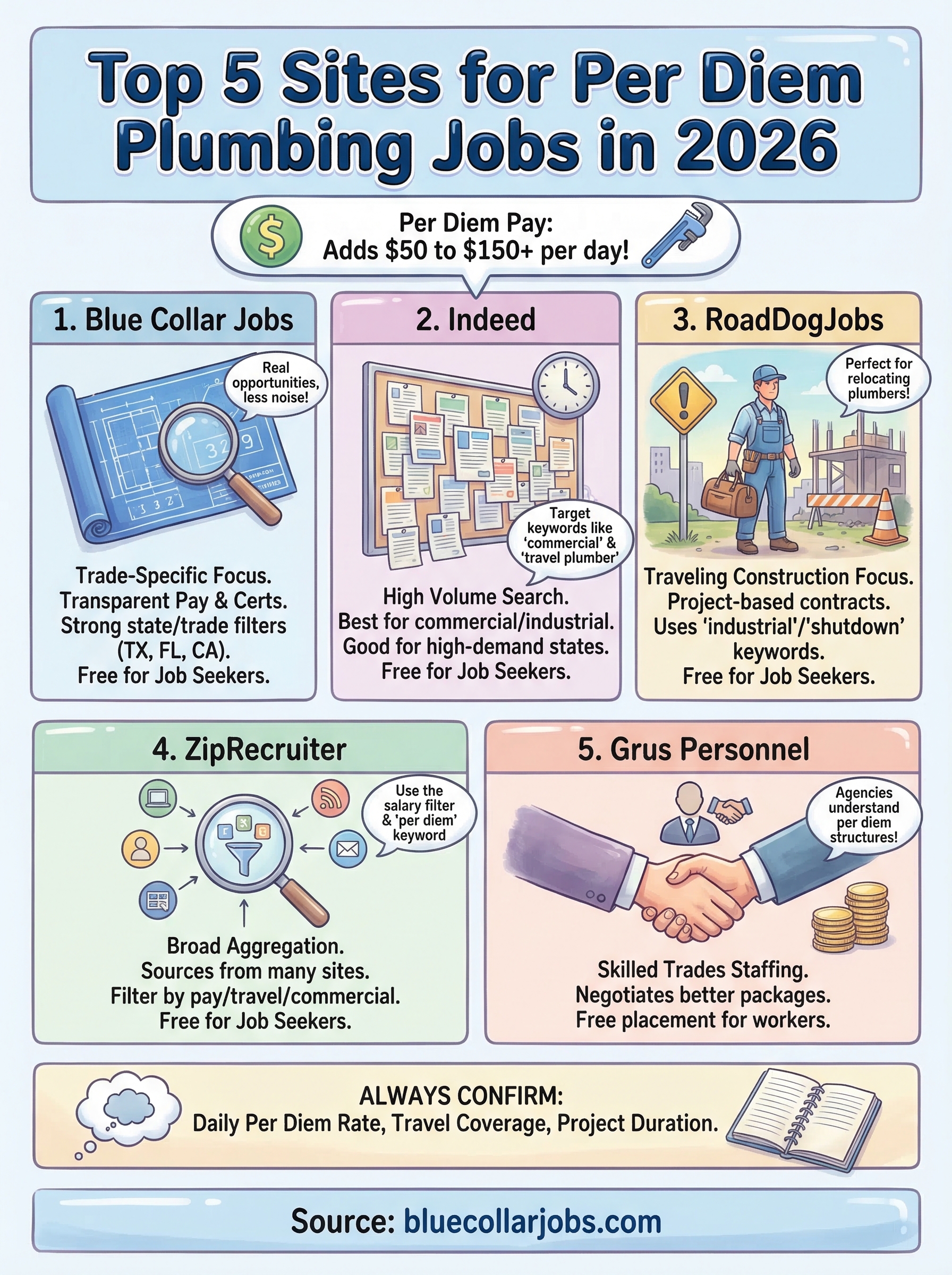
Per diem pay can add $50 to $150+ per day on top of your base wage, making plumbing jobs with per diem some of the highest-earning opportunities in the trade. These roles typically involve travel, think commercial buildouts, industrial shutdowns, or new construction projects in cities that need experienced hands fast.

The catch? Finding these gigs isn’t always straightforward. Per diem positions get buried on general job boards between office jobs and gig work, or they disappear before you even spot them. That’s exactly why trade-specific platforms like bluecollarjobs.com exist, to cut through the noise and surface real plumbing opportunities with clear pay details, location info, and experience requirements upfront.

Below, we break down the five best sites to find plumbing jobs that offer per diem pay in 2026, including what each platform does well and who it’s best suited for, whether you’re a journeyman ready to travel or a master plumber looking for premium contract work.

1. Blue Collar Jobs

Blue Collar Jobs is a trade-specific job board built entirely around skilled labor roles in plumbing, HVAC, electrical, and maintenance. Unlike general platforms that mix in unrelated listings, every job on this board is a trade position, which means you spend less time filtering and more time applying to real opportunities.

What makes it a strong fit for per diem plumbing work

Blue Collar Jobs stands out because it puts salary ranges and certification requirements directly in the search results, so you know whether a role pays competitively before you click. Employers posting here are typically contractors, service firms, and construction companies that already understand trade pay structures, including per diem and travel compensation for out-of-area plumbing jobs with per diem built into the offer.

Platforms built for trades attract employers who already speak your language, which means fewer back-and-forth conversations about what "travel pay" actually means.

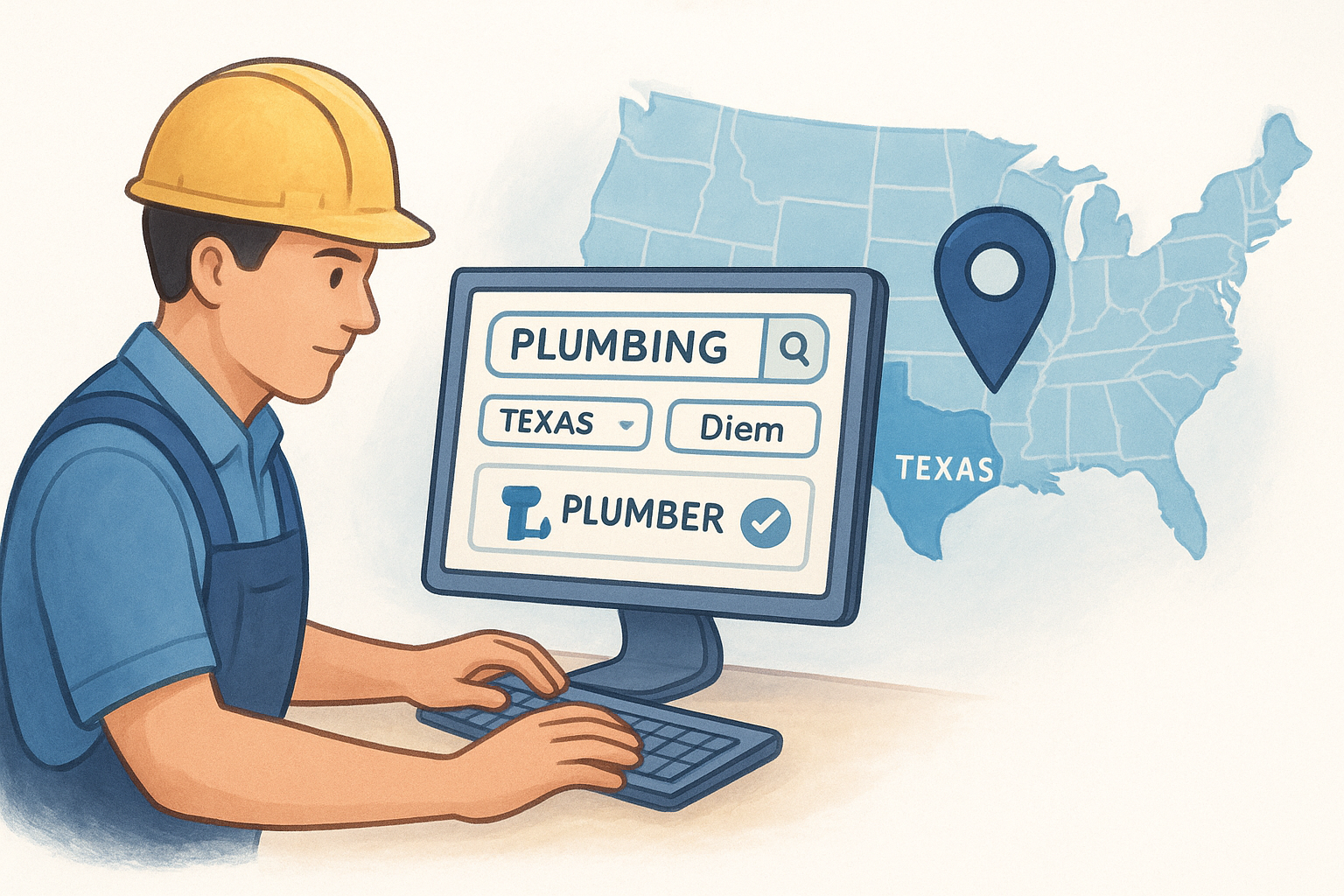
How to find per diem roles fast using trade and state filters

Use the trade filter set to Plumbing and then select the state where the project is located. Because per diem roles are common in commercial and industrial markets, Texas, Florida, and California tend to have the highest volume of travel-eligible postings on the platform. Sorting by experience level also helps if you hold a Journeyman or Master license, since higher-tier roles are more likely to include travel allowances.

How to find per diem roles fast using trade and state filters

What details to confirm in each posting before you apply

Before you submit anything, check that the listing specifies daily per diem amount, travel coverage, and project duration. Some postings list per diem as a range rather than a fixed number, so clarifying that directly with the employer saves you from surprises on the first paycheck.

Cost for job seekers and employers

Job seekers pay nothing to search and apply. Employers pay a flat posting fee based on the selected pricing tier, with no commission taken from your wages.

2. Indeed

Indeed is one of the largest general job boards in the US, and its search volume means plumbing jobs with per diem do show up regularly, especially for commercial and industrial projects posted by contractors and staffing firms.

When Indeed works best for per diem plumbing searches

The platform works best when you target high-demand states like Texas, California, or Florida, where contractors post volume positions quickly. You’ll find the most relevant listings during active project seasons, typically spring through early fall when commercial buildouts ramp up.

How to search for true per diem and travel plumbing listings

Search using specific terms like "plumber per diem" or "travel plumber" in the keyword field, then filter by location and full-time employment type. Adding "commercial" or "industrial" to your search narrows results toward higher-paying project work.

Specific search phrases return far cleaner results than broad terms like "plumbing jobs" on a general board.

How to spot staffing ads, duplicates, and vague per diem language

Watch for listings that mention "competitive compensation" without a fixed number, and flag duplicate postings from multiple staffing agencies promoting the same role. If per diem isn’t listed as a specific daily amount, ask the employer directly before you apply.

Cost for job seekers and employers

Job seekers search and apply at no cost. Employers pay per-click fees or subscribe to sponsored listing packages, and costs scale with the visibility level selected.

3. RoadDogJobs

RoadDogJobs focuses on traveling construction workers, making it a natural fit if you’re a plumber willing to relocate for project-based work. The platform attracts contractors running large-scale builds, which means roles here lean toward commercial and industrial sites where per diem is standard.

Why RoadDogJobs fits traveling construction plumbers

Unlike general boards, RoadDogJobs is built around the idea that workers travel for work. Most listings are project-based contracts rather than permanent local positions, which aligns directly with how plumbing jobs with per diem are structured in the field.

How to use project keywords like industrial and shutdown

Search terms like "industrial plumber" or "shutdown plumber" pull the most relevant listings on this platform. Adding location keywords tied to active plant or pipeline projects sharpens your results further.

Shutdown and turnaround projects almost always include per diem because crews travel from out of state to hit tight project windows.

What to ask about per diem payout and jobsite expectations

Before accepting any offer, confirm the daily per diem rate and payment schedule, and ask whether the employer covers lodging directly or pays a flat allowance. Also clarify project duration and overtime expectations upfront.

Cost for job seekers and employers

Job seekers use the platform free of charge. Employers pay to post listings, with pricing based on the scope and duration of the posting.

4. ZipRecruiter

ZipRecruiter aggregates listings from employer websites, staffing agencies, and direct posts, giving it a broader pool than most standalone job boards. For plumbing jobs with per diem, that reach translates to a solid mix of commercial, industrial, and travel-based roles posted by contractors across the US.

Where ZipRecruiter pulls per diem plumbing opportunities from

The platform sources listings from thousands of employer sites and staffing partners, which means a per diem plumbing role might appear here before it shows up elsewhere. The tradeoff is that duplicate listings are common, so track which companies you’ve already engaged with to avoid wasting time reapplying.

How to narrow results by pay, travel, and commercial work

Use the salary filter alongside keywords like "travel" or "per diem" to cut out local residential jobs that don’t include travel compensation. Filtering by full-time and contract employment types keeps your results focused on project-based commercial work.

Setting a minimum salary filter removes most residential-only postings and surfaces travel-eligible roles faster.

How to manage employer outreach and fast apply listings

ZipRecruiter’s "Invited to Apply" feature alerts you when employers actively flag your profile as a match. Apply only to listings that clearly state a per diem rate, and follow up directly with any employer who leaves pay details vague in the posting.

Cost for job seekers and employers

Job seekers search and apply for free. Employers pay a subscription fee based on the number of active listings and the level of candidate matching features they select.

5. Grus Personnel

Grus Personnel is a skilled trades staffing firm that places workers on travel and project-based assignments across the US. For plumbers targeting plumbing jobs with per diem, working through a trades-specific agency often produces better pay packages than applying cold to individual contractor listings.

Why a skilled trades staffing firm can pay better on travel jobs

Staffing firms negotiate contracts with large employers in bulk, which gives them leverage to lock in higher base rates and structured per diem packages. Because Grus Personnel focuses on trades placements exclusively, they push for travel compensation that reflects what experienced plumbers actually earn in the field.

Agencies built around skilled trades understand per diem structures and negotiate for them on your behalf.

How the placement process works for plumbers

You submit your credentials and license level, and a recruiter matches you to open travel assignments based on your availability and experience. Placements move quickly because project timelines are fixed, so have your certifications and references ready before you reach out.

How the placement process works for plumbers

What to clarify before you accept a per diem assignment

Before signing, confirm the daily per diem amount and whether lodging is covered separately or bundled into the allowance. Also ask about:

  • Project duration and likelihood of extensions
  • Overtime expectations and weekly hour requirements

Cost for job seekers and employers

Placement costs nothing for workers. Employers pay a placement fee based on contract terms negotiated directly with the agency.

plumbing jobs with per diem infographic

Start applying with a clear plan

The five platforms above cover different angles on plumbing jobs with per diem, from trade-specific boards to staffing agencies built around travel assignments. Your best move is to pick two or three platforms that match your license level and target market, then apply consistently rather than scattering efforts across every board at once.

Before you hit submit on anything, confirm the daily per diem rate and project duration in writing. Those two details determine whether a job actually pays what it appears to at first glance. If a listing leaves either of them vague, reach out to the employer directly before committing your time to the application.

Ready to start with a board built specifically for trade professionals? Browse open plumbing listings on Blue Collar Jobs and use the trade filter and state filter to zero in on roles that match your license level and preferred location.

Industrial Electrician Job Responsibilities: Duties & Skills

Industrial Electrician Job Responsibilities: Duties & Skills

Industrial electricians keep factories, plants, and large-scale facilities running. Without them, production lines stop, equipment fails, and operations grind to a halt. If you’re hiring for this role or considering it as a career path, understanding industrial electrician job responsibilities gives you a clear picture of what the position actually demands, from hands-on electrical work to reading complex schematics and maintaining compliance with safety codes.

This isn’t a job where two electricians do the same thing every day. Responsibilities shift based on the facility, the equipment, and the level of experience required. A journeyman wiring motor controls at a manufacturing plant faces different challenges than a master electrician overseeing power distribution at a water treatment facility. The specifics matter, especially when you’re writing a job description or deciding whether your skills and certifications line up with employer expectations.

Below, we break down the core duties, required skills, and daily tasks that define the industrial electrician role. Whether you’re an employer building a job listing on bluecollarjobs or a tradesperson mapping out your next career move, this guide covers what you need to know, no filler, just the details that count.

What industrial electricians do day to day

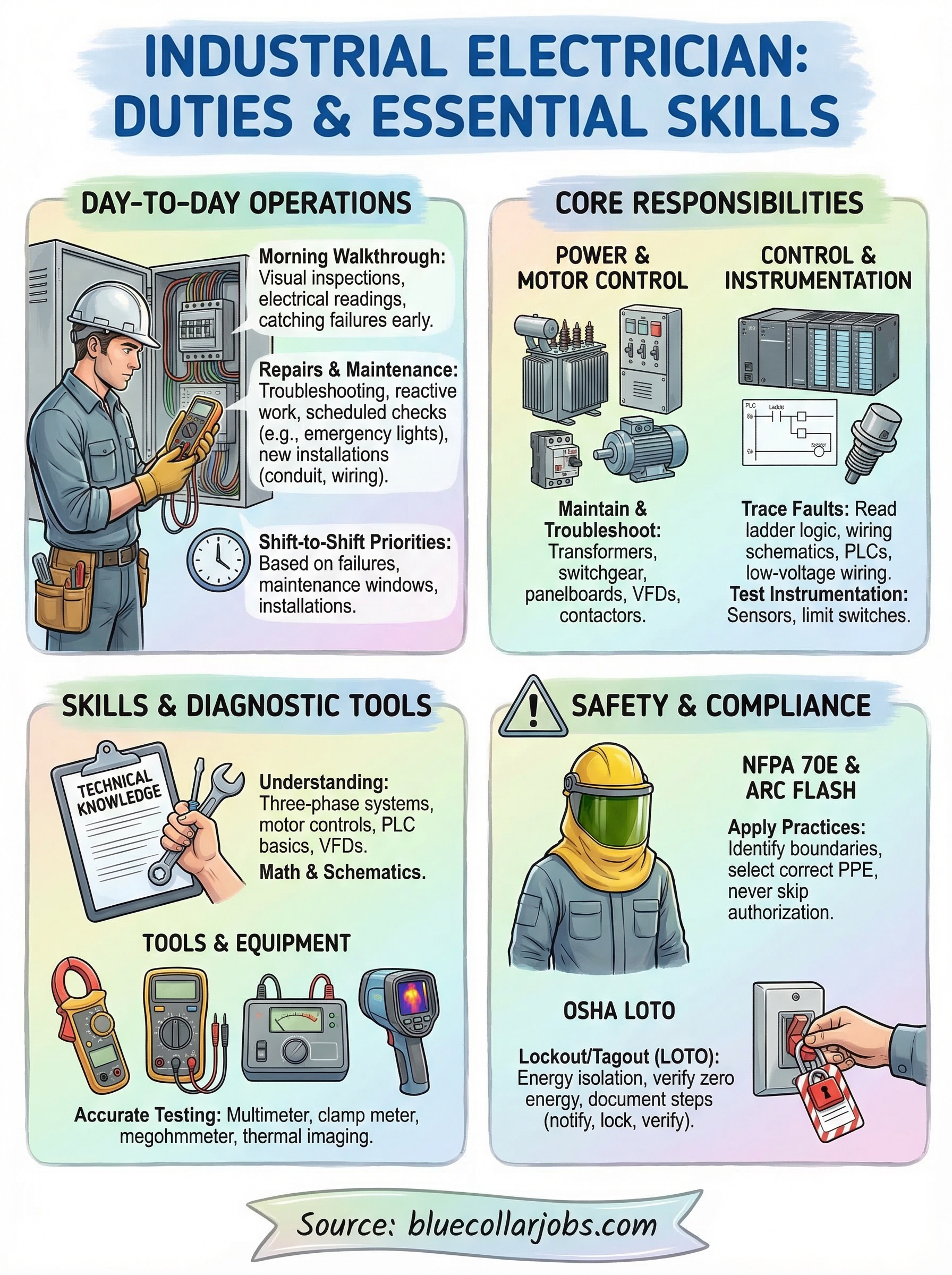
The daily routine of an industrial electrician rarely follows a fixed script. Shift-to-shift priorities change based on equipment failures, scheduled maintenance windows, and new installations. Most days combine reactive work (fixing what breaks) with planned tasks like preventive maintenance checks, panel inspections, or running new conduit for an equipment upgrade.

Morning walkthrough and equipment checks

Most shifts start with a walkthrough of critical systems: motors, control panels, switchgear, and any equipment flagged from the previous shift. You’re looking for warning signs before they become downtime. Visual inspections and electrical readings taken early catch problems before production starts, which matters when a single line stoppage costs thousands per hour.

Starting your shift with a structured inspection routine is one of the most effective ways to catch failures before they cost the facility real money.

These checks often involve using a multimeter or clamp meter to verify voltage levels, check for ground faults, or confirm that motor starter contacts are seating correctly. You document findings in a maintenance log, flag anything that needs follow-up, and coordinate with your supervisor if something needs immediate attention.

Repairs, installations, and scheduled maintenance

Once the shift gets moving, troubleshooting and repair work take up a significant portion of your time. You might pull a motor, test a variable frequency drive, or track down an intermittent fault in a control circuit. Scheduled maintenance tasks, like testing emergency lighting systems or inspecting contactors, run alongside that reactive work.

Industrial electrician job responsibilities also include supporting new equipment installations. You read electrical schematics and wiring diagrams, run conduit, pull wire, terminate connections, and test each system before it goes live. Precision matters here because mistakes in an industrial environment carry serious safety consequences.

Core responsibilities by system and task

Industrial electrician job responsibilities break down clearly when you organize them by system type. Thinking in categories makes it easier to match candidates to specific roles or identify which skill areas you still need to develop.

Power distribution and motor control

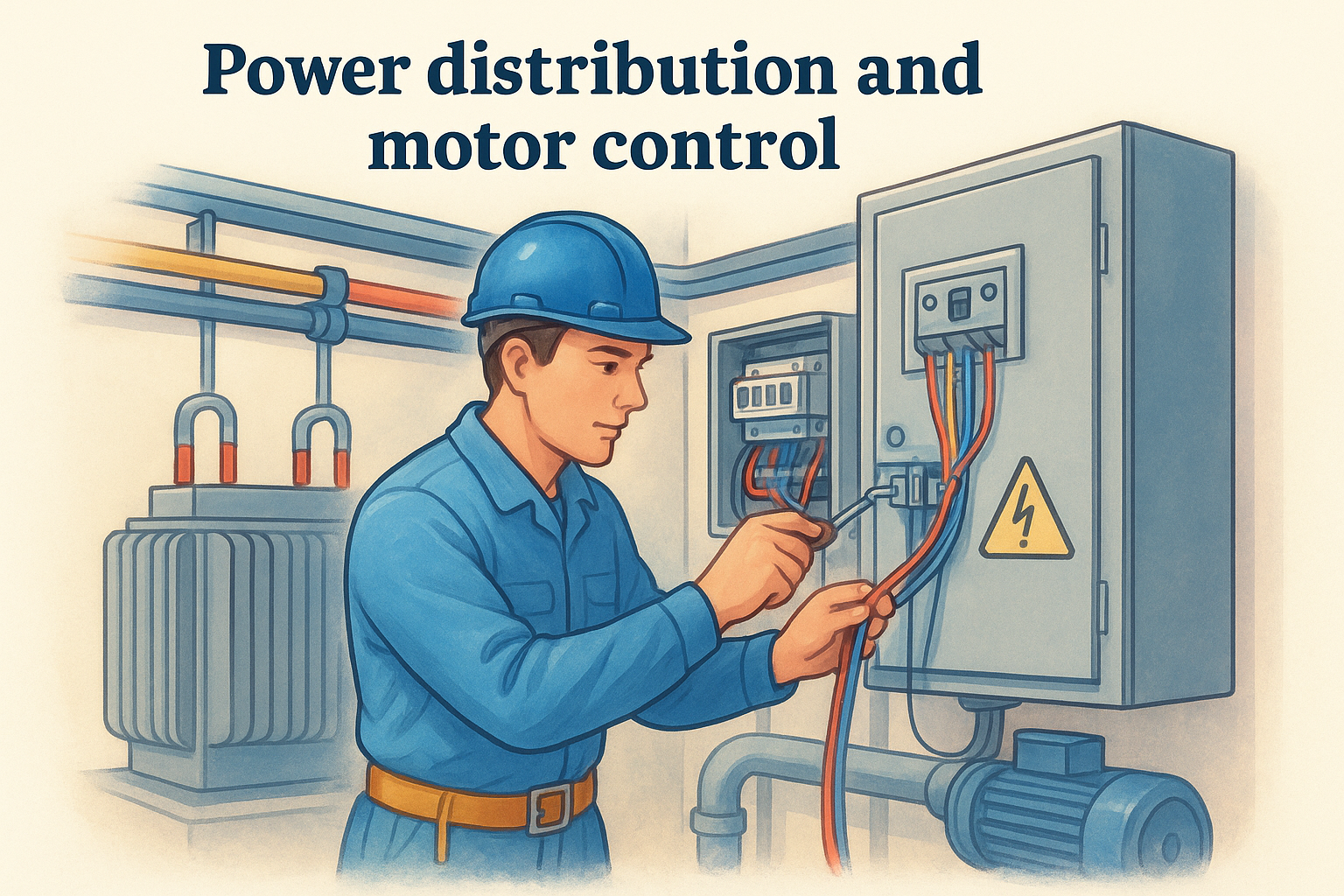
Power distribution is the backbone of any industrial facility. You’re responsible for maintaining and troubleshooting transformers, switchgear, panelboards, and bus ducts that feed power across the plant. Motor control work includes wiring and testing motor starters, contactors, and variable frequency drives that run conveyor systems, pumps, and HVAC equipment.

Power distribution and motor control

Faulty motor control circuits account for a large share of unplanned downtime in manufacturing facilities, so mastery here directly impacts production output.

You also verify correct phasing on three-phase systems and test overload protection devices to confirm motors won’t burn out under load.

Control circuits and instrumentation

Control circuits connect sensors, switches, and actuators to the equipment they manage. You read and modify ladder logic diagrams and wiring schematics to trace faults. Work in this area often involves PLCs, relay panels, and low-voltage control wiring that coordinates automated processes across production lines.

You’re expected to test instrumentation like pressure sensors and limit switches and confirm they communicate correctly with the control system before signing off on any repair.

Skills, tools, and technology you need

Industrial electrician job responsibilities demand a specific combination of technical knowledge and hands-on capability. You need to understand electrical theory at a level that lets you diagnose problems quickly, not just follow a checklist. Strong math skills and the ability to read schematics accurately are non-negotiable from day one.

Technical skills and knowledge

Your core technical foundation covers three-phase power systems, motor controls, and low-voltage control wiring. You should understand PLC basics well enough to navigate ladder logic and identify faults in automated systems. Employers increasingly expect familiarity with variable frequency drives and basic instrumentation, especially in manufacturing and processing facilities.

The more system types you can troubleshoot independently, the more value you bring to any industrial facility.

Tools and diagnostic equipment

You rely on a standard set of instruments to do the job accurately. A clamp meter and digital multimeter cover most electrical testing needs, while a megohmmeter helps you test insulation resistance on motors and cables. Thermal imaging cameras are becoming more common on industrial sites for spotting overloaded connections before they fail, so getting comfortable with that technology puts you ahead of candidates who only know the basics.

Safety, codes, and compliance expectations

Safety sits at the center of industrial electrician job responsibilities, not on the margins. Industrial facilities operate high-voltage systems where a single misstep can cause serious injury or a fatality. You’re expected to know the relevant codes, apply them on every task, and hold the workers around you to the same standard.

NFPA 70E and arc flash protocols

NFPA 70E defines electrical safety practices in the workplace, and industrial employers expect you to apply it from day one. You identify arc flash boundaries before starting any energized work, select the correct personal protective equipment (PPE) for each task category, and never skip authorization steps regardless of time pressure.

NFPA 70E and arc flash protocols

Skipping PPE requirements on energized work is one of the leading causes of electrical fatalities in industrial settings.

OSHA requirements and lockout/tagout

OSHA 29 CFR 1910.147 covers lockout/tagout procedures, and knowing it protects you and everyone working nearby. You apply energy isolation steps before any maintenance begins, verify that equipment is fully de-energized, and document each step clearly. Safety auditors and facility inspectors review those records regularly, so accuracy matters beyond the physical procedure itself.

Key lockout/tagout steps you document on every job:

  • Notify affected workers before isolation begins
  • Apply lockout devices to each energy source
  • Verify zero energy state before touching equipment

How to write a strong job description

A well-written job description saves you time and attracts the right candidates. Vague listings pull in applicants who don’t match, while specific, detailed postings filter for the people you actually need. When you list industrial electrician job responsibilities clearly, qualified candidates self-select and unqualified ones move on.

Be specific about systems and certifications

Generic descriptions like "electrical experience required" don’t tell candidates what you actually need. Name the specific systems your facility runs, such as three-phase motor controls, PLCs, or variable frequency drives. List any required certifications, like a Journeyman or Master license, directly in the posting so candidates know before applying.

Listings that specify system types and license requirements consistently attract more qualified applicants than those that rely on broad language.

Set clear expectations on experience level

Experience level and daily task breakdown are the two details candidates prioritize most when reading a job post. Describe what a typical shift looks like: percentage of time on reactive repairs versus scheduled maintenance, whether the role involves installation work, and who the position reports to. That level of detail builds candidate confidence and reduces screening time on your end.

industrial electrician job responsibilities infographic

Next steps

Industrial electrician job responsibilities span a wide range of systems, from high-voltage power distribution to PLC-based control circuits, and every employer expects candidates to bring both technical depth and safety discipline to the role. Whether you’re a tradesperson figuring out where your skills fit or an employer trying to attract the right applicants, clarity on the specific duties and requirements makes a real difference.

For job seekers, use this breakdown to sharpen your resume and target roles that match your current certifications and experience level. Highlighting specific systems you’ve worked on, like variable frequency drives or three-phase motor controls, tells employers more than a generic "electrical experience" line ever will.

For employers, a detailed, specific listing brings in candidates who actually meet your requirements. Save time on screening and reach qualified industrial electricians faster by posting your job on BlueCollarJobs where trade-focused candidates are actively looking.

HVAC Helper Job Description: Duties, Skills & Requirements

HVAC Helper Job Description: Duties, Skills & Requirements

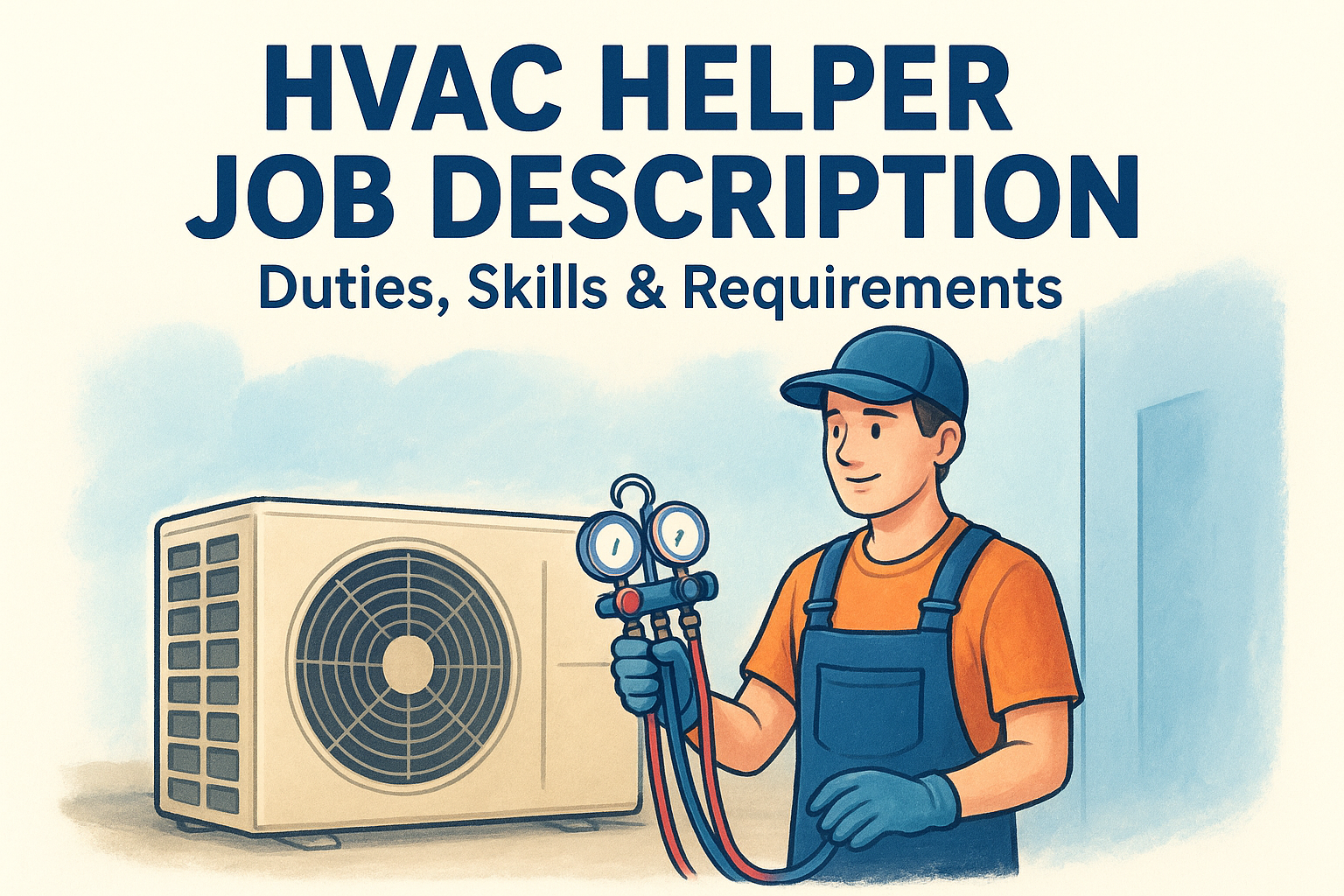
An hvac helper job description outlines the entry-level responsibilities, skills, and qualifications needed to support licensed HVAC technicians on the job. Whether you’re an employer drafting a posting or a job seeker figuring out what this role actually involves, getting the details right matters, it sets expectations for both sides of the hiring table.

HVAC helpers are the backbone of installation and service crews. They carry materials, prep work sites, hand off tools, and learn the trade hands-on under experienced technicians. It’s physically demanding work, but it’s also one of the most accessible entry points into a skilled trade that pays well and has strong long-term demand. For employers, a clear and accurate job description helps attract candidates who know what they’re signing up for, and reduces turnover before it starts.

At bluecollarjobs, we connect trade professionals with employers across the country, and HVAC helper roles are among the most frequently posted positions on our platform. Below, we break down everything that belongs in a solid HVAC helper job description, from daily duties and required skills to certifications, salary expectations, and how the role fits into a broader HVAC career path.

Why the HVAC helper role matters

The HVAC industry is large and growing steadily. The U.S. Bureau of Labor Statistics projects that employment for heating, air conditioning, and refrigeration mechanics and installers will grow faster than average over the next decade, driven by new construction, aging equipment, and tightening energy efficiency requirements across residential and commercial buildings. That growth creates real demand at every level of the trade, and the helper position is where most careers in HVAC begin. Without a steady pipeline of helpers moving into the field, service companies struggle to keep pace with the volume of work that licensed technicians carry.

Employers who invest in well-screened helpers today are building the workforce they’ll rely on for the next decade.

The workforce gap driving demand

The HVAC industry faces a well-documented skilled labor shortage, and the effects are most visible at the entry level. Many experienced technicians are approaching retirement age, and there aren’t enough trained workers moving through the pipeline behind them. When employers post an hvac helper job description, they’re not just filling a short-term opening; they’re investing in candidates who will become their next journeymen, lead technicians, and eventually foremen. Getting that job description right from the start helps attract people who are serious about the trade and have realistic expectations of what the first year of work actually looks like.

For job seekers, this labor gap works in your favor. Entry-level HVAC positions are more available and better compensated than they were ten years ago. Employers are actively willing to train motivated helpers because leaving a position unfilled costs far more in delayed jobs and overworked crews than onboarding someone who still needs to learn the technical side of the work. If you’re physically capable, reliable, and willing to learn, you’re already ahead of many applicants.

Where helpers fit within a crew

On any given job, an HVAC crew runs most efficiently when everyone works at their appropriate skill and license level. A licensed journeyman or master technician shouldn’t spend time hauling equipment from a truck, cutting and fitting ductwork sections, or preparing a work site when a helper can handle those tasks. Helpers free up high-skill workers to focus on diagnostics, refrigerant work, and electrical connections, which keeps jobs on schedule and keeps labor costs reasonable for the employer. That division of labor matters significantly on commercial projects where multiple trades are working simultaneously and time on site is tightly managed.

Where helpers fit within a crew

For you as a helper, this crew structure means you’re learning continuously while you work. Every job site puts you in direct contact with real systems, real problems, and real solutions being applied by people who have done this work for years. You see how technicians diagnose equipment faults, how they handle client communication on a service call, and how a full installation comes together from rough-in through startup and commissioning. Most helpers who stay committed to the trade and log their required field hours find that hands-on experience builds competency faster than classroom instruction alone ever could.

The role carries genuine responsibility from the first day on the job. You work near electrical panels, handle refrigerant lines, and operate in confined mechanical spaces or on rooftops in variable weather conditions. Physical stamina and consistent safety discipline are not optional; they are baseline expectations that employers watch for during every shift. If you’re evaluating whether this career path fits you, weigh those physical and safety demands just as seriously as you would any technical or certification requirement.

HVAC helper duties and day-to-day tasks

Every hvac helper job description should list the actual tasks you’ll perform day to day, not vague summaries. Helpers do real, essential work from the moment they arrive on a job site, and knowing the full scope of the role helps both employers write honest postings and candidates prepare for what they’re walking into.

Physical and site preparation tasks

Before any installation or service work begins, you set up the environment that makes everything else possible. You unload and transport equipment from the vehicle to the work area, which often means moving heavy air handlers, coil units, or sections of ductwork through tight residential hallways or up commercial stairwells. You also clear debris from work areas, lay down protective coverings on floors and surfaces, and make sure tools and materials are staged and ready before the lead technician starts technical work. That prep work directly affects how efficiently the crew moves through the job.

A helper who shows up prepared and keeps the site organized lets technicians focus entirely on skilled work, which keeps the job on schedule.

Supporting technicians during installation and service

Once work is underway, your job shifts to active assistance. You hand off tools and materials on demand, hold components in position while technicians fasten or connect them, and assist with cutting, measuring, and fitting ductwork sections according to the specs the technician is working from. On service calls, you help pull access panels, retrieve replacement parts from the truck, and assist with the physical aspects of equipment removal and reinstallation.

Supporting technicians during installation and service

Cleanup and closeout tasks also fall to you at the end of each job. You remove protective coverings, collect and return tools, dispose of packaging and old equipment properly, and help load everything back onto the vehicle. Residential customers notice the condition of their home after a crew leaves, and commercial clients track how well contractors maintain their facilities. Leaving a clean site reflects on the whole crew and directly impacts whether an employer wins repeat business from that customer.

HVAC helper skills and qualifications

Every hvac helper job description should clearly separate the skills you need on day one from the certifications and qualifications that either come with the job or must be in place before you start. Employers use this section of a job posting to filter applicants, and job seekers use it to gauge where they currently stand and what gaps they need to close before applying.

Physical and foundational requirements

The work is hands-on and physically demanding from the start. You need reliable physical stamina to lift and carry heavy equipment, work on your feet for full shifts, and operate in confined spaces or awkward positions throughout the day. Beyond raw physical capability, you also need a strong attention to detail when following instructions from a lead technician, because mistakes on a mechanical system can create safety hazards or expensive rework. Communication matters too; you’re part of a crew, and being able to ask clear questions and follow verbal directions quickly keeps jobs running on schedule.
Employers consistently rank reliability and the ability to follow instructions above prior technical knowledge for entry-level helper candidates.

The following are baseline qualifications most employers list as requirements:

  • Valid driver’s license and ability to operate a company vehicle
  • Ability to lift 50 or more pounds repeatedly throughout a shift
  • Comfort working at heights, in attics, and in crawl spaces
  • Basic math skills for measuring and reading job specs
  • High school diploma or equivalent (preferred by most employers)

Certifications and licenses

You do not need a journeyman or master license to work as a helper, but some certifications improve your hiring prospects significantly. An EPA Section 608 certification allows you to handle refrigerants legally, which removes a legal restriction from your role and makes you more immediately useful on service calls. Many employers either require or strongly prefer Section 608 certification at hire, particularly for commercial work where refrigerant handling comes up regularly.

OSHA 10-hour construction training is another credential worth completing before you apply. It signals to employers that you take on-site safety standards seriously and understand basic hazard recognition, which matters when you’re working near electrical systems and pressurized lines. Some employers cover the cost of these certifications once you’re hired, but arriving with them already in hand puts you ahead of other applicants.

How to write an HVAC helper job description

A well-written hvac helper job description does two things at once: it filters out applicants who aren’t a good fit and gives serious candidates a clear reason to apply. Most poorly performing job postings fail because they’re either too vague to set expectations or so loaded with generic language that the actual requirements get buried. Keep your posting direct, specific, and honest about what the work physically involves day to day.

Start with a clear job overview

Your opening paragraph should tell candidates exactly who you are as an employer, what type of work your company handles (residential, commercial, or both), and where the helper will be working. Mention the crew structure upfront. Candidates want to know whether they’ll be working alongside one lead technician on service calls or rotating across a larger crew on installation projects. That context shapes how candidates evaluate the role and whether it fits their current experience level and career goals. A posting that opens with that kind of specificity immediately signals that you’re an employer who has thought through what the position actually requires.

One or two sentences describing your company’s work volume and service area will attract more qualified applicants than a generic company description ever will.

Write requirements in plain, specific terms

Avoid listing every possible soft skill and instead focus on what the job actually demands on a daily basis. If the role requires lifting over 50 pounds repeatedly throughout a shift, state that directly. If you require EPA Section 608 certification before the start date, make that a hard requirement rather than burying it under "preferred qualifications." Clarity here saves you time screening unqualified candidates and saves applicants from wasting an application on a role they’re not eligible for.

Use a short bulleted list for physical requirements, certifications, and licensing details so candidates can quickly scan for hard requirements. Put your non-negotiables in the bullets and keep anything flexible in the body copy. A job posting that honestly reflects the physical demands and daily schedule attracts candidates who stay past the first month, which is where most turnover in entry-level trade positions actually happens.

HVAC helper pay, hours, and work conditions

Understanding the compensation and working conditions that come with an hvac helper job description helps both employers set competitive pay and job seekers evaluate whether the role fits their financial needs. Pay, scheduling, and physical environment all vary depending on your employer type, geographic region, and the season, so knowing the typical ranges before you apply or post a position saves everyone time.

Pay and compensation

The U.S. Bureau of Labor Statistics reports median hourly wages for heating and cooling equipment mechanics and installers, and helpers typically earn in the lower range of that spectrum since the role sits at the entry level. Most HVAC helpers in the United States earn between $16 and $22 per hour, depending on the state, the type of work (residential versus commercial), and whether the employer provides benefits. Employers in states with high costs of living, such as California, New York, and Washington, tend to pay more. Some employers also offer overtime pay, tool allowances, and performance bonuses that can push total annual compensation significantly above the base hourly rate.

Adding EPA Section 608 certification before you apply often results in a higher starting wage because it removes a legal restriction from your role on the job.

Hours and scheduling

HVAC helpers typically work full-time schedules of 40 hours per week, though hours vary heavily with the season. Summer and winter peak seasons drive high demand for service calls and installations, which means overtime is common during those months and can add meaningful income for helpers willing to work extended hours. Some employers run on-call or weekend rotations, particularly companies that offer emergency service. If you’re evaluating a position, ask directly about overtime expectations and weekend availability requirements before accepting an offer.

Physical work conditions

The work environment is physically demanding and changes from job to job. On any given week, you might work in a cramped attic crawling around ductwork, on a commercial rooftop in direct sun, or in a basement mechanical room running new refrigerant lines. Weather exposure is real, and heat-related fatigue during summer peak season is a genuine occupational hazard that experienced crews manage through hydration protocols and scheduled breaks. Employers should address these conditions honestly in any job posting, and job seekers should factor them into their decision.

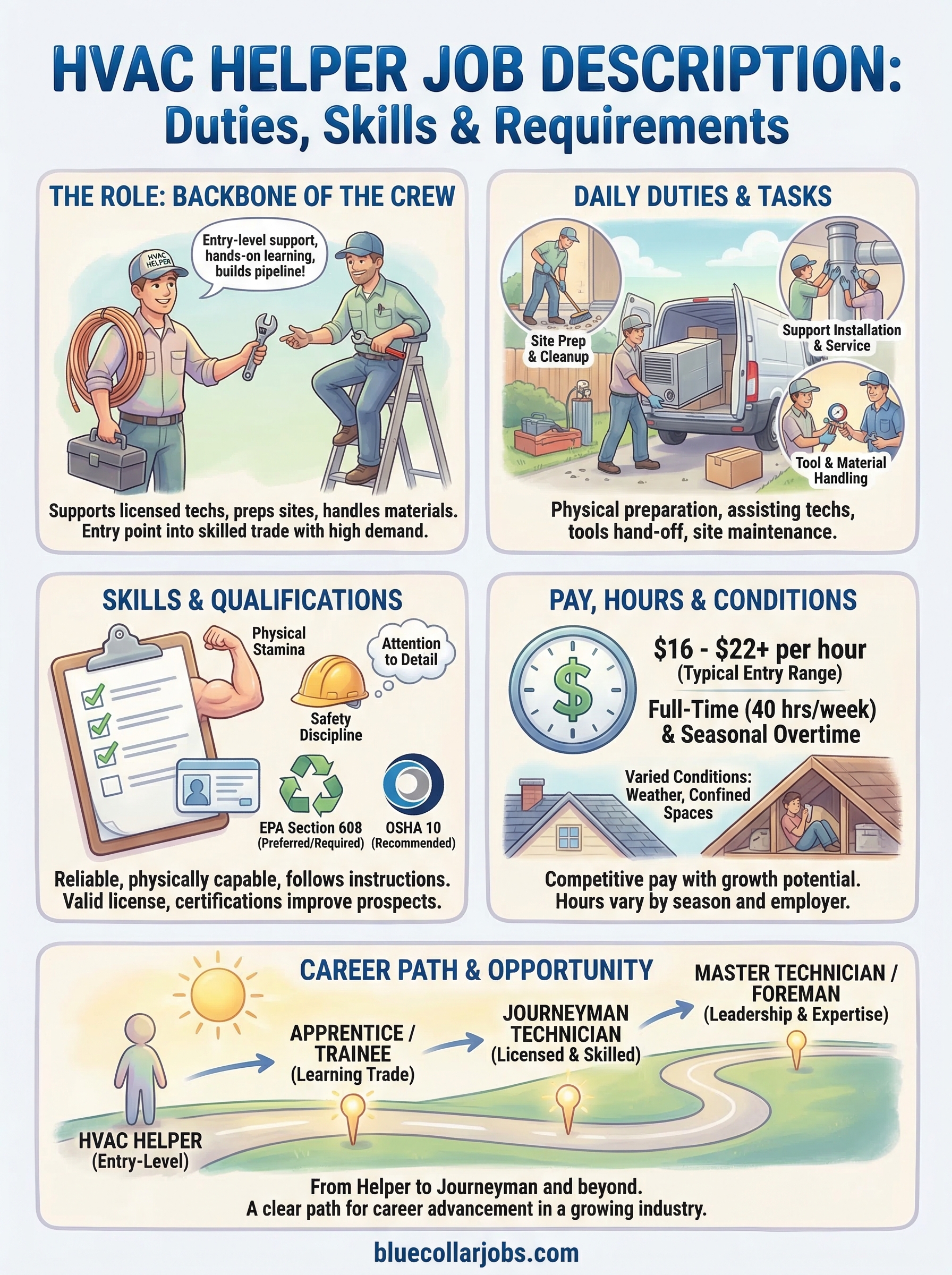
hvac helper job description infographic

Next steps

A complete hvac helper job description gives everyone clarity from the start. Employers who write honest, specific postings attract candidates who show up ready to work and stay through their first year. Job seekers who understand the daily demands, pay range, and certification requirements can walk into an interview confident and prepared to make a real case for themselves.

Whether you’re hiring your next helper or looking for your first trade position, the right platform makes a significant difference in how quickly you connect with the right match. BlueCollarJobs specializes exclusively in skilled trade roles, which means your posting reaches candidates who are actively looking for HVAC work, not sifting through thousands of unrelated listings. You won’t find your next apprentice buried under white-collar job postings here.

Take the next step and post your HVAC helper job today to reach qualified candidates faster.

What Is An Apprenticeship Program? Pay, Length, Requirements

What Is An Apprenticeship Program? Pay, Length, Requirements

If you’re asking what is an apprenticeship program, here’s the short answer: it’s a structured training arrangement where you earn a paycheck while learning a skilled trade under experienced professionals. Apprenticeships combine hands-on work with classroom instruction, and they’re one of the most direct paths into careers like plumbing, HVAC, electrical work, and mechanical trades, no four-year degree required.

For many blue-collar workers, an apprenticeship is where everything starts. It’s how you go from zero experience to holding a journeyman license, and eventually, to earning a competitive salary in a trade that’s in high demand. For employers, apprenticeship programs are how you build a pipeline of skilled, loyal workers trained to your standards. Either way, understanding how these programs actually work matters before you commit time or money.

This guide breaks down the full picture, what apprenticeships involve, how long they take, what they pay, and what’s required to get into one. At bluecollarjobs, we connect tradespeople with employers across the country, and apprenticeship-level positions are some of the most posted roles on our platform. Whether you’re exploring your first trade career or you’re an employer thinking about starting a program, this article covers what you need to know.

Why apprenticeship programs matter for trade careers

The trades industry is facing a significant labor shortage, and apprenticeship programs are one of the primary mechanisms the industry uses to close that gap. The U.S. Bureau of Labor Statistics projects strong employment growth across plumbing, electrical, and HVAC fields through the early 2030s, with hundreds of thousands of positions expected to open as experienced workers retire. If you’re entering the workforce now, that demand works directly in your favor. Apprenticeships give you a structured, paid path to step into roles that genuinely need to be filled.

The skilled trades workforce gap

Across the United States, trade employers struggle to find qualified workers more than almost any other sector. The average age of a skilled tradesperson is rising, and retirement rates are outpacing the number of new workers coming into the field. That’s not a minor imbalance. In plumbing, HVAC, and electrical work, a single unfilled position can delay construction projects, leave a facility without critical maintenance, or cost a small contractor real revenue each week. Apprenticeship programs are the industry’s primary answer to this problem because they create workers with verified, documented skills and logged hands-on hours that employers can actually evaluate.

When demand for skilled tradespeople exceeds supply, apprenticeship-trained workers carry a measurable hiring advantage over self-taught candidates with no formal record of their hours.

What you gain beyond classroom training alone

Understanding what is an apprenticeship program starts with recognizing what separates it from other training paths. A traditional trade school or community college program gives you foundational knowledge in a classroom setting, but it does not give you the hours on a real job site, the guidance of a licensed journeyman, or the wage progression that comes with a registered apprenticeship. You graduate with theory. Apprenticeships graduate you with documented, verifiable experience that employers can trust and licensing boards can count.

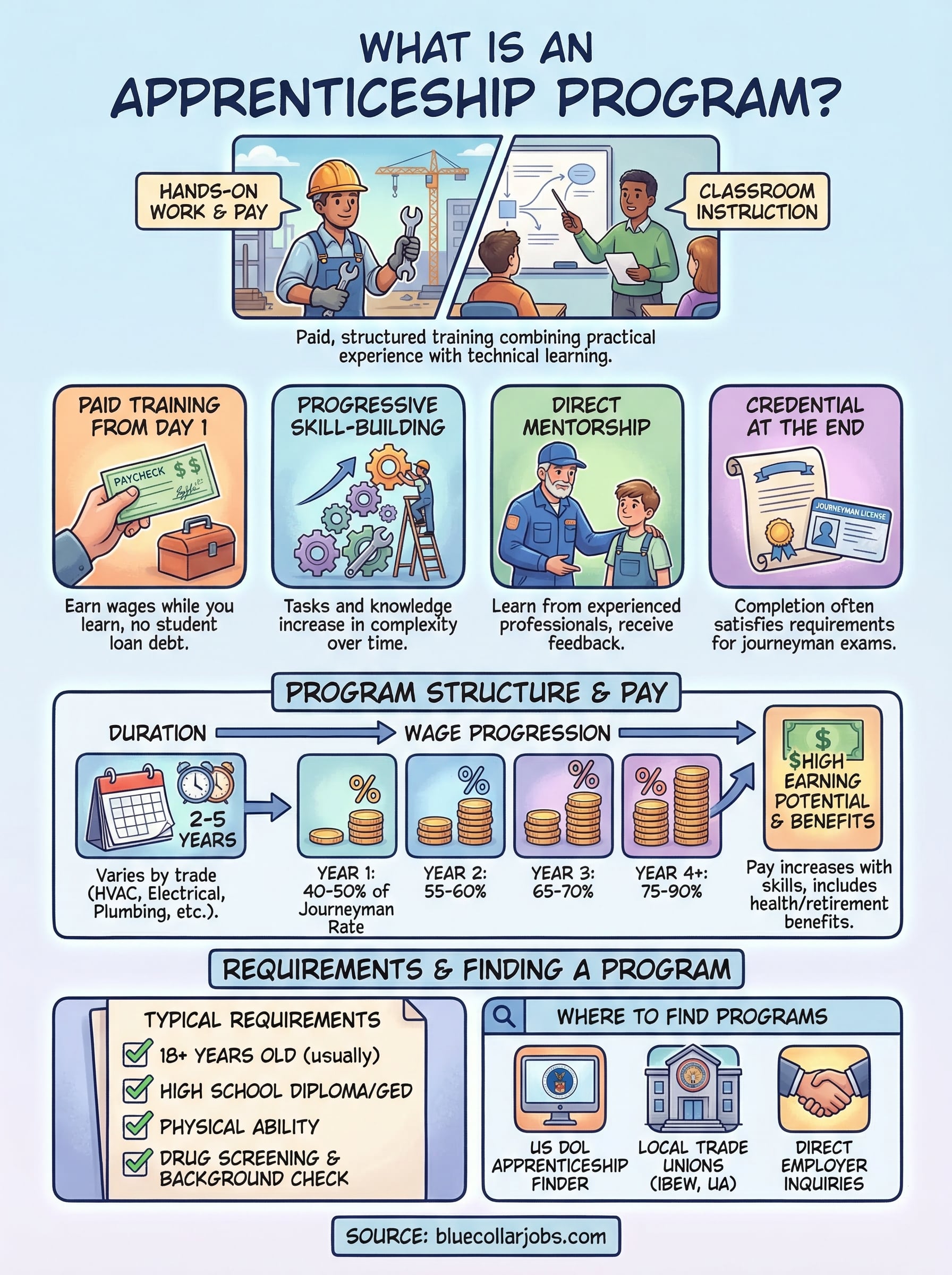
The practical benefits are concrete:

  • Paid training: You earn a wage from day one, so you’re not taking on debt to learn.
  • Progressive skill-building: Tasks increase in complexity as your competency grows, so your knowledge compounds over time.
  • Direct mentorship: You work alongside licensed professionals who catch and correct mistakes in real time.
  • Credential at the end: Completing a registered program often satisfies the hour requirements needed to sit for a journeyman license exam in your state.

Why employers build apprenticeship programs

For employers, running an apprenticeship program is a long-term staffing strategy, not just a short-term fix. When you train someone from the ground up, you shape their habits, their approach to safety, and their understanding of your specific work standards. That matters in trades where inconsistent technique can cause safety hazards or expensive callbacks that damage your reputation with clients. Companies that operate apprenticeship programs also tend to see stronger employee retention. Workers who came up through a company’s own program stay longer because they feel a real connection to the organization that trained them.

Employers who register their programs through the U.S. Department of Labor’s Office of Apprenticeship gain access to federal resources, potential state-level tax incentives, and national recognition that strengthens recruiting. A registered program signals to job seekers that the training is structured, legitimate, and recognized across the wider industry, which makes it easier to attract motivated candidates who are serious about building a long-term trade career.

How an apprenticeship program works day to day

Most people picture apprenticeships as purely hands-on work, but the day-to-day structure is actually split between two environments: the job site and the classroom. Understanding what is an apprenticeship program in practice means understanding that both sides carry equal weight. You spend the majority of your time working alongside a journeyman or master tradesperson, completing real tasks on real projects. You also spend a set number of hours per year in related technical instruction, which covers theory, code requirements, safety standards, and the math behind the work you’re doing in the field.

The split between job site and classroom

On the job site, your responsibilities increase incrementally as your skill level grows. Early on, you handle foundational tasks such as material prep, basic installations, and equipment handling under close supervision. As you log more hours and demonstrate competency, your supervisor assigns you more complex work. That progression is deliberate. Registered apprenticeship programs require a structured set of competencies to be documented and signed off by your supervisor, which means your advancement is tied to verified performance, not just time served.

The split between job site and classroom

The classroom component typically runs a few hours per week or in concentrated blocks throughout the year, depending on your program’s structure. This instruction usually happens through a trade union training center, community college, or a program sponsor’s dedicated facility. The coursework reinforces what you’re doing on the job, so if you’re running conduit in the field that week, your class might cover electrical load calculations that week too. That alignment between field work and classroom content is one of the features that makes apprenticeships more effective than studying trade theory in isolation.

The combination of paid field hours and structured classroom instruction is what gives apprenticeship graduates a credential that both licensing boards and employers recognize as legitimate.

How your schedule and tasks progress

Your weekly schedule during an apprenticeship looks similar to a standard full-time job. Most apprentices work 40 hours per week at their primary employer, with classroom hours added on top or built into the schedule depending on the program. At the end of each year, your wage rate steps up according to a predetermined scale, and the tasks you’re trusted to handle independently increase in scope. By the final year, most apprentices are operating with near-journeyman independence, supervised but not micromanaged.

Pay and benefits in apprenticeship programs

One of the first questions people ask when exploring what is an apprenticeship program is simple: how much will you actually earn? The answer depends on your trade, your location, and the program you join, but apprenticeship wages are real wages, not stipends or token amounts. You start at a percentage of the journeyman rate in your trade and step up each year as you complete more hours. That structure means your income grows predictably while your skills do the same.

How apprenticeship wages are structured

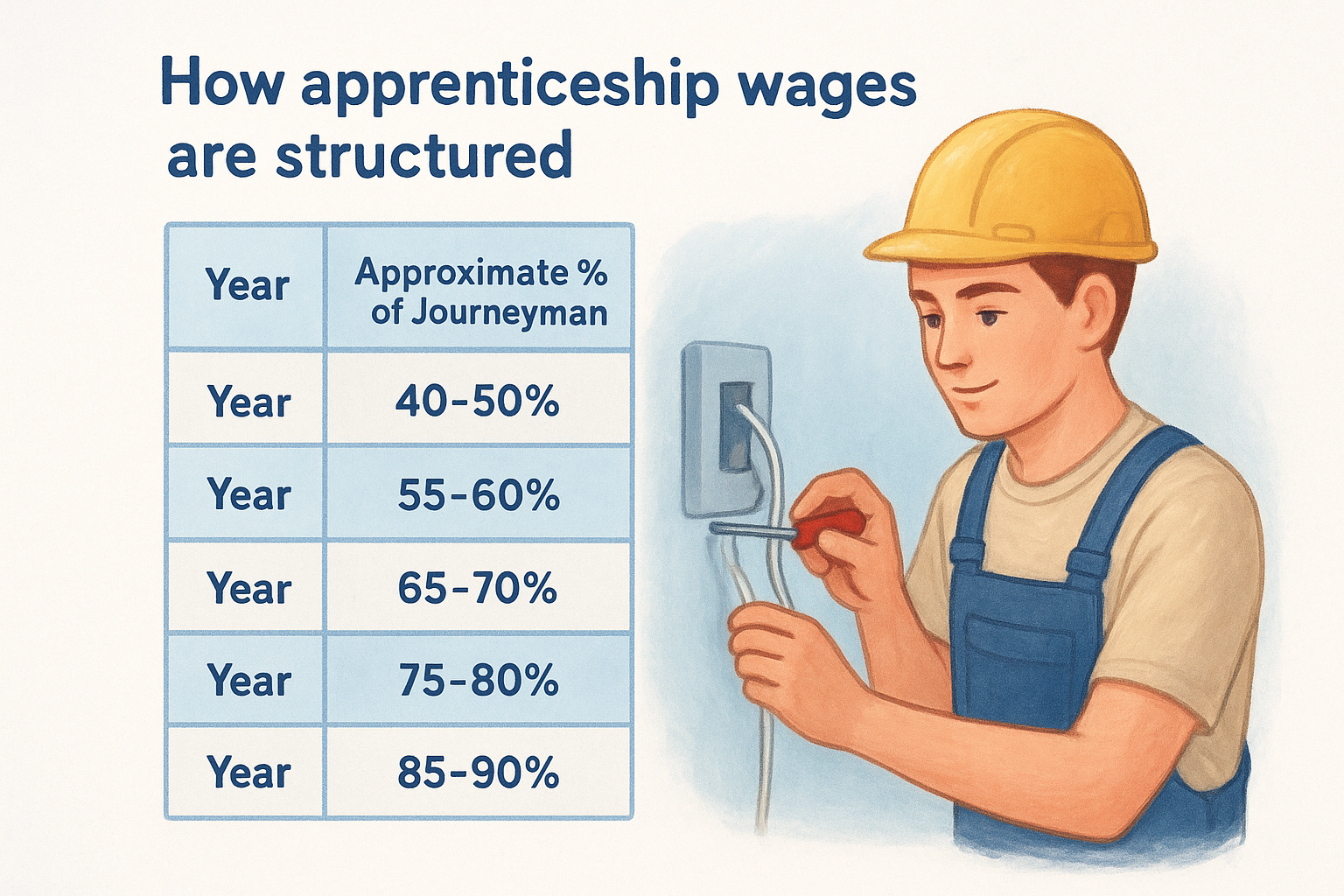
Apprenticeship pay follows a tiered wage scale tied directly to your progress through the program. Most registered programs start apprentices at 40 to 50 percent of the journeyman wage in their specific trade, then increase that percentage at set intervals, usually every 6 to 12 months. By your final year, you’re typically earning 80 to 90 percent of the journeyman rate. That final-year wage can reach $25 to $35 per hour in trades like electrical and plumbing, depending on your region and whether your program is union-affiliated.

How apprenticeship wages are structured

A wage progression that starts at roughly half the journeyman rate and climbs steadily each year means your paycheck reflects your growing skill level in a direct, measurable way.

Here’s a simplified example of how the scale typically works across a five-year electrical apprenticeship:

Year Approximate % of Journeyman Rate
1 40-50%
2 55-60%
3 65-70%
4 75-80%
5 85-90%

Benefits beyond the base wage

Wages are only part of the picture. Many registered apprenticeship programs, especially union-sponsored ones, include a full benefits package that covers health insurance, paid time off, and retirement contributions. Those benefits kick in from the start of your employment, not after a probationary period that stretches on indefinitely. For a worker entering the trades without a college degree, access to employer-sponsored health coverage and a pension from your first year of work represents real financial value that a base wage number alone doesn’t capture.

Beyond formal benefits, you avoid student loan debt entirely since your employer covers the cost of your on-the-job training and the program sponsor typically funds the classroom instruction. That distinction matters when you compare an apprenticeship path to a four-year degree with tens of thousands of dollars in loans attached to it.

How long apprenticeship programs last and what you earn

When you’re trying to understand what is an apprenticeship program in practical terms, program length is one of the most important variables to know upfront. Apprenticeships are not short courses. They run for multiple years by design, because building genuine trade competency takes logged hours, not weeks of instruction. The specific length depends on your trade and the program sponsor, but most registered programs fall between two and five years.

Program length by trade

Different trades set different minimum hour requirements, and those requirements drive the total program length. A two-year program in a general maintenance trade might require 2,000 to 4,000 on-the-job hours, while a more technical trade like electrical or plumbing typically requires 8,000 or more. That difference reflects the complexity of the work and the licensing requirements in each field. Before you commit to a program, check the hour requirements directly with your state’s licensing board so you know exactly what you’re signing up for.

Here’s a general overview of typical apprenticeship lengths by trade:

Trade Typical Program Length
HVAC 3-5 years
Electrical 4-5 years
Plumbing 4-5 years
Pipefitting 5 years
General Maintenance 2-3 years

Completing a registered apprenticeship with the required documented hours puts you in a direct position to sit for your journeyman license exam, which is the credential that unlocks the highest-paying roles in your trade.

What completion means for your earning potential

Finishing your apprenticeship is not just a milestone on paper. It’s the point where your earning potential shifts significantly upward. Once you hold a journeyman license, you move off the apprentice wage scale entirely and negotiate your rate as a fully credentialed tradesperson. In electrical and plumbing work, journeyman wages in high-demand states like California, Texas, and Florida regularly range from $35 to $55 per hour, with overtime opportunities that push annual income well above six figures for experienced workers.

Your total earnings over the apprenticeship period also add up to more than most people expect. If you earn an average of $22 per hour across a four-year electrical apprenticeship, you exit the program with roughly $180,000 in gross wages earned while training, and you carry zero student loan debt into your career. That math alone makes the time commitment worth calculating before you dismiss a multi-year program as too long.

Requirements and how to find the right program

Before you commit to a program, you need to know what qualifications most sponsors expect and where to actually locate legitimate opportunities. Understanding what is an apprenticeship program also means understanding the entry requirements, because meeting them upfront saves you time and prevents wasted applications to programs you’re not yet eligible for.

What most programs require from applicants

Most registered apprenticeship programs share a common baseline of requirements, though the specifics vary by trade and sponsor. The minimum age is almost always 18, and some programs set it at 17 with parental consent for certain non-hazardous trades. Beyond age, a high school diploma or GED is the standard educational requirement across the board. If you’re entering an electrical or plumbing apprenticeship, many programs also require proof of completed algebra coursework, since the math involved in load calculations and pipe sizing is applied regularly on the job.

Physical requirements are also standard. You’ll typically need to pass a physical exam that confirms you can handle the demands of the trade, which may include lifting, working in confined spaces, or extended time on your feet. Drug screening is routine before program entry, and some programs run a background check depending on the nature of the work sites you’ll access.

Gathering your documentation before you apply, including your diploma, transcripts, and any prior trade certifications, speeds up the application process and signals to sponsors that you’re serious.

Where to search for registered apprenticeship programs

The most reliable place to start your search is the U.S. Department of Labor’s Apprenticeship Finder, which lists federally registered programs by trade and location. You can filter by state, occupation, and program type, which makes it straightforward to identify what’s available in your area. Union halls are another strong source, particularly for electrical, plumbing, and pipefitting apprenticeships, since many of the largest registered programs in those trades are union-sponsored through organizations like IBEW or UA.

Directly contacting local trade contractors and employers is also worth doing. Smaller, employer-run programs often don’t advertise widely online, so a direct conversation with a plumbing company or HVAC contractor about their apprenticeship structure can open doors that a job board search wouldn’t reveal. Combine both approaches and you significantly increase your chances of finding a program that fits your trade, location, and schedule.

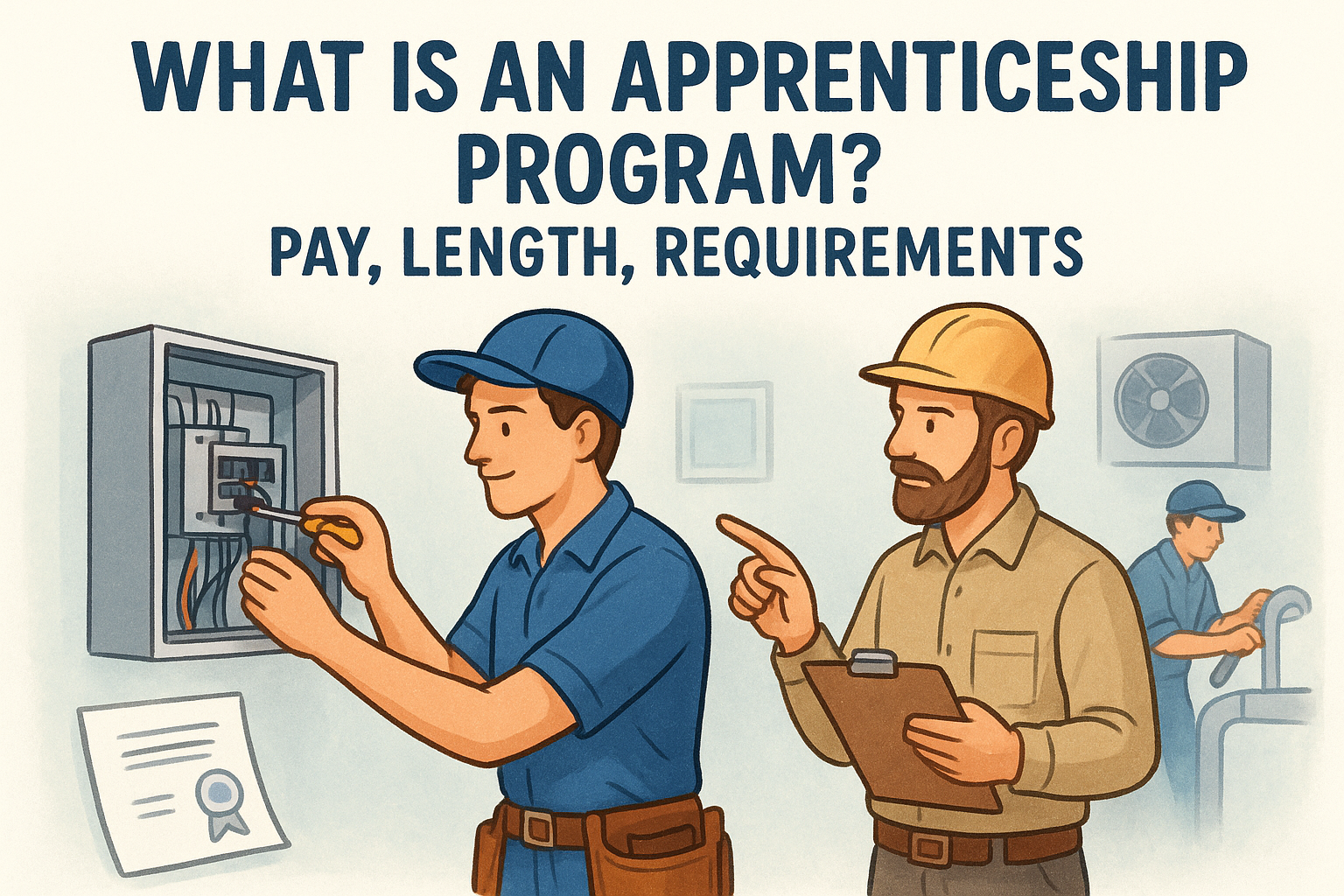
what is an apprenticeship program infographic

Key takeaways and finding your next role

Now you have a complete picture of what is an apprenticeship program: a paid, structured training path that builds real skills, pays a progressive wage, and ends with a credential that opens higher-paying roles. The commitment runs two to five years depending on your trade, but you earn money throughout the entire period and exit with zero debt and a journeyman license within reach. That combination of earned income and zero tuition is what separates apprenticeships from nearly every other training path available today.

Whether you’re a job seeker looking to break into plumbing, HVAC, or electrical work, or an employer building a long-term workforce pipeline, the fundamentals stay the same. Apprenticeships work because they connect learning directly to doing. Start by identifying registered programs in your trade and region, then apply early since most programs fill quickly. Ready to find apprentice-level openings near you? Browse current blue collar trade jobs and connect with employers hiring right now.

Master Electrician Jobs Near Me: 5 Places Hiring This Week

Master Electrician Jobs Near Me: 5 Places Hiring This Week

If you’re searching for master electrician jobs near me, you already know your license puts you in a strong position. Demand for master electricians across the U.S. remains high, and employers are actively competing for candidates who hold that credential, often with salaries north of $80K and solid benefits packages to match.

The challenge isn’t whether jobs exist. It’s cutting through the clutter on general job boards that bury trade roles under thousands of irrelevant listings. That’s exactly why we built bluecollarjobs, to give skilled tradespeople a direct line to employers who need them, filtered by trade, experience level, and location.

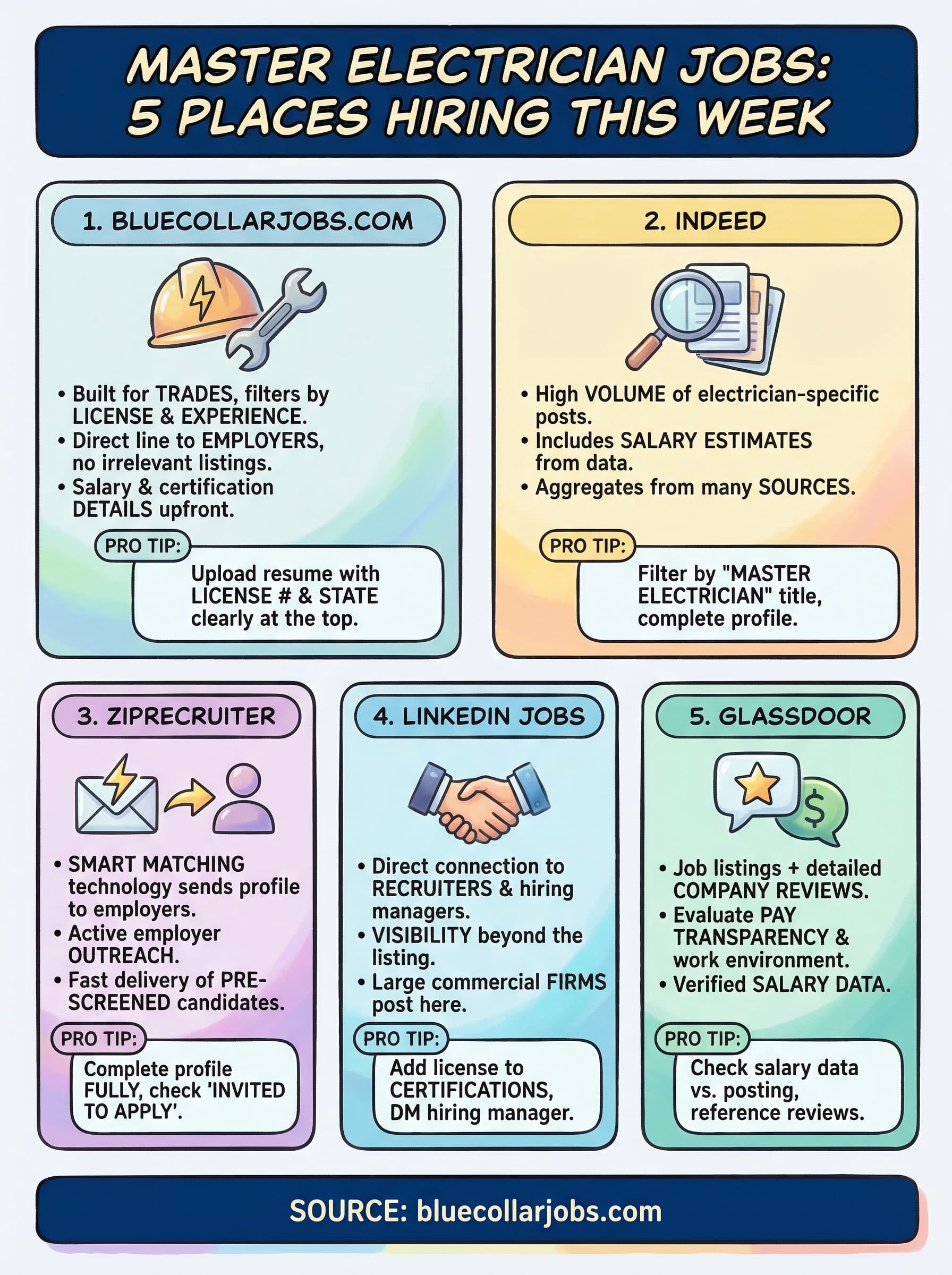
This week, we pulled together five places actively hiring master electricians right now. Each listing includes pay details, location, and what you’d need to apply, so you can spend less time searching and more time picking the right fit.

1. Bluecollarjobs.com

Bluecollarjobs.com is built specifically for skilled tradespeople, which means every listing on the platform is relevant to someone with your license and experience. You won’t scroll past office jobs or retail positions to find what you actually need.

1. Bluecollarjobs.com

Why this site works for master electricians

Unlike general job boards, Bluecollarjobs.com filters listings by trade, experience level, and state, so searches for master electrician jobs near me actually return results you can act on. Salary ranges and certification requirements appear directly in the search results, so you’re not clicking into listings blind.

If a job requires a Master Electrician license, that detail appears upfront, saving you from wasting time on roles that don’t match your credentials.

How to find master electrician jobs near you fast

Start by selecting Electrical from the trade filter, then narrow results down by your state. Set the experience level to Master to remove apprentice and journeyman listings from your results. The whole process takes under a minute and returns only the positions that fit your profile.

What details to check before you apply

Before applying, confirm the posted salary range aligns with your expectations and check whether the role specifies a state-issued license. Many listings also note employment type, such as full-time, contract, or shift-based work, which directly affects your scheduling and tax situation.

Application tips that help you stand out

Upload a resume that lists your Master Electrician license number and issuing state clearly at the top. Employers on this platform actively search for certified candidates, so placing your credentials front and center makes it easy for hiring managers to qualify you quickly.

2. Indeed

Indeed is one of the largest job boards in the country, and it pulls listings from company career pages, recruiter posts, and direct employer submissions. That volume works in your favor when you’re tracking down master electrician jobs near me across multiple states or cities.

Why this site works for master electricians

Indeed aggregates a high volume of electrician-specific postings daily, including roles from both small contractors and large commercial employers. Many listings include salary estimates pulled from employer data, giving you a realistic benchmark before you apply.

Filtering by "Master Electrician" as a job title, rather than just "electrician," cuts the noise significantly and surfaces more relevant results.

How to find master electrician jobs near you fast

Type "master electrician" in the job title field and enter your zip code or city. Set the distance radius to 25 or 50 miles depending on how far you’re willing to travel, then sort by "Date Posted" to see the freshest listings first.

What details to check before you apply

Confirm the listing specifies license requirements and not just general electrical experience. Check the employer’s review rating on Indeed to get a quick read on work culture and management.

Application tips that help you stand out

Upload your resume with your license number and issuing state listed near the top. Keep your Indeed profile complete and current so employers can find you through their candidate search tools as well.

3. ZipRecruiter

ZipRecruiter uses a matching algorithm that actively sends your profile to employers, rather than waiting for you to find and apply to every listing manually. That makes it a strong option when you’re searching for master electrician jobs near me and want employers reaching out to you at the same time.

Why this site works for master electricians

The platform’s smart matching technology flags your profile to employers actively looking for licensed electricians in your area. Many trade employers post exclusively on ZipRecruiter because the platform delivers pre-screened candidates faster than larger general boards.

Once you upload your license credentials, ZipRecruiter can surface your profile to employers before they even post a public listing.

How to find master electrician jobs near you fast

Search for "master electrician" in the job title field and enter your city or zip code. Apply the "Invited to Apply" filter to see roles where employers have already flagged your profile as a match, which cuts search time significantly.

What details to check before you apply

Review the required certifications listed in each posting and confirm the employer recognizes your state’s licensing authority. Check whether the role lists overtime expectations, since many commercial electrical positions include mandatory hours beyond a standard schedule.

Application tips that help you stand out

Complete your ZipRecruiter profile fully, including your license type, issuing state, and years of experience. A complete profile receives significantly more employer invitations, which shortens your overall job search timeline considerably.

4. LinkedIn Jobs

LinkedIn Jobs connects you directly with hiring managers and recruiters, which sets it apart from traditional job boards. Many commercial contractors and large electrical firms post roles here first, especially for licensed professionals at the master level.

4. LinkedIn Jobs

Why this site works for master electricians

LinkedIn gives you visibility beyond the job listing itself. Recruiters actively search the platform for candidates with specific credentials, so having your master license on your profile means employers can find you for master electrician jobs near me before a role even goes public.

A complete LinkedIn profile with trade certifications listed can lead to inbound recruiter outreach, removing the need to apply cold.

How to find master electrician jobs near you fast

Search "master electrician" in the jobs tab and filter by your city or zip code. Set the "Date Posted" filter to the past week to avoid chasing listings that are already filled.

What details to check before you apply

Review the company size and industry on the employer’s LinkedIn page before applying. Larger firms typically list structured pay bands and benefits packages, while smaller contractors may offer more flexible scheduling.

Application tips that help you stand out

Add your license number and issuing state to the certifications section of your profile. After applying, send the hiring manager a short direct message confirming your interest and pointing to your credentials.

5. Glassdoor

Glassdoor combines job listings with detailed company reviews written by current and former employees. That combination makes it a strong resource when you’re searching for master electrician jobs near me and want more than just a job title and pay range before you commit.

Why this site works for master electricians

Glassdoor lets you evaluate an employer’s pay transparency and work environment before you even click apply. Many electrical contractors and commercial firms post listings here alongside verified salary data submitted anonymously by workers in similar roles, giving you real leverage in any salary negotiation.

Checking the employer’s overall rating and reading recent reviews takes five minutes and can save you from accepting a role with known management or scheduling problems.

How to find master electrician jobs near you fast

Search "master electrician" in the jobs field and enter your city or zip code. Sort results by "Most Recent" to avoid spending time on listings that closed weeks ago.

What details to check before you apply

Review the posted salary range against the anonymous pay data on the same company page to spot any gaps. Also confirm whether the listing specifies state licensure requirements upfront.

Application tips that help you stand out

Keep your license type and issuing state at the top of your resume. Reference specific details from the company’s Glassdoor profile in your cover letter to show you’ve done your homework.

master electrician jobs near me infographic

Next Steps

You now have five solid platforms to start your search for master electrician jobs near me, each with a different advantage depending on what matters most to you. Bluecollarjobs.com gives you the fastest route to trade-specific listings filtered by state and experience level, while the other four platforms add volume, employer insight, and direct recruiter access.

Pick one or two platforms from this list and set up job alerts using your exact title and zip code so new listings hit your inbox the moment they go live. Waiting to check manually means missing postings within the first 24 hours, which is often when employers move fastest on strong candidates.

Your Master Electrician license is a competitive credential, and the right employer is looking for exactly what you bring. Start by checking the current openings on Blue Collar Jobs and filter by your state to see who is hiring this week.

Plumbing Jobs Near Me: How To Find Local Openings Fast

Plumbing Jobs Near Me: How To Find Local Openings Fast

Searching for plumbing jobs near me sounds simple enough, until you’re scrolling through generic job boards packed with unrelated listings. The demand for plumbers across the United States keeps growing, and employers are actively competing for skilled tradespeople at every experience level, from apprentices to master plumbers. The openings are out there. Finding them shouldn’t feel like a second job.

This guide breaks down exactly how to find local plumbing positions quickly, what to expect in terms of pay and requirements, and which strategies actually work for landing interviews. Whether you’re just starting out or you’re a licensed journeyman ready for a change, you’ll walk away with a clear plan to move forward.

At bluecollarjobs, we built our platform specifically for skilled trades hiring, no white-collar noise, no irrelevant results. Just trade-specific listings organized by location, experience level, and certification. Below, we’ll show you how to use tools like ours (and others) to lock down the right plumbing job in your area.

What you need before you start searching

Before you open a single job listing, get your own details in order. Employers hiring for plumbing jobs near me searches move fast, and candidates who respond with complete, organized information get called back first. Spending 30 minutes preparing now saves you from scrambling when a strong opportunity appears.

Your credentials and certifications

The plumbing industry runs on licenses, and knowing exactly what you hold and where it’s valid before you apply keeps you from wasting time on roles you aren’t eligible for yet. Requirements vary by state, but most employers expect candidates to specify their license type upfront. Pull together every document you have and check the expiration dates on each one.

Here’s a quick checklist of what to gather:

  • Apprentice card or program enrollment letter (if you’re early in your career)
  • Journeyman plumber license, issuing state, and license number
  • Master plumber license (if applicable)
  • Backflow prevention certification (required for many commercial roles)
  • OSHA 10 or OSHA 30 card
  • State-specific endorsements or specialty certifications

If your license is due for renewal within 90 days, renew it before you apply. Employers regularly screen out candidates whose credentials are close to expiring.

Your resume and references

A strong plumbing resume doesn’t need to be long, but it does need to be specific. Hiring managers want to see the type of systems you’ve worked on, the tools you’re certified to operate, and the scope of projects you’ve handled. Generic resumes get skipped.

Use this basic template as your starting point:

[Your Full Name]
[Phone Number] | [Email Address] | [City, State]

LICENSE & CERTIFICATIONS
- [License type, state, license number, expiration date]
- [Any additional certifications]

EXPERIENCE
[Company Name] | [Job Title] | [Start Date - End Date]
- Installed and serviced [specific systems, e.g., PEX water supply lines, gas lines]
- Worked on [commercial/residential/industrial] projects up to [X] units or [X] sq ft
- Used [specific tools or equipment, e.g., pipe threaders, hydrostatic test pumps]

[Repeat for each role]

SKILLS
[Pipe materials, code knowledge, specialty areas]

REFERENCES
Available upon request

Keep three professional references on a separate document, ready to send the moment an employer asks. Former supervisors or foremen carry the most weight with hiring managers compared to coworkers or personal contacts.

Your target pay range

Walking into a search without a clear pay target means you’ll waste time applying to positions that don’t meet your financial needs. Research what plumbers at your experience level earn in your specific metro area before you start clicking through listings. Pay varies significantly between rural counties and major cities, even within the same state.

For example, a journeyman plumber in Houston earns differently than one in a smaller Texas market. Factors that shift your rate include overtime availability, benefits packages, and whether the role is union or non-union. Decide whether a lower base rate with strong health and retirement benefits works for your situation, or whether you need a specific weekly take-home number. Write that number down before you start searching and use it as a hard filter, not a rough guideline. Knowing your floor prevents you from wasting interview time on roles that were never going to work.

Step 1. Pick the right plumbing role and schedule

Applying to every plumbing jobs near me result you find is one of the fastest ways to burn out before you land anything. Narrowing your focus to roles that match your license level and work preferences cuts down the noise and puts your applications in front of the right employers from the start.
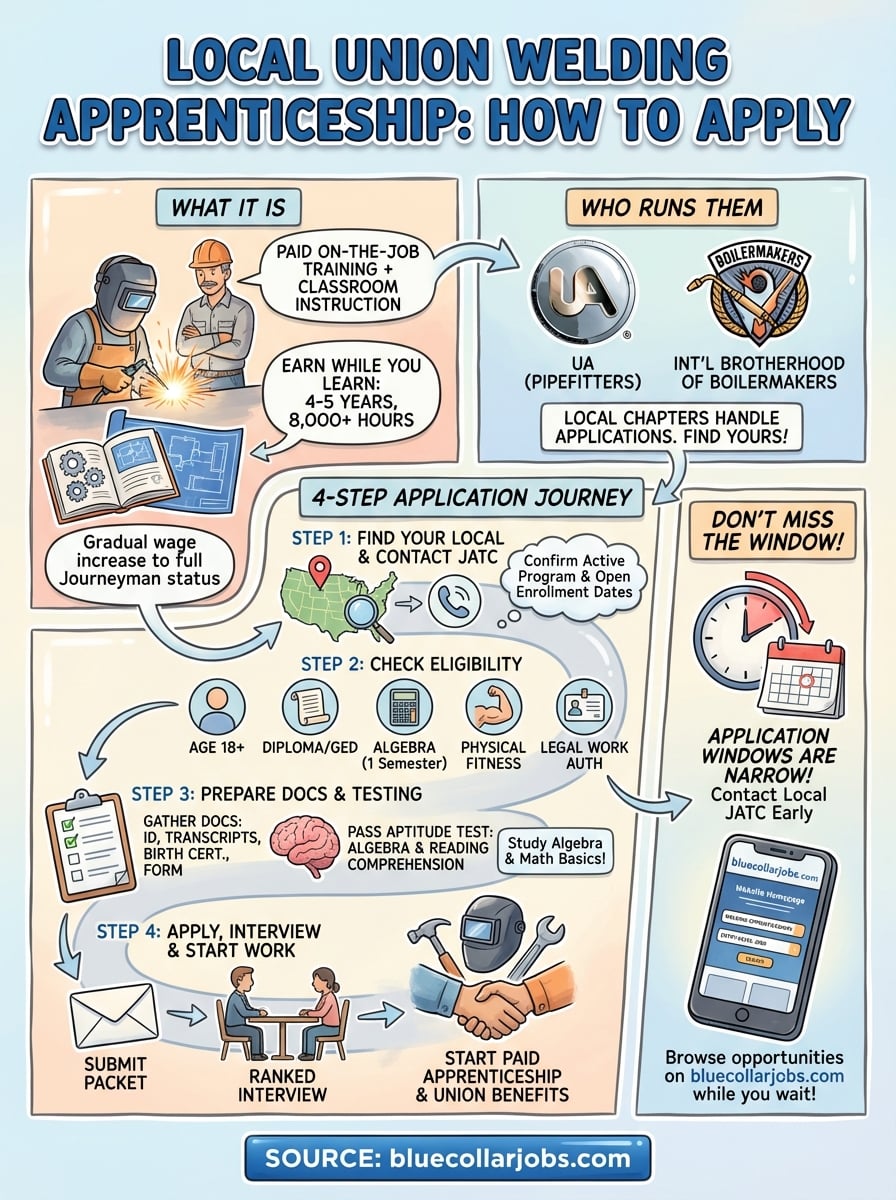
Know your experience tier

Your license and years on the job determine which roles are actually open to you. Employers filter candidates fast, and applying above your current tier without the required credentials wastes everyone’s time. The table below maps out what each level typically requires and what you can expect to earn.

Know your experience tier

Experience Tier Typical Requirements Avg. Hourly Range (US)
Apprentice/Helper Enrolled in or completed apprenticeship program $16 – $22
Journeyman State journeyman license, 4-5 years experience $26 – $40
Master Plumber Master license, 2+ years as journeyman $38 – $60+
Foreman/Supervisor Master license or equivalent field experience $45 – $70+

Applying at the correct tier also signals professionalism to hiring managers, which works in your favor before the interview even starts.

Choose your schedule and setting

Once you know your tier, decide what type of work environment fits your life. Plumbing roles split across residential, commercial, and industrial settings, and each one carries a different pace, schedule, and pay structure. Residential service work typically means varied daily hours and direct customer interaction, while commercial and industrial roles tend to run on fixed shifts with larger crews.

Factor in whether you prefer union or non-union employment as well. Union shops offer defined pay scales, stronger benefits, and pension contributions. Non-union positions often pay a higher base hourly rate but shift more benefit costs onto you. Neither option is universally better, so knowing your preference before you search keeps you from wasting time on listings that were never going to work for your situation.

Here are the main schedule types you’ll see in listings:

  • Day shift (6am-2pm or 7am-3pm): Standard for most commercial new construction projects
  • On-call/service: Common in residential and emergency repair roles
  • Project-based/contract: Set duration, often higher pay, no long-term commitment
  • Overtime-heavy: Typical in industrial maintenance, expect 50+ hour weeks regularly

Step 2. Search local listings the fast way

Typing "plumbing jobs near me" into a search bar and scrolling through the first page of results is slow and inconsistent. Most job boards bury strong listings behind dozens of irrelevant results because their algorithms prioritize paid placements over relevance. A more targeted approach gets you to the right openings in a fraction of the time.

Use filters, not keywords alone

Every major job platform gives you filter controls that most job seekers skip past entirely. Instead of running broad keyword searches, use filters to sort by trade category, location radius, experience level, and date posted. Setting the date posted filter to "last 7 days" cuts out stale listings and shows you which employers are actively hiring right now, not three months ago.

Use filters, not keywords alone

Here’s a quick filter checklist to run on any job board you use:

  • Trade category: Set to plumbing or pipefitting specifically
  • Location radius: Start at 25 miles, expand to 50 if results are thin
  • Experience level: Match your tier (apprentice, journeyman, master)
  • Date posted: Last 7 days for active openings
  • Employment type: Full-time, part-time, or contract based on your preference

Running these filters consistently across two or three platforms gives you a far more accurate picture of the local market than a single broad search ever will.

Set up job alerts so listings come to you

Rather than checking listings manually every day, configure job alerts on the platforms you use. Most boards let you save a specific search and send an email notification the moment a new listing matches your criteria. You receive the alert before most other candidates have even opened the site.

When you build each alert, use specific terms like "journeyman plumber [your city]" or "master plumber [your county]" rather than generic phrases. Specific alerts produce fewer, better-matched notifications and save you time screening irrelevant results. Here’s a simple template to follow:

Search term: Journeyman Plumber [City, State]
Radius: 25 miles
Alert frequency: Daily
Employment type: Full-time

Save one alert per role type you’re targeting. If you’re open to both journeyman and foreman positions, create two separate alerts rather than combining them into one broad search that floods your inbox with mismatched listings.

Step 3. Find jobs that never hit a job board

A significant share of plumbing jobs near me never get posted anywhere public. Small and mid-size plumbing contractors fill open positions by calling someone they know or by responding to a direct inquiry that landed in their inbox that morning. Getting in front of those employers before a posting exists cuts your competition down to almost zero.

Reach out to local contractors directly

Build a list of 10 to 15 plumbing and mechanical contractors within your target radius and contact them directly, even when no opening is advertised. A short, professional email works better than a cold phone call for this kind of outreach because it gives the hiring manager something to forward or file. Keep the message brief and specific about your license type and availability.

Use this template as your starting point:

Subject: Licensed Journeyman Plumber Available - [City, State]

Hi [Name or Hiring Team],

My name is [Your Name]. I'm a licensed journeyman plumber based in [City]
with [X] years of experience in [residential/commercial/industrial] work.
I'm currently exploring new opportunities in the area and wanted to reach
out directly in case you have upcoming needs.

I hold a valid [State] journeyman license [License #] and am available
[full-time / start date]. I'm happy to share my resume and references
at your convenience.

[Your Name]
[Phone Number]
[Email Address]

Send this to the owner or field supervisor when possible. Generic "info@" emails rarely reach the person making hiring decisions.

Tap your local union hall

If you hold a union card or are open to union work, your local union hall maintains an out-of-work list that contractors call directly when they need help on a job. Walk in, add your name to the list, and ask the dispatcher how active the local market is right now. UA locals across the country place journeymen and apprentices regularly through this system, and the positions often pay better than what shows up in public listings.

Connect through plumbing supply houses

Counter staff at local plumbing supply houses talk to contractors every single day. Stopping in, introducing yourself, and leaving a few business cards costs nothing and puts your name in front of people who hear about open positions before anyone else does. Supply house contacts work particularly well for residential service and small commercial work in tight-knit local markets.

Step 4. Apply quickly and follow up like a pro

Speed matters more than most job seekers realize. When a strong plumbing jobs near me listing goes live, the employer often starts reviewing applications within hours, not days. Submitting a complete, targeted application the same day you find it puts you near the top of the pile before it gets crowded.

Send a tailored application every time

Copying the same cover message across every application is the fastest way to get ignored. Take two minutes to read each job posting carefully and pull out one or two specific details, the type of systems they work on, the license they require, or the environment they operate in. Then reference those details directly in your message so the employer can see you actually read what they posted.

Use this cover message template as your base:

Subject: Licensed [Journeyman/Master] Plumber Applying - [Job Title]

Hi [Hiring Manager Name or Team],

I'm applying for the [Job Title] role posted on [Platform].
I hold a valid [State] [license type] license and have [X] years
of hands-on experience in [specific system or environment
mentioned in the posting].

I'm attaching my resume and am available for a call at your
convenience. My references are ready to share on request.

[Your Name]
[Phone Number]
[Email Address]

Personalizing even one line of your message increases your response rate significantly compared to a generic application.

Follow up at the right time

Most candidates send an application and wait. Following up three to five business days later with a short, professional note puts your name back in front of the hiring manager at a point when they’re actively sorting through candidates. Keep the follow-up brief and direct.

Here’s what to send:

Subject: Following Up - [Job Title] Application

Hi [Name],

I wanted to follow up on my application for the [Job Title]
position submitted on [date]. I'm still very interested
in the role and happy to answer any questions or provide
additional information.

[Your Name]
[Phone Number]

One follow-up is enough. Sending multiple messages in a short window signals impatience and can eliminate you from consideration even if your credentials are a strong match for the role.

plumbing jobs near me infographic

Next steps

You now have everything you need to find local plumbing work fast. Prepare your credentials and resume before you search, narrow your target by role and schedule, use filters and job alerts to surface active listings, reach out to contractors directly, and follow up on every application you send.

The difference between candidates who land plumbing jobs near me and those who keep scrolling comes down to preparation and consistency. Most job seekers skip the first two steps and then wonder why responses are slow. Running this process as a repeatable system rather than a series of random actions gives you a real edge in a competitive local market.

Ready to keep building your trade career? The BlueCollarJobs.com blog covers hiring trends, resume advice, and industry insights written specifically for skilled trades professionals across the United States. Start there and then browse active listings by trade, location, and experience level when you’re ready to apply.

Maintenance Electrician Job Duties: Daily Responsibilities

Maintenance Electrician Job Duties: Daily Responsibilities

A maintenance electrician keeps buildings, equipment, and production lines running by handling everything from circuit troubleshooting to preventive upkeep on electrical systems. But the full scope of maintenance electrician job duties goes well beyond basic repairs, it includes diagnostics, code compliance, emergency response, and coordination with other trades. Whether you’re writing a job description, prepping for an interview, or updating your resume, knowing exactly what this role demands day-to-day matters.

At bluecollarjobs, we list hundreds of electrical positions across the country, and maintenance electrician roles consistently rank among the most in-demand listings on our board. That gives us a clear view of what employers expect and what candidates need to bring to the table. We built this breakdown to reflect real job requirements pulled from active postings and industry standards.

Below, you’ll find a detailed look at the daily responsibilities, technical skills, and core tasks that define the maintenance electrician role, organized so you can quickly find what’s relevant to your situation, whether you’re hiring or applying. We also cover common certifications and experience levels employers look for, from apprentice to journeyman and beyond.

What a maintenance electrician does

A maintenance electrician installs, inspects, tests, and repairs electrical systems across commercial, industrial, and residential settings. Unlike a construction electrician who focuses on new builds, a maintenance electrician works on existing systems, keeping them safe, operational, and compliant with national and local electrical codes such as the NEC. The role demands a strong combination of technical knowledge and hands-on problem-solving across a wide range of equipment types and work environments.

Core responsibilities

Maintenance electrician job duties center on three core activities: routine inspections, fault diagnosis, and repairs that prevent small problems from turning into costly shutdowns. On any given shift, you might test circuit breakers, replace deteriorated wiring, recalibrate control systems, or trace the source of a tripped breaker affecting an entire facility floor. The work rarely repeats in the same way, which is why employers consistently value adaptability and independent decision-making alongside technical skills.

Employers hiring maintenance electricians expect candidates who can read schematics, diagnose faults quickly, and document their work accurately, all without constant supervision.

Your job also involves coordinating with other trades. You’ll regularly work alongside HVAC technicians, pipefitters, and millwrights to make sure electrical work doesn’t stall broader maintenance schedules. Communicating technical issues clearly to non-electrical personnel, like facility managers or plant supervisors, is part of the role too.

Work environments

Where you work shapes what you do day to day. A maintenance electrician in a manufacturing plant handles motor controls, PLCs, and high-voltage equipment, while one in a commercial building focuses on lighting systems, panel boards, and low-voltage wiring. Hospitals and universities bring their own demands, including strict uptime requirements and detailed compliance standards that leave little margin for error.

Work environments

Your environment also determines which certifications and licenses employers expect. Many facilities require a Journeyman or Master Electrician license, and some industrial sites add requirements around arc flash safety or specific equipment training. Knowing your target environment lets you align your credentials directly with what active job postings actually ask for.

Why these duties matter on the job site

Understanding maintenance electrician job duties isn’t just useful for writing a resume or job posting. It directly affects safety outcomes and operational costs at any facility. When a maintenance electrician performs their work correctly and consistently, equipment runs longer, unplanned downtime drops, and the risk of electrical fires or injuries falls significantly. When those duties get skipped or handled poorly, the consequences hit fast.

The cost of skipped maintenance

Electrical failures in commercial and industrial facilities don’t just cause inconvenience. They can trigger production shutdowns, equipment damage, and serious safety incidents that carry both human and financial costs. The Occupational Safety and Health Administration reports that electrical hazards cause hundreds of workplace fatalities each year in the United States, and a large portion are preventable through proper maintenance practices. Your thoroughness and consistency on the job directly reduce that risk for everyone on site.

Consistent preventive work by a skilled maintenance electrician is one of the most effective tools a facility has to avoid unplanned downtime and costly emergency repairs.

What employers look for

Employers use a clear list of duties to set performance expectations and accountability standards from day one. When your resume reflects the actual tasks a facility needs covered, you stand out immediately. For hiring managers, a well-defined duty list helps them screen candidates by specific technical experience, license level, and familiarity with relevant equipment, whether that’s PLC systems, panel boards, or emergency backup power.

Daily maintenance electrician job duties

No two shifts look exactly the same, but core maintenance electrician job duties follow a consistent pattern tied to inspection, repair, and documentation. You start your shift by reviewing work orders from the previous day and checking equipment logs to understand what issues are already on the board. From there, you move through your assigned areas with a plan, but you stay flexible enough to handle whatever surfaces during the day.

The ability to shift between planned maintenance tasks and unplanned repairs without losing accuracy is what separates a reliable maintenance electrician from an average one.

Tasks you handle on a standard shift

Your daily work covers a defined set of technical responsibilities that keep facilities running without interruption. Each task builds on the last, so staying organized and thorough matters throughout your entire shift.

Tasks you handle on a standard shift

Common daily tasks include:

  • Testing and inspecting circuit breakers, outlets, switches, and control panels for wear or malfunction
  • Replacing damaged wiring, fuses, or components before they cause larger failures
  • Reading and interpreting electrical schematics and blueprints to locate fault sources
  • Logging completed work orders and any flagged issues in the facility’s maintenance system
  • Coordinating with other tradespeople to sequence electrical work around active production schedules
  • Checking lighting systems, emergency backup units, and power distribution panels for proper function

Each of these tasks feeds directly into the facility’s broader safety and operational goals, which makes your attention to detail a direct business asset.

Preventive, corrective, and emergency work

Maintenance electrician job duties break down into three distinct categories of work: preventive, corrective, and emergency. Each category carries different urgency levels and technical demands, but all three require the same attention to detail and accurate documentation. Understanding how these categories divide your daily workload helps you manage your time more effectively and communicate priorities clearly to your supervisor.

Preventive work

Preventive work runs on a scheduled inspection and testing cycle that catches problems before they cause failures. You check equipment like motor controls, distribution panels, and lighting circuits on a regular rotation, replacing components that show wear before they fail. This type of work protects the facility’s operational uptime and keeps electrical systems within code compliance without waiting for something to go wrong.

Preventive maintenance is far cheaper than emergency repairs, and your consistent follow-through is what keeps that cost advantage in place.

Corrective and emergency work

Corrective work happens when an inspection or report flags a specific fault that needs repair. You diagnose the root cause, source the right parts, and fix the issue with minimal disruption to facility operations.

Emergency work is a different category entirely. When a breaker fails mid-shift or a power feed to critical equipment goes down, you respond fast, working under pressure to restore power safely and within code requirements before downtime compounds into larger operational losses. Both corrective and emergency situations test your technical knowledge more directly than scheduled work does, and employers weigh your performance in those moments heavily.

How to use duties for resumes and hiring

Once you understand the full scope of maintenance electrician job duties, you can put that knowledge to work directly, whether you’re building a resume or writing a job posting. The goal in both cases is the same: match specific tasks and skills to what the role actually requires, rather than listing generic responsibilities that blend in with every other candidate or posting on the board.

Specificity is what gets resumes noticed and job postings filled faster.

For job seekers

Your resume should reflect the actual equipment and systems you’ve worked on, not just broad categories like "electrical maintenance." Pull language directly from job postings and mirror it in your experience section. If you’ve worked on PLC systems, motor controls, or emergency backup power, name those systems explicitly. Employers scan for those terms first, so vague phrasing costs you early in the screening process.

  • List tasks by environment: manufacturing, commercial, or institutional
  • Include license level (Apprentice, Journeyman, Master) in a dedicated credentials section
  • Quantify your work where possible, such as the number of units maintained or uptime improvement results

For employers

A strong job posting names specific technical requirements instead of relying on catch-all phrases like "electrical experience required." Break your listing into daily responsibilities, required certifications, and equipment familiarity, so candidates self-screen before applying. That cuts your review time and attracts applicants whose backgrounds actually match what your facility needs.

maintenance electrician job duties infographic

Wrap-up and next steps

Maintenance electrician job duties cover a wide range of technical work, from scheduled inspections and fault diagnosis to emergency response and accurate documentation. Whether you’re applying for a role or building a job posting, understanding exactly what this position demands at the task level puts you ahead from the start. The more specific and accurate your understanding of these responsibilities, the more effectively you can match your experience to what employers actually need.

Your next step is to put this knowledge into action. If you’re hiring, list your open position with the specific certifications, equipment types, and daily responsibilities your facility requires so the right candidates find your posting first. If you’re a job seeker, use the duty breakdown here to sharpen your resume and target roles that match your license level and experience. Either way, post or find your next electrical job on BlueCollarJobs and connect with the right opportunity faster.

Local Union Welding Apprenticeship: How To Apply Near You

Local Union Welding Apprenticeship: How To Apply Near You

A local union welding apprenticeship is one of the most reliable paths into a skilled trade career that pays well from day one. Union programs, mostly run through the United Association (UA) and the International Brotherhood of Boilermakers, combine paid on-the-job training with classroom instruction, and they cover tuition costs that would otherwise come out of your pocket.

But finding open programs and figuring out the application process isn’t always straightforward. Requirements vary by local chapter, application windows are narrow, and the steps aren’t always posted in obvious places. That’s exactly the kind of gap we built bluecollarjobs to fill, connecting trade workers with real opportunities across every state, including apprenticeships and entry-level positions in welding and other skilled trades.

This guide breaks down how union welding apprenticeships work, what you need to qualify, and how to find a program accepting applications near you. We’ll walk through the timeline, the training structure, and the specific steps to get your application in front of the right local chapter.

What a local union welding apprenticeship is

A local union welding apprenticeship is a structured training program where you earn a wage while learning the trade from the ground up. Unlike trade school, you don’t pay tuition while sitting in a classroom full-time. Instead, you work alongside licensed journeymen on real job sites, get paid for every hour, and attend related technical instruction (RTI) classes in the evenings or on weekends.

Apprentices typically start at 50-60% of a journeyman’s hourly rate, with automatic raises tied to each program level they complete.

How the training is structured

Most union welding apprenticeships span four to five years, split between field hours and classroom instruction. You’ll log roughly 8,000 hours of on-the-job work over the course of the program, alongside several hundred hours of RTI annually. The program moves in tiers, and your hourly rate increases at each step. By the time you finish, you hold a journeyman card recognized on job sites across the country.

Your RTI classroom hours cover technical subjects you’ll use on every job site, including blueprint reading, metallurgy, welding codes like AWS D1.1, and OSHA safety standards. These topics are tested requirements for advancing in the program, not optional add-ons.

Who runs these programs

The United Association (UA) and the International Brotherhood of Boilermakers sponsor the majority of union welding apprenticeships in the United States. The UA focuses on pipefitters and welders working on piping systems, while the Boilermakers train workers specializing in pressure vessels, tanks, and industrial construction. Both organizations run programs through local chapter offices, which means your application goes to the chapter covering your area rather than to a national body.

Each local chapter controls its own application windows and entry requirements, so the specific steps vary by location. That’s why your first move is identifying which local covers your zip code and contacting them directly.

Step 1. Find the right local and training center

Your first move in pursuing a local union welding apprenticeship is locating the specific chapter that covers your geographic area. Both the UA and the Boilermakers run through a local chapter system, meaning your zip code determines which office handles your application. Contacting the wrong local wastes time, so pin down your chapter before you take any other steps.

Step 1. Find the right local and training center

The UA’s official website lets you search for locals by state and city, making it the fastest way to confirm which chapter covers your area.

How to locate your local chapter

Once you identify your state, use the union’s official directory to pull the local number, phone contact, and physical address for your chapter. Call the hall directly and ask two things: whether the apprenticeship program is currently active, and when the next open enrollment window opens. Many locals only accept applications once or twice a year, so missing that window means waiting another full cycle.

  • Visit ua.org and use the "Find a Local" search tool
  • Call the hall and ask specifically for the JATC office (Joint Apprenticeship Training Committee), which runs the actual training program
  • Confirm the application open date and request the checklist of required documents

Step 2. Check requirements and eligibility

Before you submit anything to your local JATC, confirm that you meet the baseline eligibility criteria. Most union welding apprenticeship programs share a common set of requirements, but specific locals can add conditions such as a valid driver’s license or documented work history in a related field.

Meeting the minimum age and education requirements doesn’t guarantee entry, but failing to meet them disqualifies you before the process even starts.

Standard entry requirements

Most local union welding apprenticeship programs require applicants to meet the following criteria before their application is accepted:

  • Age: 18 years old at the time of application
  • Education: High school diploma or GED equivalent
  • Math: Proof of one semester (or equivalent) of algebra, either completed or currently enrolled
  • Physical fitness: Ability to perform the physical demands of the trade
  • Legal work authorization: Eligible to work in the United States

Some locals also require a valid government-issued photo ID and a copy of your birth certificate at the time you submit your paperwork. Pull these documents together before the application window opens so you are not scrambling at the deadline.

Step 3. Prepare your application and testing

Once you confirm your eligibility and application window, start gathering your paperwork well before the deadline. Most locals in a local union welding apprenticeship program require the same core documents, but having everything organized ahead of time prevents last-minute delays that could push you to the next cycle.

What documents to gather

Your JATC office will give you a specific checklist, but the following documents are standard across most programs:

  • High school diploma or GED transcript
  • Government-issued photo ID (driver’s license or passport)
  • Birth certificate or proof of legal work authorization
  • Algebra coursework documentation (transcript or enrollment confirmation)
  • Completed application form from your local JATC

The aptitude test

Nearly every local requires applicants to pass a written aptitude test before they move forward in the selection process. The test covers two areas: reading comprehension and algebra. You do not need advanced math, but you need to work confidently through linear equations and basic problem-solving under timed conditions.

The aptitude test

Reviewing a standard algebra workbook for two to three weeks before your test date gives you a measurable edge over applicants who show up cold.

Study the mechanics of solving for variables, working with fractions, and interpreting word problems. Both subject areas are scored, and a strong combined score moves your ranking up on the selection list.

Step 4. Apply, interview, and start work

Submit your completed application packet to the JATC office by the posted deadline. Confirm receipt in person or by phone and get a reference number as proof your paperwork was logged.

The interview

Applicants who score high enough move to a ranked interview, where the committee evaluates your work history, attitude, and commitment. Dress appropriately, show up early, and bring a second copy of your application documents as backup.

  • Be direct about your motivation for pursuing a local union welding apprenticeship
  • Mention any prior hands-on experience, even if informal
  • Ask about the dispatch process and expected start dates

Your ranking combines your aptitude test score and your interview score, so a strong interview can lift your standing even if your test score was average.

Starting your apprenticeship

After you receive your acceptance letter, the JATC dispatches you to a signatory contractor in your area. Your first day on the job is paid, and your wage increases follow a fixed schedule tied to program milestones.

You also register with your local union hall at this stage, which activates your health and retirement benefits and begins your official record of union hours.

local union welding apprenticeship infographic

What to do next

You now have a clear roadmap for pursuing a local union welding apprenticeship: find your chapter, confirm eligibility, prepare your documents, pass the aptitude test, and show up to the interview ready to compete. The process takes preparation, but every step is manageable if you tackle them in order. The biggest mistake applicants make is waiting too long and missing the application window by a few days.

Start by calling your local JATC office this week to get the exact open enrollment date and a copy of their required documents checklist. That call takes five minutes and tells you everything you need to know about your specific timeline.

If you are also looking for entry-level welding jobs or helper positions to build experience while you wait for the next enrollment cycle, browse the current listings at bluecollarjobs.com for trade-specific opportunities posted by employers actively hiring near you.