
Searching for plumbing jobs near me sounds simple enough, until you’re scrolling through generic job boards packed with unrelated listings. The demand for plumbers across the United States keeps growing, and employers are actively competing for skilled tradespeople at every experience level, from apprentices to master plumbers. The openings are out there. Finding them shouldn’t feel like a second job.
This guide breaks down exactly how to find local plumbing positions quickly, what to expect in terms of pay and requirements, and which strategies actually work for landing interviews. Whether you’re just starting out or you’re a licensed journeyman ready for a change, you’ll walk away with a clear plan to move forward.
At bluecollarjobs, we built our platform specifically for skilled trades hiring, no white-collar noise, no irrelevant results. Just trade-specific listings organized by location, experience level, and certification. Below, we’ll show you how to use tools like ours (and others) to lock down the right plumbing job in your area.
What you need before you start searching
Before you open a single job listing, get your own details in order. Employers hiring for plumbing jobs near me searches move fast, and candidates who respond with complete, organized information get called back first. Spending 30 minutes preparing now saves you from scrambling when a strong opportunity appears.
Your credentials and certifications
The plumbing industry runs on licenses, and knowing exactly what you hold and where it’s valid before you apply keeps you from wasting time on roles you aren’t eligible for yet. Requirements vary by state, but most employers expect candidates to specify their license type upfront. Pull together every document you have and check the expiration dates on each one.
Here’s a quick checklist of what to gather:
- Apprentice card or program enrollment letter (if you’re early in your career)
- Journeyman plumber license, issuing state, and license number
- Master plumber license (if applicable)
- Backflow prevention certification (required for many commercial roles)
- OSHA 10 or OSHA 30 card
- State-specific endorsements or specialty certifications
If your license is due for renewal within 90 days, renew it before you apply. Employers regularly screen out candidates whose credentials are close to expiring.
Your resume and references
A strong plumbing resume doesn’t need to be long, but it does need to be specific. Hiring managers want to see the type of systems you’ve worked on, the tools you’re certified to operate, and the scope of projects you’ve handled. Generic resumes get skipped.
Use this basic template as your starting point:
[Your Full Name]
[Phone Number] | [Email Address] | [City, State]

LICENSE & CERTIFICATIONS
- [License type, state, license number, expiration date]
- [Any additional certifications]

EXPERIENCE
[Company Name] | [Job Title] | [Start Date - End Date]
- Installed and serviced [specific systems, e.g., PEX water supply lines, gas lines]
- Worked on [commercial/residential/industrial] projects up to [X] units or [X] sq ft
- Used [specific tools or equipment, e.g., pipe threaders, hydrostatic test pumps]

[Repeat for each role]

SKILLS
[Pipe materials, code knowledge, specialty areas]

REFERENCES
Available upon request
Keep three professional references on a separate document, ready to send the moment an employer asks. Former supervisors or foremen carry the most weight with hiring managers compared to coworkers or personal contacts.
Your target pay range
Walking into a search without a clear pay target means you’ll waste time applying to positions that don’t meet your financial needs. Research what plumbers at your experience level earn in your specific metro area before you start clicking through listings. Pay varies significantly between rural counties and major cities, even within the same state.
For example, a journeyman plumber in Houston earns differently than one in a smaller Texas market. Factors that shift your rate include overtime availability, benefits packages, and whether the role is union or non-union. Decide whether a lower base rate with strong health and retirement benefits works for your situation, or whether you need a specific weekly take-home number. Write that number down before you start searching and use it as a hard filter, not a rough guideline. Knowing your floor prevents you from wasting interview time on roles that were never going to work.
Step 1. Pick the right plumbing role and schedule
Applying to every plumbing jobs near me result you find is one of the fastest ways to burn out before you land anything. Narrowing your focus to roles that match your license level and work preferences cuts down the noise and puts your applications in front of the right employers from the start.
Know your experience tier
Your license and years on the job determine which roles are actually open to you. Employers filter candidates fast, and applying above your current tier without the required credentials wastes everyone’s time. The table below maps out what each level typically requires and what you can expect to earn.

| Experience Tier | Typical Requirements | Avg. Hourly Range (US) |
|---|---|---|
| Apprentice/Helper | Enrolled in or completed apprenticeship program | $16 – $22 |
| Journeyman | State journeyman license, 4-5 years experience | $26 – $40 |
| Master Plumber | Master license, 2+ years as journeyman | $38 – $60+ |
| Foreman/Supervisor | Master license or equivalent field experience | $45 – $70+ |
Applying at the correct tier also signals professionalism to hiring managers, which works in your favor before the interview even starts.
Choose your schedule and setting
Once you know your tier, decide what type of work environment fits your life. Plumbing roles split across residential, commercial, and industrial settings, and each one carries a different pace, schedule, and pay structure. Residential service work typically means varied daily hours and direct customer interaction, while commercial and industrial roles tend to run on fixed shifts with larger crews.
Factor in whether you prefer union or non-union employment as well. Union shops offer defined pay scales, stronger benefits, and pension contributions. Non-union positions often pay a higher base hourly rate but shift more benefit costs onto you. Neither option is universally better, so knowing your preference before you search keeps you from wasting time on listings that were never going to work for your situation.
Here are the main schedule types you’ll see in listings:
- Day shift (6am-2pm or 7am-3pm): Standard for most commercial new construction projects
- On-call/service: Common in residential and emergency repair roles
- Project-based/contract: Set duration, often higher pay, no long-term commitment
- Overtime-heavy: Typical in industrial maintenance, expect 50+ hour weeks regularly
Step 2. Search local listings the fast way
Typing "plumbing jobs near me" into a search bar and scrolling through the first page of results is slow and inconsistent. Most job boards bury strong listings behind dozens of irrelevant results because their algorithms prioritize paid placements over relevance. A more targeted approach gets you to the right openings in a fraction of the time.
Use filters, not keywords alone
Every major job platform gives you filter controls that most job seekers skip past entirely. Instead of running broad keyword searches, use filters to sort by trade category, location radius, experience level, and date posted. Setting the date posted filter to "last 7 days" cuts out stale listings and shows you which employers are actively hiring right now, not three months ago.
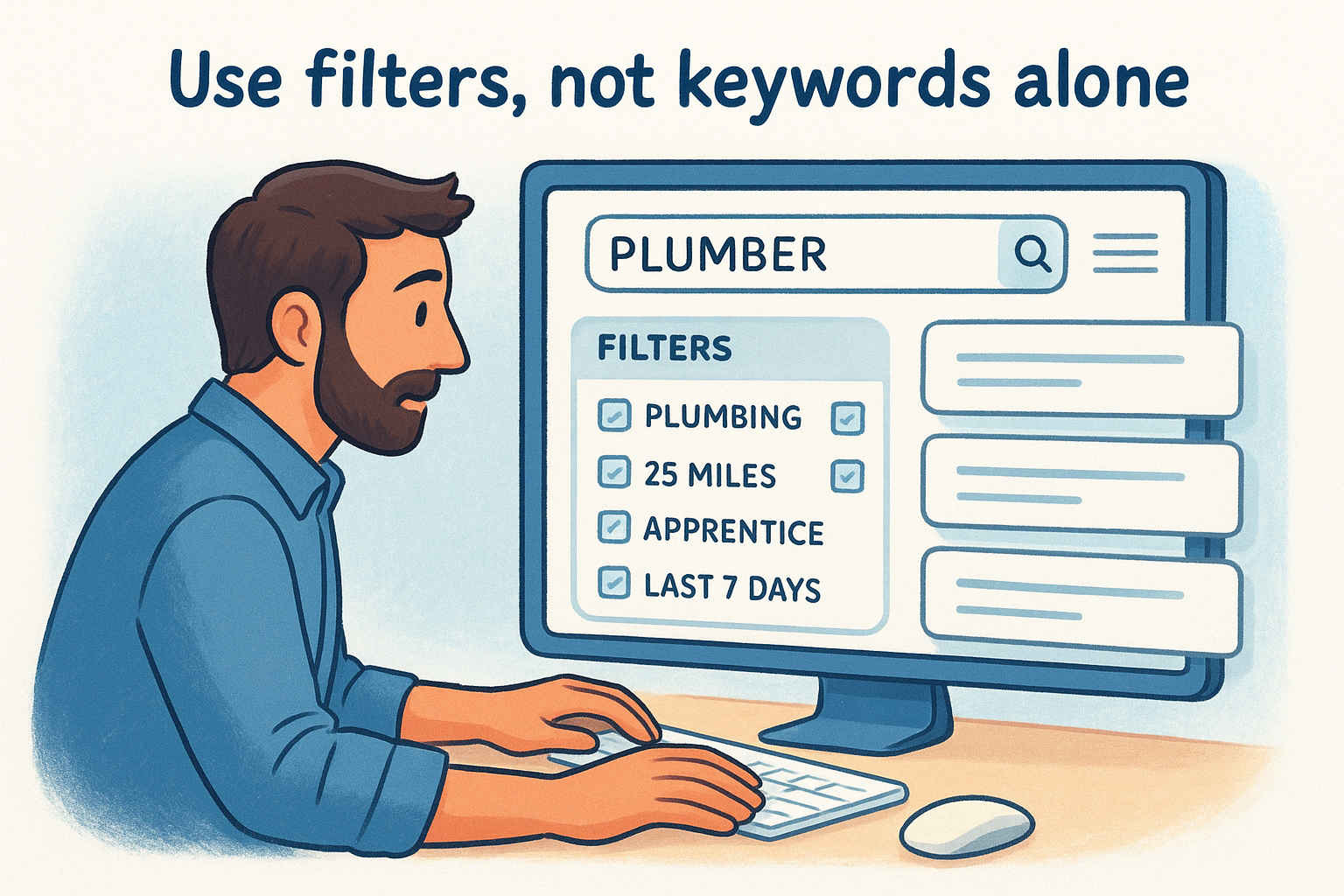
Here’s a quick filter checklist to run on any job board you use:
- Trade category: Set to plumbing or pipefitting specifically
- Location radius: Start at 25 miles, expand to 50 if results are thin
- Experience level: Match your tier (apprentice, journeyman, master)
- Date posted: Last 7 days for active openings
- Employment type: Full-time, part-time, or contract based on your preference
Running these filters consistently across two or three platforms gives you a far more accurate picture of the local market than a single broad search ever will.
Set up job alerts so listings come to you
Rather than checking listings manually every day, configure job alerts on the platforms you use. Most boards let you save a specific search and send an email notification the moment a new listing matches your criteria. You receive the alert before most other candidates have even opened the site.
When you build each alert, use specific terms like "journeyman plumber [your city]" or "master plumber [your county]" rather than generic phrases. Specific alerts produce fewer, better-matched notifications and save you time screening irrelevant results. Here’s a simple template to follow:
Search term: Journeyman Plumber [City, State]
Radius: 25 miles
Alert frequency: Daily
Employment type: Full-time
Save one alert per role type you’re targeting. If you’re open to both journeyman and foreman positions, create two separate alerts rather than combining them into one broad search that floods your inbox with mismatched listings.
Step 3. Find jobs that never hit a job board
A significant share of plumbing jobs near me never get posted anywhere public. Small and mid-size plumbing contractors fill open positions by calling someone they know or by responding to a direct inquiry that landed in their inbox that morning. Getting in front of those employers before a posting exists cuts your competition down to almost zero.
Reach out to local contractors directly
Build a list of 10 to 15 plumbing and mechanical contractors within your target radius and contact them directly, even when no opening is advertised. A short, professional email works better than a cold phone call for this kind of outreach because it gives the hiring manager something to forward or file. Keep the message brief and specific about your license type and availability.
Use this template as your starting point:
Subject: Licensed Journeyman Plumber Available - [City, State]

Hi [Name or Hiring Team],

My name is [Your Name]. I'm a licensed journeyman plumber based in [City]
with [X] years of experience in [residential/commercial/industrial] work.
I'm currently exploring new opportunities in the area and wanted to reach
out directly in case you have upcoming needs.

I hold a valid [State] journeyman license [License #] and am available
[full-time / start date]. I'm happy to share my resume and references
at your convenience.

[Your Name]
[Phone Number]
[Email Address]
Send this to the owner or field supervisor when possible. Generic "info@" emails rarely reach the person making hiring decisions.
Tap your local union hall
If you hold a union card or are open to union work, your local union hall maintains an out-of-work list that contractors call directly when they need help on a job. Walk in, add your name to the list, and ask the dispatcher how active the local market is right now. UA locals across the country place journeymen and apprentices regularly through this system, and the positions often pay better than what shows up in public listings.
Connect through plumbing supply houses
Counter staff at local plumbing supply houses talk to contractors every single day. Stopping in, introducing yourself, and leaving a few business cards costs nothing and puts your name in front of people who hear about open positions before anyone else does. Supply house contacts work particularly well for residential service and small commercial work in tight-knit local markets.
Step 4. Apply quickly and follow up like a pro
Speed matters more than most job seekers realize. When a strong plumbing jobs near me listing goes live, the employer often starts reviewing applications within hours, not days. Submitting a complete, targeted application the same day you find it puts you near the top of the pile before it gets crowded.
Send a tailored application every time
Copying the same cover message across every application is the fastest way to get ignored. Take two minutes to read each job posting carefully and pull out one or two specific details, the type of systems they work on, the license they require, or the environment they operate in. Then reference those details directly in your message so the employer can see you actually read what they posted.
Use this cover message template as your base:
Subject: Licensed [Journeyman/Master] Plumber Applying - [Job Title]

Hi [Hiring Manager Name or Team],

I'm applying for the [Job Title] role posted on [Platform].
I hold a valid [State] [license type] license and have [X] years
of hands-on experience in [specific system or environment
mentioned in the posting].

I'm attaching my resume and am available for a call at your
convenience. My references are ready to share on request.

[Your Name]
[Phone Number]
[Email Address]
Personalizing even one line of your message increases your response rate significantly compared to a generic application.
Follow up at the right time
Most candidates send an application and wait. Following up three to five business days later with a short, professional note puts your name back in front of the hiring manager at a point when they’re actively sorting through candidates. Keep the follow-up brief and direct.
Here’s what to send:
Subject: Following Up - [Job Title] Application

Hi [Name],

I wanted to follow up on my application for the [Job Title]
position submitted on [date]. I'm still very interested
in the role and happy to answer any questions or provide
additional information.

[Your Name]
[Phone Number]
One follow-up is enough. Sending multiple messages in a short window signals impatience and can eliminate you from consideration even if your credentials are a strong match for the role.
Next steps
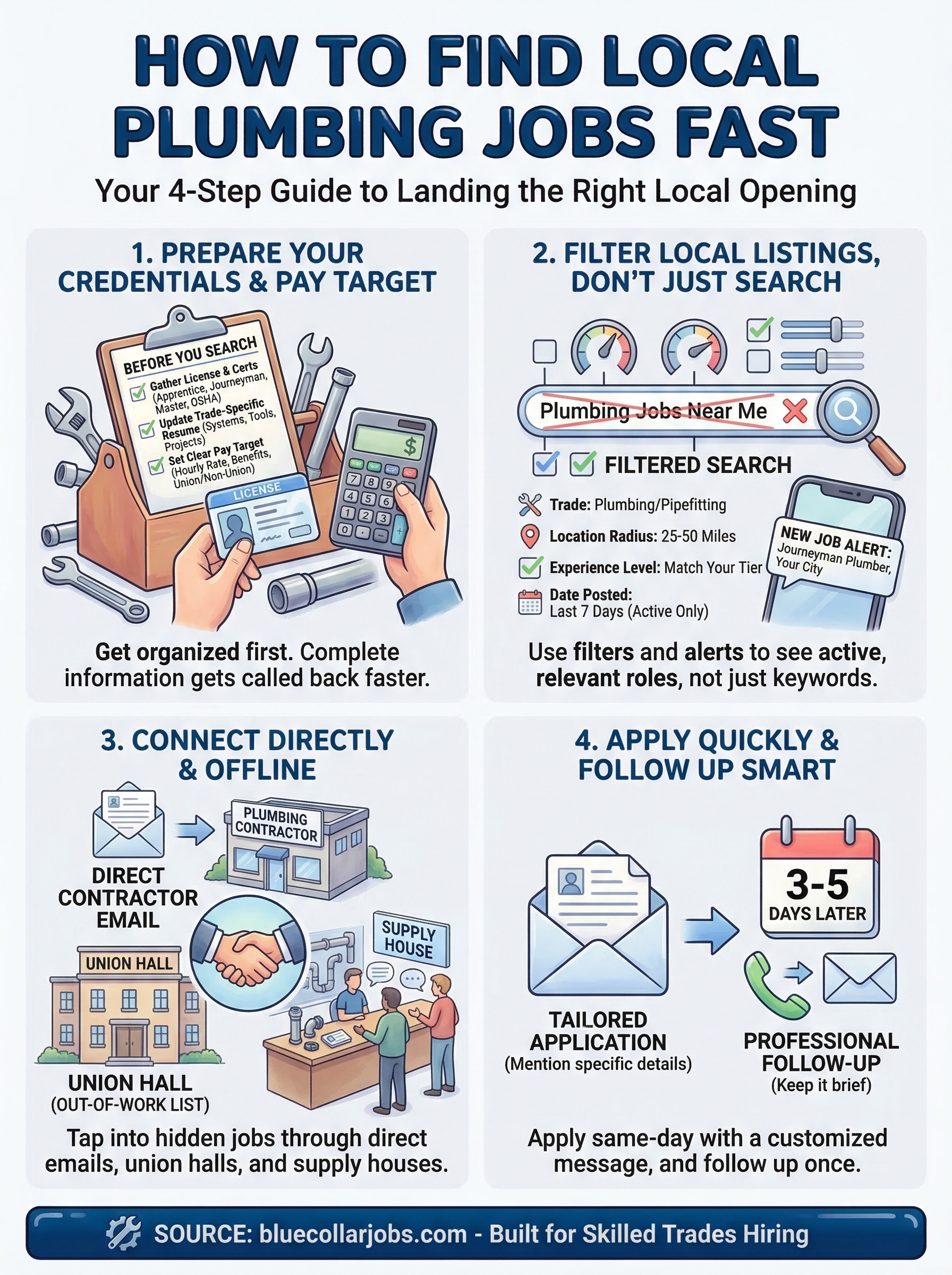
You now have everything you need to find local plumbing work fast. Prepare your credentials and resume before you search, narrow your target by role and schedule, use filters and job alerts to surface active listings, reach out to contractors directly, and follow up on every application you send.
The difference between candidates who land plumbing jobs near me and those who keep scrolling comes down to preparation and consistency. Most job seekers skip the first two steps and then wonder why responses are slow. Running this process as a repeatable system rather than a series of random actions gives you a real edge in a competitive local market.
Ready to keep building your trade career? The BlueCollarJobs.com blog covers hiring trends, resume advice, and industry insights written specifically for skilled trades professionals across the United States. Start there and then browse active listings by trade, location, and experience level when you’re ready to apply.

21 thoughts on “Plumbing Jobs Near Me: How To Find Local Openings Fast”