
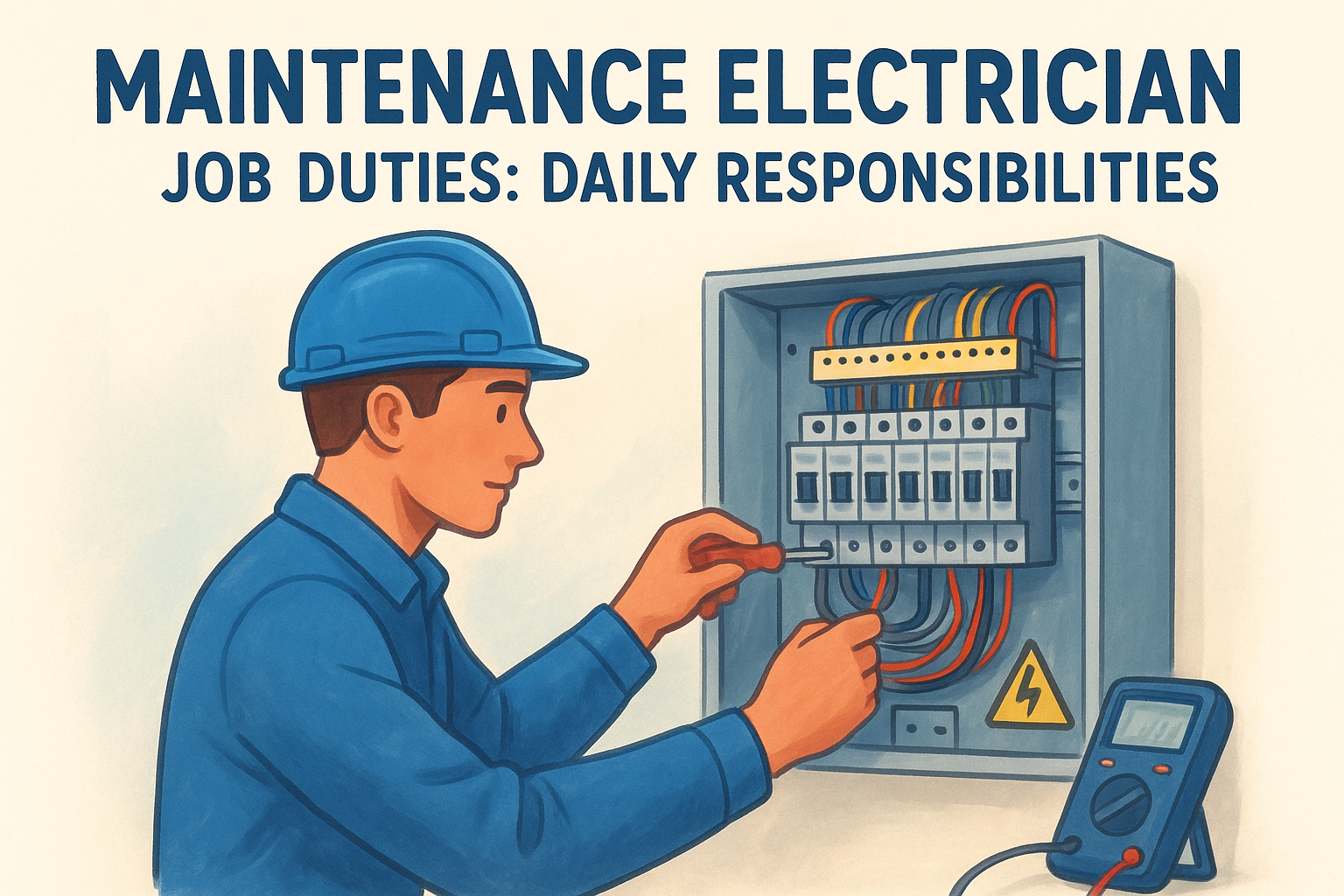
A maintenance electrician keeps buildings, equipment, and production lines running by handling everything from circuit troubleshooting to preventive upkeep on electrical systems. But the full scope of maintenance electrician job duties goes well beyond basic repairs, it includes diagnostics, code compliance, emergency response, and coordination with other trades. Whether you’re writing a job description, prepping for an interview, or updating your resume, knowing exactly what this role demands day-to-day matters.
At bluecollarjobs, we list hundreds of electrical positions across the country, and maintenance electrician roles consistently rank among the most in-demand listings on our board. That gives us a clear view of what employers expect and what candidates need to bring to the table. We built this breakdown to reflect real job requirements pulled from active postings and industry standards.
Below, you’ll find a detailed look at the daily responsibilities, technical skills, and core tasks that define the maintenance electrician role, organized so you can quickly find what’s relevant to your situation, whether you’re hiring or applying. We also cover common certifications and experience levels employers look for, from apprentice to journeyman and beyond.
What a maintenance electrician does
A maintenance electrician installs, inspects, tests, and repairs electrical systems across commercial, industrial, and residential settings. Unlike a construction electrician who focuses on new builds, a maintenance electrician works on existing systems, keeping them safe, operational, and compliant with national and local electrical codes such as the NEC. The role demands a strong combination of technical knowledge and hands-on problem-solving across a wide range of equipment types and work environments.
Core responsibilities
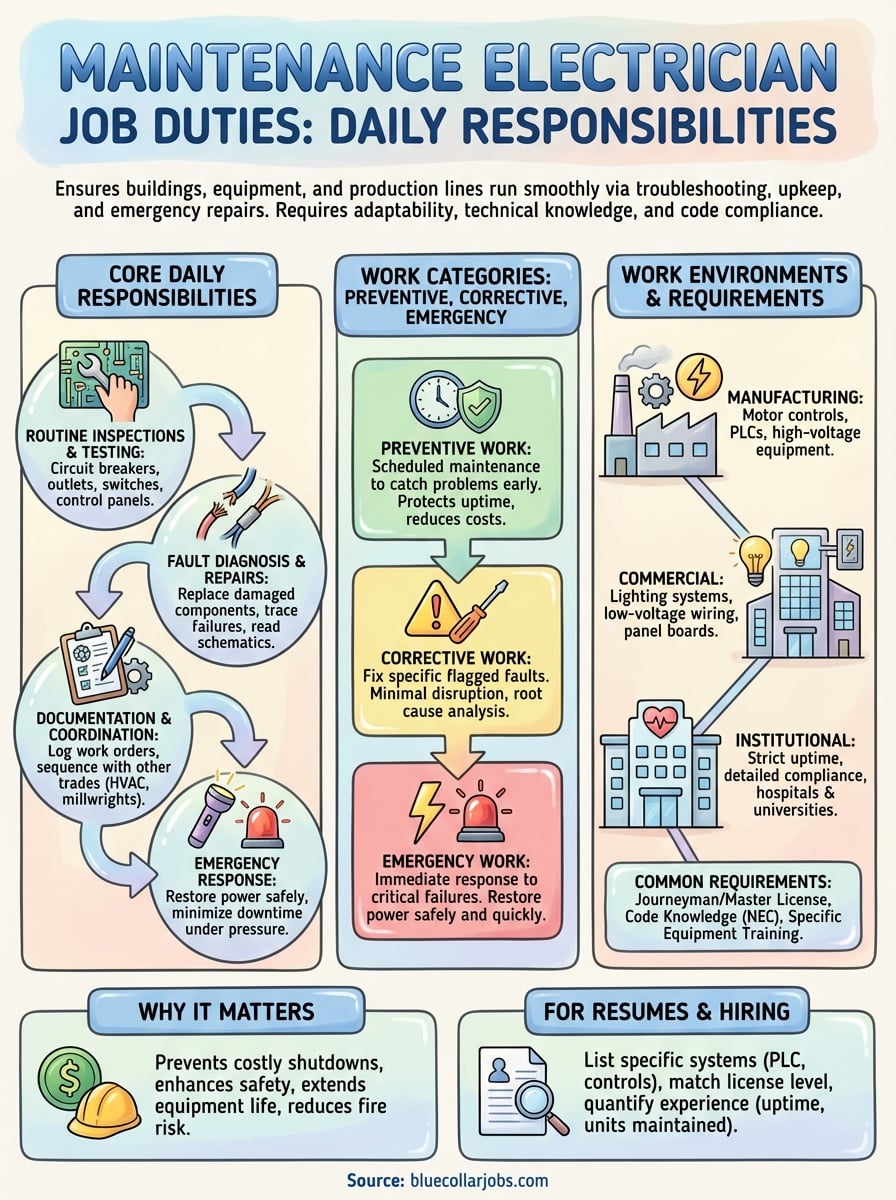
Maintenance electrician job duties center on three core activities: routine inspections, fault diagnosis, and repairs that prevent small problems from turning into costly shutdowns. On any given shift, you might test circuit breakers, replace deteriorated wiring, recalibrate control systems, or trace the source of a tripped breaker affecting an entire facility floor. The work rarely repeats in the same way, which is why employers consistently value adaptability and independent decision-making alongside technical skills.
Employers hiring maintenance electricians expect candidates who can read schematics, diagnose faults quickly, and document their work accurately, all without constant supervision.
Your job also involves coordinating with other trades. You’ll regularly work alongside HVAC technicians, pipefitters, and millwrights to make sure electrical work doesn’t stall broader maintenance schedules. Communicating technical issues clearly to non-electrical personnel, like facility managers or plant supervisors, is part of the role too.
Work environments
Where you work shapes what you do day to day. A maintenance electrician in a manufacturing plant handles motor controls, PLCs, and high-voltage equipment, while one in a commercial building focuses on lighting systems, panel boards, and low-voltage wiring. Hospitals and universities bring their own demands, including strict uptime requirements and detailed compliance standards that leave little margin for error.
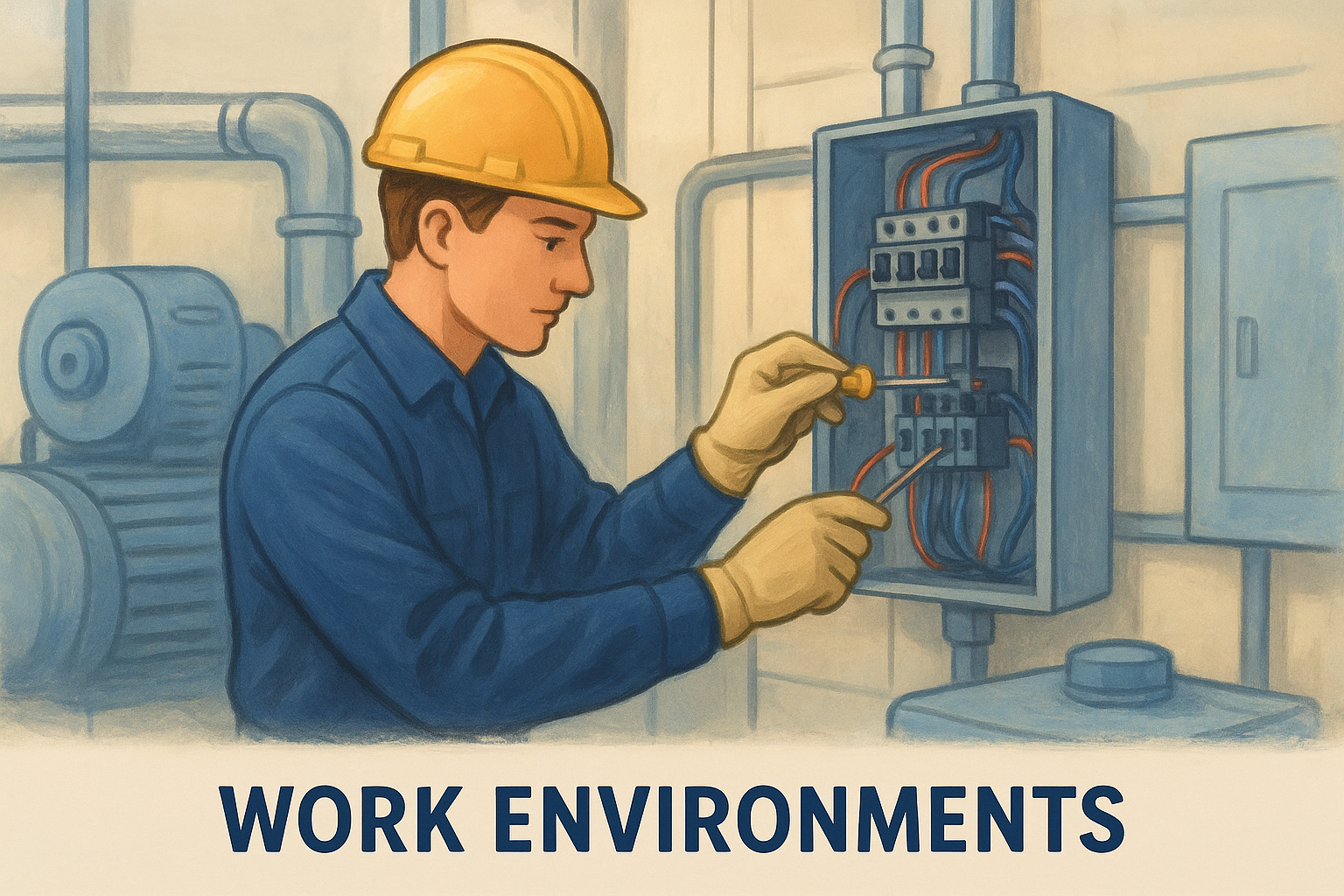
Your environment also determines which certifications and licenses employers expect. Many facilities require a Journeyman or Master Electrician license, and some industrial sites add requirements around arc flash safety or specific equipment training. Knowing your target environment lets you align your credentials directly with what active job postings actually ask for.
Why these duties matter on the job site
Understanding maintenance electrician job duties isn’t just useful for writing a resume or job posting. It directly affects safety outcomes and operational costs at any facility. When a maintenance electrician performs their work correctly and consistently, equipment runs longer, unplanned downtime drops, and the risk of electrical fires or injuries falls significantly. When those duties get skipped or handled poorly, the consequences hit fast.
The cost of skipped maintenance
Electrical failures in commercial and industrial facilities don’t just cause inconvenience. They can trigger production shutdowns, equipment damage, and serious safety incidents that carry both human and financial costs. The Occupational Safety and Health Administration reports that electrical hazards cause hundreds of workplace fatalities each year in the United States, and a large portion are preventable through proper maintenance practices. Your thoroughness and consistency on the job directly reduce that risk for everyone on site.
Consistent preventive work by a skilled maintenance electrician is one of the most effective tools a facility has to avoid unplanned downtime and costly emergency repairs.
What employers look for
Employers use a clear list of duties to set performance expectations and accountability standards from day one. When your resume reflects the actual tasks a facility needs covered, you stand out immediately. For hiring managers, a well-defined duty list helps them screen candidates by specific technical experience, license level, and familiarity with relevant equipment, whether that’s PLC systems, panel boards, or emergency backup power.
Daily maintenance electrician job duties
No two shifts look exactly the same, but core maintenance electrician job duties follow a consistent pattern tied to inspection, repair, and documentation. You start your shift by reviewing work orders from the previous day and checking equipment logs to understand what issues are already on the board. From there, you move through your assigned areas with a plan, but you stay flexible enough to handle whatever surfaces during the day.
The ability to shift between planned maintenance tasks and unplanned repairs without losing accuracy is what separates a reliable maintenance electrician from an average one.
Tasks you handle on a standard shift
Your daily work covers a defined set of technical responsibilities that keep facilities running without interruption. Each task builds on the last, so staying organized and thorough matters throughout your entire shift.
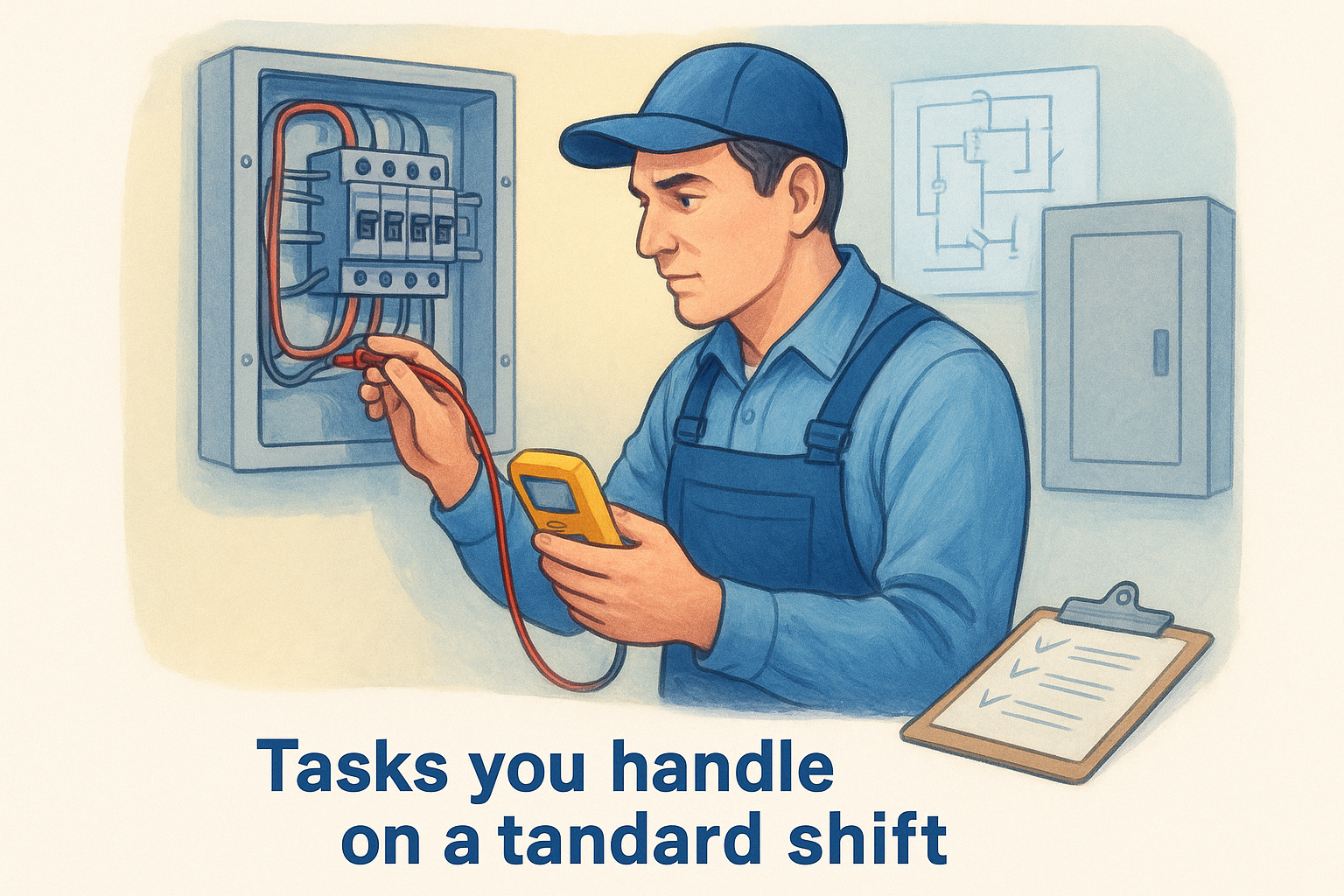
Common daily tasks include:
- Testing and inspecting circuit breakers, outlets, switches, and control panels for wear or malfunction
- Replacing damaged wiring, fuses, or components before they cause larger failures
- Reading and interpreting electrical schematics and blueprints to locate fault sources
- Logging completed work orders and any flagged issues in the facility’s maintenance system
- Coordinating with other tradespeople to sequence electrical work around active production schedules
- Checking lighting systems, emergency backup units, and power distribution panels for proper function
Each of these tasks feeds directly into the facility’s broader safety and operational goals, which makes your attention to detail a direct business asset.
Preventive, corrective, and emergency work
Maintenance electrician job duties break down into three distinct categories of work: preventive, corrective, and emergency. Each category carries different urgency levels and technical demands, but all three require the same attention to detail and accurate documentation. Understanding how these categories divide your daily workload helps you manage your time more effectively and communicate priorities clearly to your supervisor.
Preventive work
Preventive work runs on a scheduled inspection and testing cycle that catches problems before they cause failures. You check equipment like motor controls, distribution panels, and lighting circuits on a regular rotation, replacing components that show wear before they fail. This type of work protects the facility’s operational uptime and keeps electrical systems within code compliance without waiting for something to go wrong.
Preventive maintenance is far cheaper than emergency repairs, and your consistent follow-through is what keeps that cost advantage in place.
Corrective and emergency work
Corrective work happens when an inspection or report flags a specific fault that needs repair. You diagnose the root cause, source the right parts, and fix the issue with minimal disruption to facility operations.
Emergency work is a different category entirely. When a breaker fails mid-shift or a power feed to critical equipment goes down, you respond fast, working under pressure to restore power safely and within code requirements before downtime compounds into larger operational losses. Both corrective and emergency situations test your technical knowledge more directly than scheduled work does, and employers weigh your performance in those moments heavily.
How to use duties for resumes and hiring
Once you understand the full scope of maintenance electrician job duties, you can put that knowledge to work directly, whether you’re building a resume or writing a job posting. The goal in both cases is the same: match specific tasks and skills to what the role actually requires, rather than listing generic responsibilities that blend in with every other candidate or posting on the board.
Specificity is what gets resumes noticed and job postings filled faster.
For job seekers
Your resume should reflect the actual equipment and systems you’ve worked on, not just broad categories like "electrical maintenance." Pull language directly from job postings and mirror it in your experience section. If you’ve worked on PLC systems, motor controls, or emergency backup power, name those systems explicitly. Employers scan for those terms first, so vague phrasing costs you early in the screening process.
- List tasks by environment: manufacturing, commercial, or institutional
- Include license level (Apprentice, Journeyman, Master) in a dedicated credentials section
- Quantify your work where possible, such as the number of units maintained or uptime improvement results
For employers
A strong job posting names specific technical requirements instead of relying on catch-all phrases like "electrical experience required." Break your listing into daily responsibilities, required certifications, and equipment familiarity, so candidates self-screen before applying. That cuts your review time and attracts applicants whose backgrounds actually match what your facility needs.
Wrap-up and next steps
Maintenance electrician job duties cover a wide range of technical work, from scheduled inspections and fault diagnosis to emergency response and accurate documentation. Whether you’re applying for a role or building a job posting, understanding exactly what this position demands at the task level puts you ahead from the start. The more specific and accurate your understanding of these responsibilities, the more effectively you can match your experience to what employers actually need.
Your next step is to put this knowledge into action. If you’re hiring, list your open position with the specific certifications, equipment types, and daily responsibilities your facility requires so the right candidates find your posting first. If you’re a job seeker, use the duty breakdown here to sharpen your resume and target roles that match your license level and experience. Either way, post or find your next electrical job on BlueCollarJobs and connect with the right opportunity faster.

Do you want to go to Montenegro? Montenegro an Adriatic holiday with pristine beaches and beautiful cities. Resorts, excursions, and active recreation. An ideal destination for travel and seaside relaxation.
Женский портал https://lubimoy.com.ua статьи о красоте, здоровье, отношениях и саморазвитии. Полезные советы, лайфхаки и актуальные темы для женщин. Все для вдохновения и гармонии каждый день.
Онлайн женский журнал https://zhenskiy.kyiv.ua статьи о красоте, здоровье, моде и любви. Советы, тренды и полезный контент для женщин любого возраста.
Актуальные новости https://ktm.org.ua Украины онлайн. Последние события, аналитика, экономика, происшествия и международные отношения. Только проверенная информация и важные обновления в режиме реального времени.
портал новин inews.in.ua висвітлює події в Україні та світі, а також теми технологій. Тут можна знайти новини про гаджети, техніку, ІТ та актуальні тренди.
Full turnkey accounting support https://financeprofessional.ee filing declarations, calculating salaries, and reporting to the tax office. The guys work with e-Residency, everything is done online, without visiting the office. The prices are reasonable, and the reports are always on time.
Погружайся в захватывающие сюжеты вместе с нами! Голливудские блокбастеры, культовые сериалы, добрые мультфильмы и зрелищные премьеры – всё доступно в отличном качестве. Никакой рекламы, только чистое удовольствие от просмотра. Создай свою коллекцию любимых фильмов и наслаждайся: кино
https://tidak-berfungsi.website/
luxury villas for sale phuket [url=https://villas-for-sale-in-phuket-4.com]luxury villas for sale phuket[/url]
прокапаться от алкоголя нижний новгород [url=https://kapelnicza-ot-pokhmelya-nizhnij-novgorod-8.ru]прокапаться от алкоголя нижний новгород[/url]
производитель рулонных штор [url=https://rulonnye-shtory-s-elektroprivodom190.ru]https://rulonnye-shtory-s-elektroprivodom190.ru[/url]
выведение из запоя на дому цена [url=https://vyvod-iz-zapoya-na-domu-ekaterinburg-26.ru]выведение из запоя на дому цена[/url]
лечение алкоголизма в нижнем новгороде [url=https://vyvod-iz-zapoya-v-staczionare-nizhnij-novgorod-22.ru]лечение алкоголизма в нижнем новгороде[/url]