
How Long Is Electrician Apprenticeship? Years, OJT & School
Becoming a licensed electrician takes years of dedicated training, and most people underestimate just how long. If you’re researching how long is electrician apprenticeship, you’re likely weighing whether this career path fits your timeline and goals. The answer isn’t one-size-fits-all, but there’s a clear framework that applies across most states.
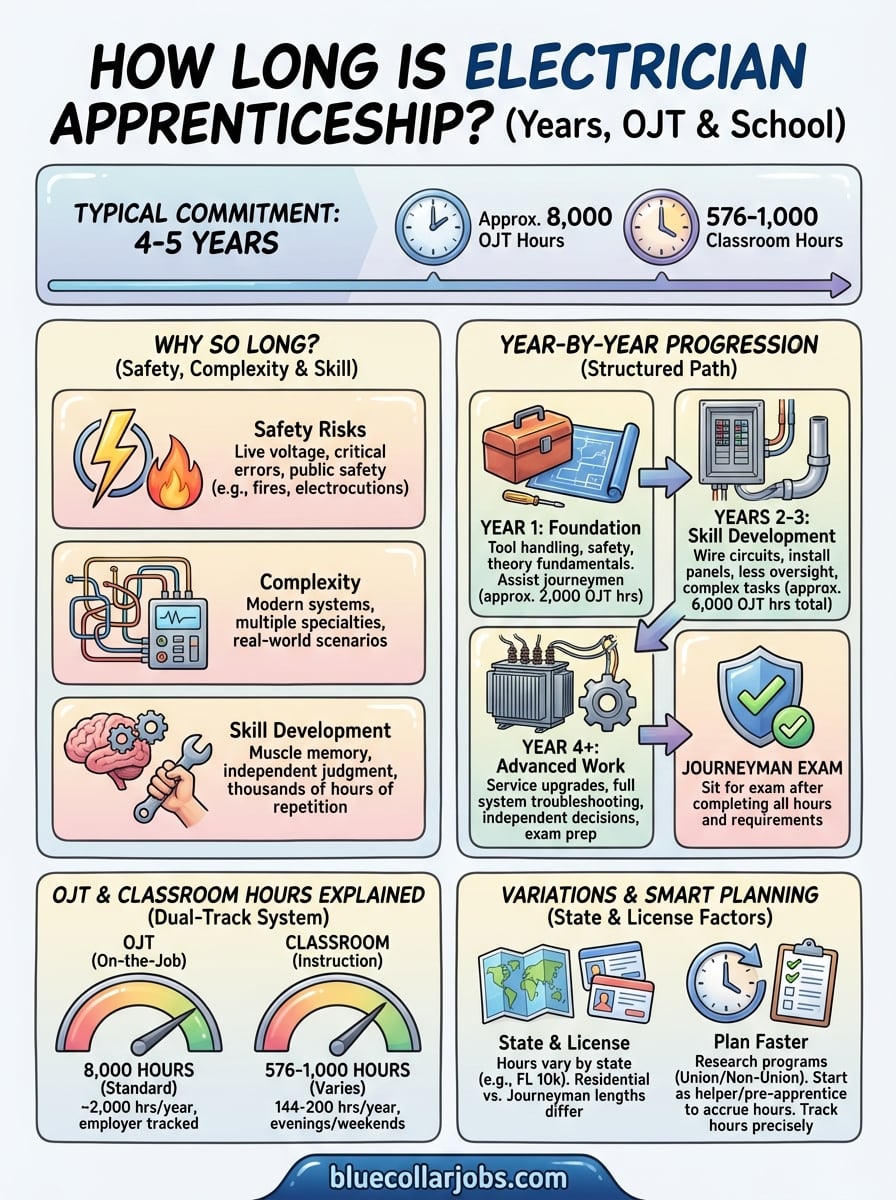
A typical electrical apprenticeship runs 4 to 5 years, combining roughly 8,000 hours of on-the-job training with 576 to 1,000 hours of classroom instruction. That’s the commitment required before you can sit for your journeyman exam and work independently. Some programs compress this timeline; others stretch it depending on your state’s licensing requirements and the type of electrical work you’re pursuing.
This guide breaks down the exact hours, schooling requirements, and factors that can speed up or slow down your path to becoming a journeyman electrician. At bluecollarjobs, we connect apprentices and licensed electricians with employers actively hiring across the trades, so understanding these timelines helps you plan your career progression and know when you’ll be ready to land higher-paying positions.
Why electrician apprenticeships take 4 to 5 years
The 4 to 5 year timeline exists because electrical work involves serious risks. You’re dealing with live voltage, complex building codes, and systems that can kill someone if installed incorrectly. State licensing boards don’t set these requirements arbitrarily. They base them on decades of industry data showing that competent electricians need thousands of hours to develop safe judgment and technical skill.
The safety and complexity factor
Electrical systems in modern buildings are far more complicated than most people realize. You need to master residential wiring, commercial three-phase systems, load calculations, panel upgrades, motor controls, and emergency backup systems. Each specialty requires hands-on practice under supervision before you can troubleshoot problems independently. Your apprenticeship exposes you to hundreds of unique scenarios that textbooks can’t replicate, like tracking down intermittent faults in old wiring or installing conduit runs through retrofitted spaces.
Licensing boards require extensive training because electrical mistakes can result in fires, electrocutions, and code violations that put entire buildings at risk.
Licensing boards set minimum standards
State regulatory agencies enforce minimum hour requirements to protect public safety. Most jurisdictions mandate 8,000 hours of on-the-job training because this translates to roughly four years of full-time work at 40 hours per week. Your classroom instruction typically runs 144 to 200 hours annually, covering National Electrical Code updates, blueprint reading, and electrical theory. These standards ensure every licensed journeyman meets the same baseline competency, regardless of which contractor employed them during training.
Skill progression requires real-world repetition
When you’re asking how long is electrician apprenticeship, you’re really asking how long it takes to become competent without constant supervision. The answer is thousands of hours because muscle memory and decision-making speed only develop through repetition. First-year apprentices spend months just learning to bend conduit correctly and pull wire without damaging insulation. By year three, you’re running circuits independently and managing your own tasks on job sites. Year four focuses on advanced installations like service upgrades, transformer work, and final troubleshooting that requires understanding how entire systems interact.
Your brain needs time to internalize the patterns of electrical work. You’ll wire hundreds of outlets, install dozens of panels, and troubleshoot countless problems before the logic becomes automatic. Contractors won’t trust you with unsupervised work until you’ve proven you can handle the full range of tasks safely and efficiently, which is exactly why programs can’t compress the timeline without compromising quality.
Typical apprenticeship timeline year by year
Understanding how long is electrician apprenticeship becomes clearer when you break it down by year. Each stage builds on the previous one, gradually increasing your responsibilities and technical knowledge. Your progression follows a structured path that moves from basic tasks to complex installations, though the exact pace varies based on your employer and the types of projects you work on.
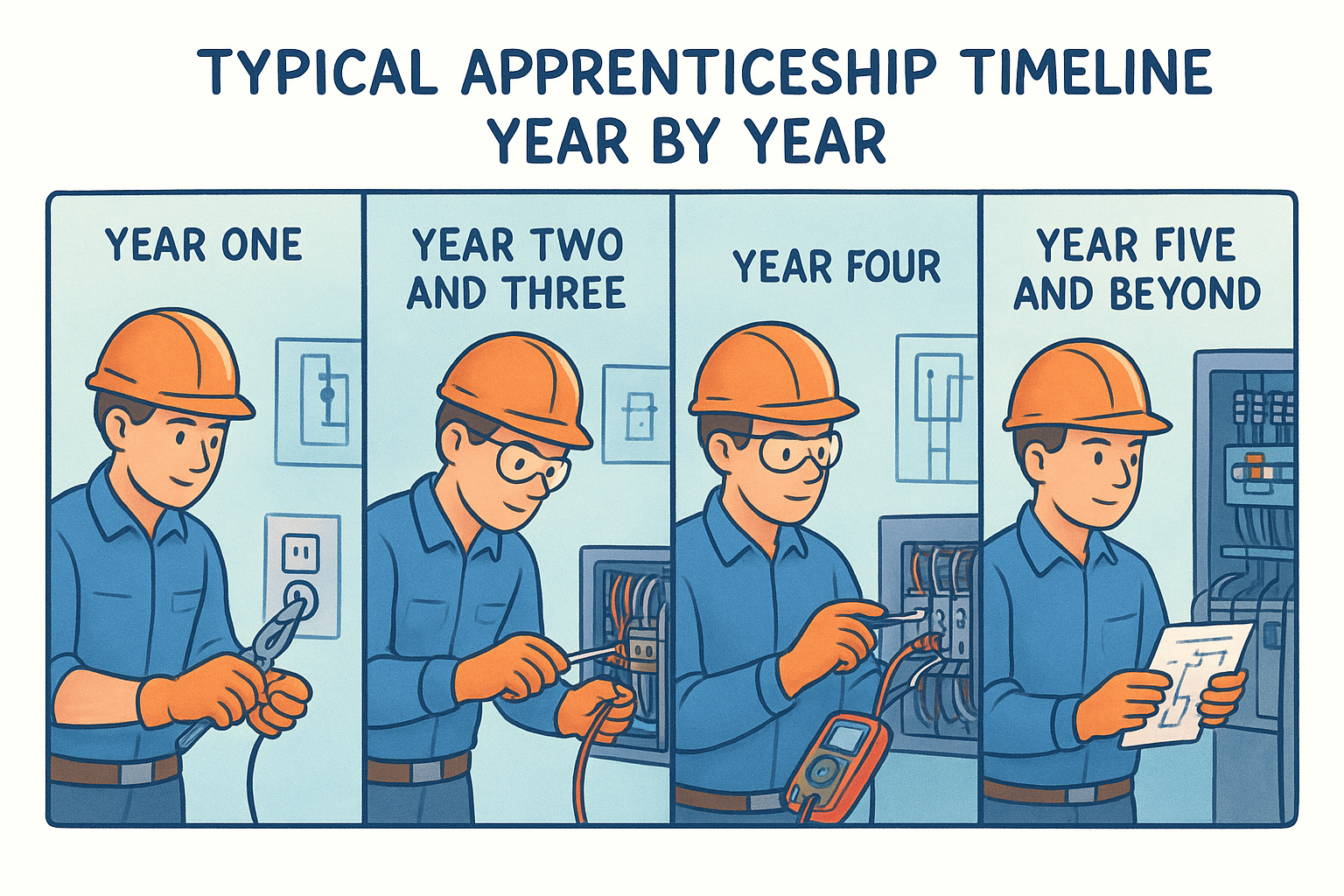
Year one: Foundation and basic tasks
Your first year focuses on tool handling, material identification, and job site safety. You’ll spend most of your time assisting journeymen by pulling wire, bending conduit, drilling holes, and installing outlet boxes. Expect to learn proper PPE use, ladder safety, and how to read basic blueprints. Your classroom work covers electrical theory fundamentals like Ohm’s law, circuit types, and wire sizing basics. Most first-year apprentices accumulate 2,000 hours of on-the-job training while completing 144 to 200 hours of evening or weekend classes.
Years two and three: Skill development
During years two and three, you start wiring circuits independently and troubleshooting simpler problems. Your tasks expand to include installing panels, running conduit systems, and connecting devices without constant oversight. You’re trusted with more complex calculations and begin working on commercial projects that involve three-phase power and larger loads. Classroom instruction shifts to advanced code requirements, motor controls, and specialized systems. By the end of year three, you’ve logged around 6,000 hours and handle most routine installations competently.
Year four and beyond: Advanced work
Your final year prepares you for the journeyman exam and independent work. You tackle service upgrades, transformer installations, and full system troubleshooting. Supervisors expect you to manage your own tasks and make judgment calls about code compliance without needing approval. Your classroom work covers final exam preparation and specialized topics like solar systems or industrial controls, rounding out your education before you sit for licensing.
The structured year-by-year progression ensures you master foundational skills before advancing to complex electrical work that requires independent decision-making.
OJT and classroom hours explained
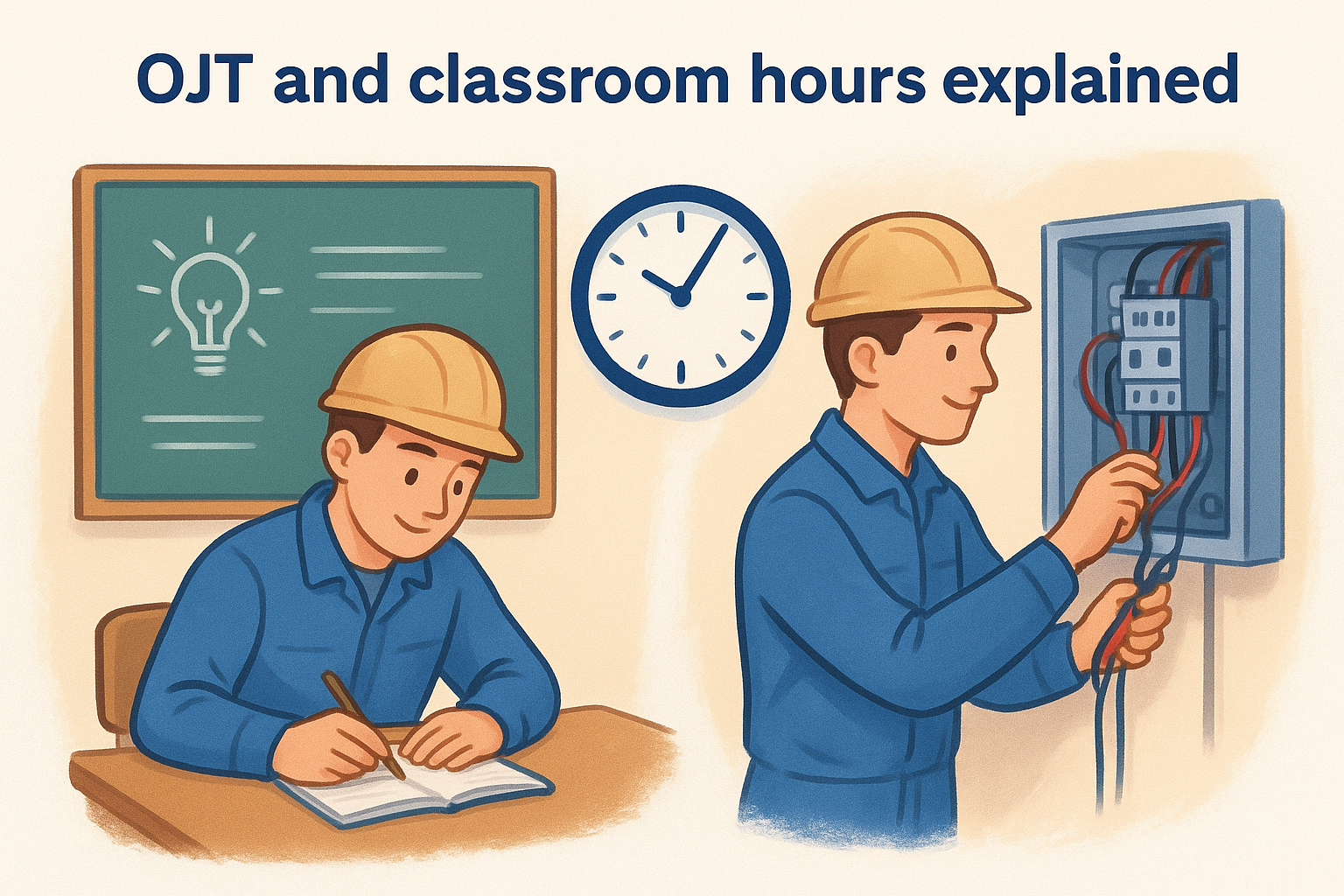
When people ask how long is electrician apprenticeship, they’re often surprised to learn it’s measured in hours, not just years. Your apprenticeship operates on a dual-track system combining hands-on work with formal education, and both components are mandatory for licensing. Understanding these hour requirements helps you plan your schedule and track your progress toward journeyman status.
The 8,000 hour on-the-job standard
Most states require 8,000 hours of documented on-the-job training before you can sit for your journeyman exam. This breaks down to approximately 2,000 hours per year if you’re working full-time at 40 hours per week. Your employer tracks these hours through verified work records or monthly reports submitted to your state licensing board. Some programs allow overtime hours to count toward your total, which can shorten your calendar timeline slightly, though the total hour requirement remains fixed.
Tracking your OJT hours accurately from day one prevents licensing delays and ensures you meet state requirements when you’re ready to test.
Classroom requirements vary by program
Your classroom instruction typically ranges from 576 to 1,000 total hours spread across your apprenticeship, depending on your state and the program you join. Most programs schedule classes during evenings or weekends, requiring 144 to 200 hours annually of attendance. Union apprenticeships and registered programs often lean toward the higher end of this range, while independent electrical contractors may offer the minimum required hours. Each class session covers code updates, electrical theory, and specialized topics like motor controls or renewable energy systems that you can’t fully learn on job sites alone.
What changes by state and license type
The answer to how long is electrician apprenticeship shifts considerably based on where you live and which license you’re pursuing. While the 4 to 5 year range holds true nationally, your state’s licensing board sets the exact hour requirements, and different license classifications have their own paths. Understanding these variations helps you plan realistically and avoid surprises when you’re ready to test.
State-specific hour requirements
States set their own minimum training hours, and the differences are significant. California requires 8,000 hours of supervised work, while states like Texas demand the same 8,000 hours but with different classroom minimums. Some states like Florida mandate 10,000 hours total, extending your apprenticeship by an additional year. Your state licensing board’s website lists the exact requirements, including whether they accept out-of-state hours if you relocate mid-apprenticeship. Reciprocity agreements between states vary widely, so transferring your progress isn’t guaranteed.
License types and their timelines
Different electrical specializations require different training lengths. A residential wireman license typically needs 4,000 to 6,000 hours, roughly half the commitment of a journeyman electrician license. Limited energy technicians working on low-voltage systems like fire alarms or security may complete apprenticeships in 2 to 3 years. Industrial electricians often face extended requirements due to the complexity of high-voltage systems and motor controls. Choosing your specialization early determines both your timeline and which job opportunities you’ll qualify for after licensing.
State requirements and license classifications directly impact your total training time, making it essential to verify your specific path before committing to an apprenticeship program.
Master electrician licenses add another 2 to 4 years beyond journeyman status, though this advanced credential involves supervision experience rather than formal apprenticeship hours.
How to plan your path and start faster
Knowing how long is electrician apprenticeship helps you make strategic decisions that accelerate your timeline without cutting corners. The fastest route involves choosing the right program upfront and maximizing every hour of training from day one. Smart planning reduces wasted time and positions you for earlier licensing, which directly translates to higher pay and better job opportunities.
Research programs before you apply
Your choice of apprenticeship program affects both quality and speed. Union programs like IBEW offer structured training with guaranteed classroom hours but may have waiting lists that delay your start date by six months or more. Independent contractor apprenticeships let you start immediately but require you to verify they’re registered with your state board. Community college partnerships provide the best of both worlds, combining formal education with employer connections that count toward your hours. Check whether programs accept transfer credits or previous electrical experience, as some states allow up to 1,000 hours of credit for related work or military training.
Start accumulating hours early
You can begin logging hours before formal apprenticeship registration in many states. Pre-apprentice programs and helper positions count toward your total if properly documented, shaving months off your timeline. Working for a licensed electrician while completing your application paperwork means you’re earning hours immediately rather than waiting for program acceptance. Track every hour meticulously using daily logs and weekly summaries your employer signs off on, because lost documentation can’t be recreated later.
Starting as a helper or pre-apprentice lets you accumulate credited hours while waiting for formal program acceptance, potentially shortening your overall timeline by six to twelve months.
Overtime hours accelerate your progress in states that count them toward your 8,000 hour requirement. A 50-hour work week accumulates hours 25% faster than standard schedules, though burnout risk increases with extended hours.
Next steps
Now that you know how long is electrician apprenticeship typically takes and what factors affect your timeline, your next move depends on where you stand today. If you haven’t started yet, research registered apprenticeship programs in your state and verify their licensing board approval before applying. Current apprentices should track your hours meticulously and set milestones for when you’ll hit 2,000, 4,000, and 6,000 hours to stay motivated.
Your licensing exam preparation should begin at least six months before you reach 8,000 hours. Study materials and practice tests help you identify weak areas in code knowledge or electrical theory that need extra attention before test day.
For more insights on career advancement and industry hiring trends, explore our blog for electricians and skilled trades professionals. We regularly publish guides on licensing requirements, salary expectations, and job market analysis that help you make informed decisions throughout your electrical career.
Want blue collar jobs delivered to your inbox?
Want blue collar jobs delivered to your inbox?
