
IBEW Apprenticeship Program: Requirements, Pay, And Steps
Becoming a union electrician through an IBEW apprenticeship program offers one of the most reliable paths into a skilled trade career. You earn while you learn, receive structured classroom instruction, and graduate with a journeyman license recognized across the country. It’s a proven route that thousands of electrical workers have taken to build stable, well-paying careers.
But getting in isn’t automatic. You’ll need to meet specific eligibility requirements, pass aptitude tests, and compete against other applicants for limited spots. Understanding exactly what’s expected, and how to prepare, gives you a real advantage.
This guide breaks down everything you need to know: who qualifies, what the application process looks like, how much apprentices earn, and what training involves. At bluecollarjobs, we connect tradespeople with opportunities across the electrical field, and an IBEW apprenticeship is often the first step toward those careers.
Why an IBEW apprenticeship can be a smart path
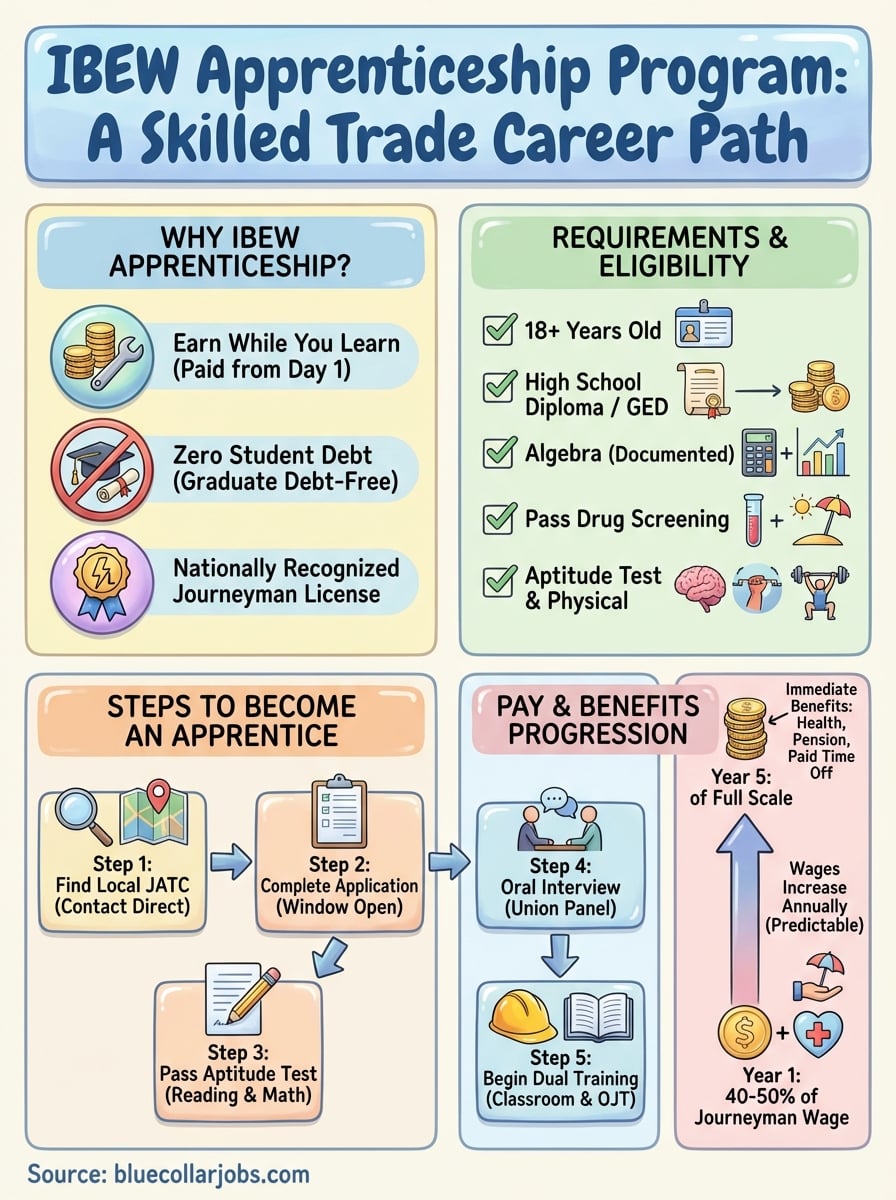
Choosing an IBEW apprenticeship program gives you immediate earning power without student debt. You start collecting a paycheck on day one, and your wages increase automatically as you complete each stage of training. Most apprentices graduate debt-free with five years of real-world experience already on their résumé.
Financial advantages from day one
Your income grows predictably throughout the program. First-year apprentices typically earn 40-50% of journeyman wages, which translates to $20-$25 per hour in most markets. By your final year, you’re making 80-90% of full scale, often exceeding $40 per hour before you even take your journeyman exam.
The average IBEW apprentice graduates with zero educational debt and five years of documented work experience.
Benefits packages start immediately in most IBEW programs. You receive health insurance, retirement contributions, and paid time off from the beginning. These aren’t privileges you wait years to access like in many corporate careers.
Union backing and job placement
IBEW locals actively place their apprentices with signatory contractors who agree to specific wage and safety standards. You’re not scrambling to find work between training sessions. The union handles job assignments, which means consistent employment throughout your apprenticeship.
Graduates hold a nationally recognized credential that transfers across state lines. If you move from Texas to Oregon, your IBEW journeyman status travels with you. Contractors know exactly what skills you bring because the training curriculum follows strict national standards.
Job security in union electrical work remains strong. Infrastructure projects, renewable energy installations, and commercial construction all require licensed electricians who meet code requirements. The IBEW network gives you access to these opportunities before non-union workers even hear about them.
IBEW apprenticeship requirements and eligibility
Every IBEW apprenticeship program sets clear baseline standards you must meet before your application gets reviewed. These aren’t suggestions or preferences. They’re mandatory minimums enforced by local unions nationwide, though some regions add extra requirements based on their specific market needs.
Basic qualifications you must meet
You need to be at least 18 years old and hold a high school diploma or GED. Some locals require one year of high school algebra with a passing grade, while others mandate proof of completion. Your transcript matters during the screening process.
Most IBEW locals require documented proof of high school algebra completion before you can sit for the aptitude test.
Drug testing happens at multiple stages. You’ll submit to a substance screening before acceptance, during training, and randomly throughout your apprenticeship. Failed tests result in immediate dismissal from the program without appeal options.
Physical and aptitude requirements
The aptitude test covers reading comprehension and algebra-based math. You need to score in the top percentile of applicants to advance to the interview round. Many locals only accept the highest-scoring candidates because spots are limited.
Physical demands include lifting 50 pounds regularly, working at heights, and standing for extended periods. You’ll need a valid driver’s license in most jurisdictions since job sites change frequently and public transportation isn’t always practical.
How to apply to an IBEW apprenticeship program
The application process for an IBEW apprenticeship program follows a structured timeline that runs differently in each local. You can’t apply year-round. Most locals open applications for two to four weeks once or twice annually, and missing that window means waiting six months to a year for the next cycle.
Find your local JATC
Your first step is identifying the Joint Apprenticeship and Training Committee (JATC) that covers your geographic area. Search for “IBEW local” plus your city or county name. Each JATC posts application periods, requirements, and contact information on their website.
Call the training office directly to confirm application dates and required documents. Don’t rely solely on website information, which sometimes lags behind current procedures. Ask specifically about prerequisite courses or materials you should study before the aptitude test.
Complete the application and testing process
You’ll submit your application packet during the designated window, which typically includes your high school transcript, birth certificate, and application fee ranging from $25 to $75. The JATC schedules your aptitude test several weeks after the application deadline.

High-scoring applicants advance to oral interviews where you explain your interest in the electrical trade and answer scenario-based questions.
Interview panels consist of union members and contractors who evaluate your communication skills and motivation. They rank all candidates, and the JATC extends offers based on available slots.
What you learn in IBEW apprenticeship training
Your IBEW apprenticeship program combines classroom instruction with hands-on work experience that runs simultaneously throughout the entire five-year program. You spend specific hours each week in formal education while working full-time on actual job sites. This dual approach builds both technical knowledge and practical skill at the same time.
Classroom education
You attend classes typically one or two evenings per week during the academic year, totaling around 180 to 200 hours annually. The curriculum covers electrical theory, National Electrical Code (NEC) updates, blueprint reading, and safety protocols that keep you compliant with OSHA standards.
IBEW classroom instruction follows a standardized national curriculum, which means your education meets the same quality benchmarks whether you train in Maine or California.
Math courses go beyond basic algebra into trigonometry and geometry needed for conduit bending calculations and load center sizing. Instructors are licensed journeymen or master electricians with decades of field experience who teach real troubleshooting techniques, not just textbook theory.
On-the-job training
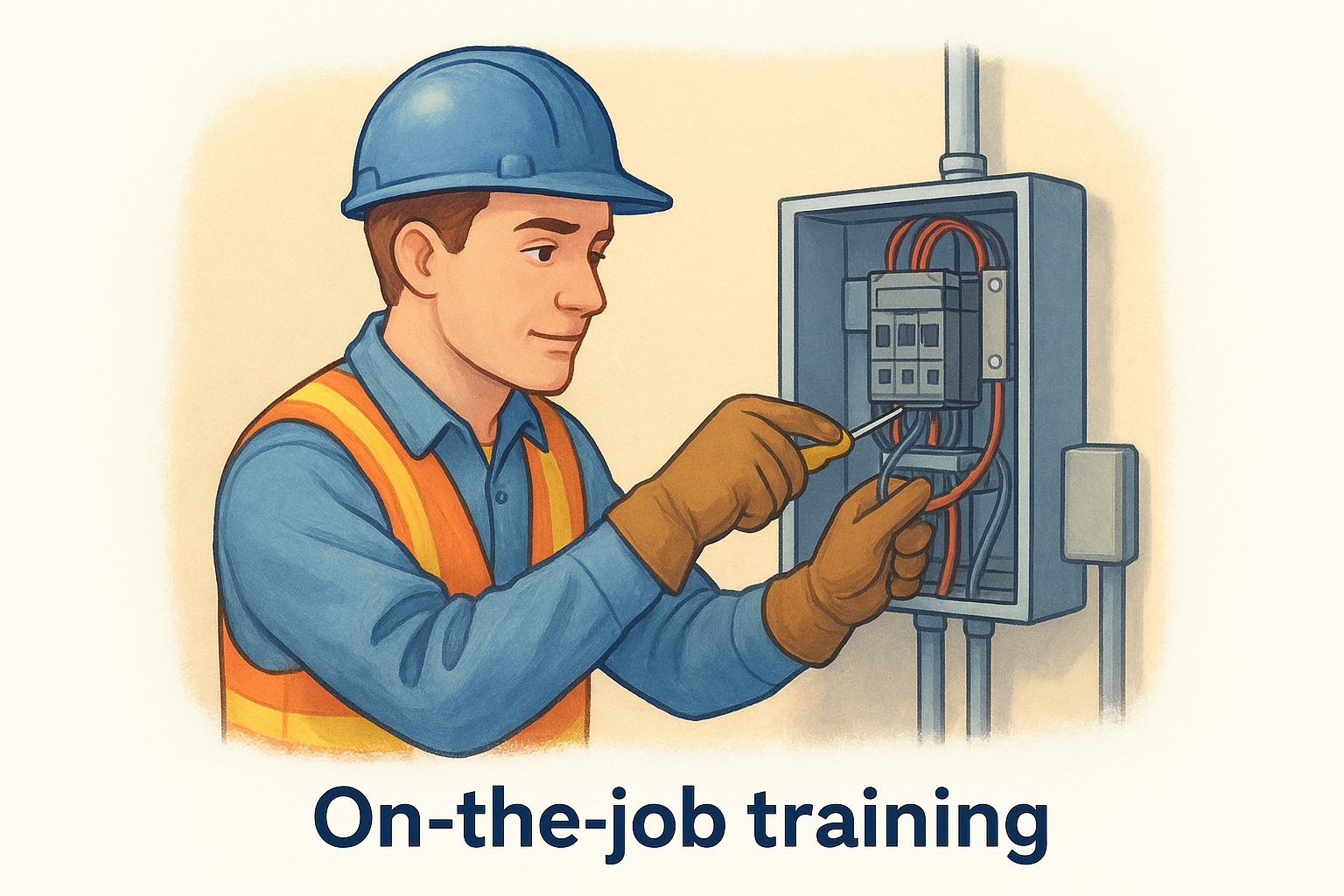
Field work gives you 8,000 hours of documented experience before you qualify for your journeyman exam. You rotate through different contractor assignments that expose you to residential wiring, commercial installations, and industrial systems. Each placement teaches specific skills like motor controls, fire alarm systems, or high-voltage distribution that round out your technical abilities.
IBEW apprenticeship pay and benefits
Your compensation in an IBEW apprenticeship program increases automatically as you advance through each year of training. The pay structure follows a predetermined scale tied directly to the journeyman rate in your local, which means your raises happen on schedule without negotiation. Benefits start immediately and mirror what journeymen receive from day one.
Starting wages and progression
First-year apprentices earn 40-50% of journeyman scale, which translates to $18-$25 per hour depending on your geographic region. Your wages jump to 50-60% in year two, then increase by roughly 10% annually until you reach 90% by your fifth year. A journeyman making $50 per hour means you start around $22 and finish near $45 before graduation.
IBEW apprentices receive predictable raises every six months or annually, giving you clear visibility into your earning potential throughout the entire program.
Benefits package
Health insurance coverage begins on your first day and extends to your family without the waiting periods common in non-union positions. Your employer contributes to a pension fund that builds retirement income separate from any personal savings you accumulate. Most locals also provide annuity programs that function like additional retirement accounts funded entirely by contractor contributions, not paycheck deductions.
Next steps
Your path to joining an IBEW apprenticeship program starts with researching your local JATC and marking their application window on your calendar. Don’t wait until the last minute. Review algebra concepts several weeks before the aptitude test, gather required documents like your high school transcript and birth certificate, and prepare for the oral interview by practicing clear answers about your interest in the electrical trade.
Contact the JATC office directly to confirm application deadlines and ask about study materials they recommend. Some locals offer pre-apprenticeship courses that strengthen your candidacy and improve your test scores.
Once you complete your apprenticeship and earn your journeyman license, you’ll need consistent opportunities to build your career. BlueCollarJobs connects electrical professionals with openings across all trades and experience levels. Browse our blog for more insights on advancing in skilled trades and finding the right path after graduation.
Want blue collar jobs delivered to your inbox?
Want blue collar jobs delivered to your inbox?
