
Getting into the plumbing trade starts with one critical step: understanding the plumber apprenticeship requirements before you apply. Every state sets its own rules around age minimums, education, and registration, and missing even one box can delay your start by months. Whether you’re fresh out of high school or switching careers, knowing exactly what’s expected of you upfront saves real time and frustration.
A plumbing apprenticeship typically lasts four to five years and combines paid on-the-job training with classroom instruction. You’ll work under a licensed plumber, learn local building codes, and build the hours needed to eventually sit for your journeyman exam. It’s a structured path with clear milestones, but the entry requirements, things like minimum age, high school diploma or GED, and physical fitness standards, vary depending on the program and state.
This guide breaks down every requirement you need to meet, step by step, so you can move forward with a plan. At bluecollarjobs, we connect trade professionals with employers across the country, and we regularly see apprentice-level plumbing positions posted by companies actively looking to train new talent. If you’re serious about starting this career, understanding the requirements covered below is your first real move.
What a plumbing apprenticeship is
A plumbing apprenticeship is a formal, earn-while-you-learn training program that takes you from zero experience to a fully qualified plumber over four to five years. You spend the majority of that time working on actual job sites under the supervision of a licensed journeyman or master plumber, and you supplement that hands-on work with classroom instruction covering theory, codes, and safety. Unlike a trade school program where you pay tuition and then look for work, an apprenticeship pays you a wage from day one while you build the skills and documented hours required to sit for your journeyman license exam.
How the program is structured
Most apprenticeship programs in the United States are sponsored by one of two types of organizations: a local union affiliate (typically through the United Association of Plumbers and Pipefitters) or an independent, non-union contractor group. Both formats follow a similar structure. You sign up as an apprentice, get placed with a sponsoring employer, and work under a licensed plumber while completing a set number of hours each year. Alongside the field work, you attend technical classes, usually evenings or weekends, that cover pipe systems, hydraulics, local building codes, and blueprint reading.
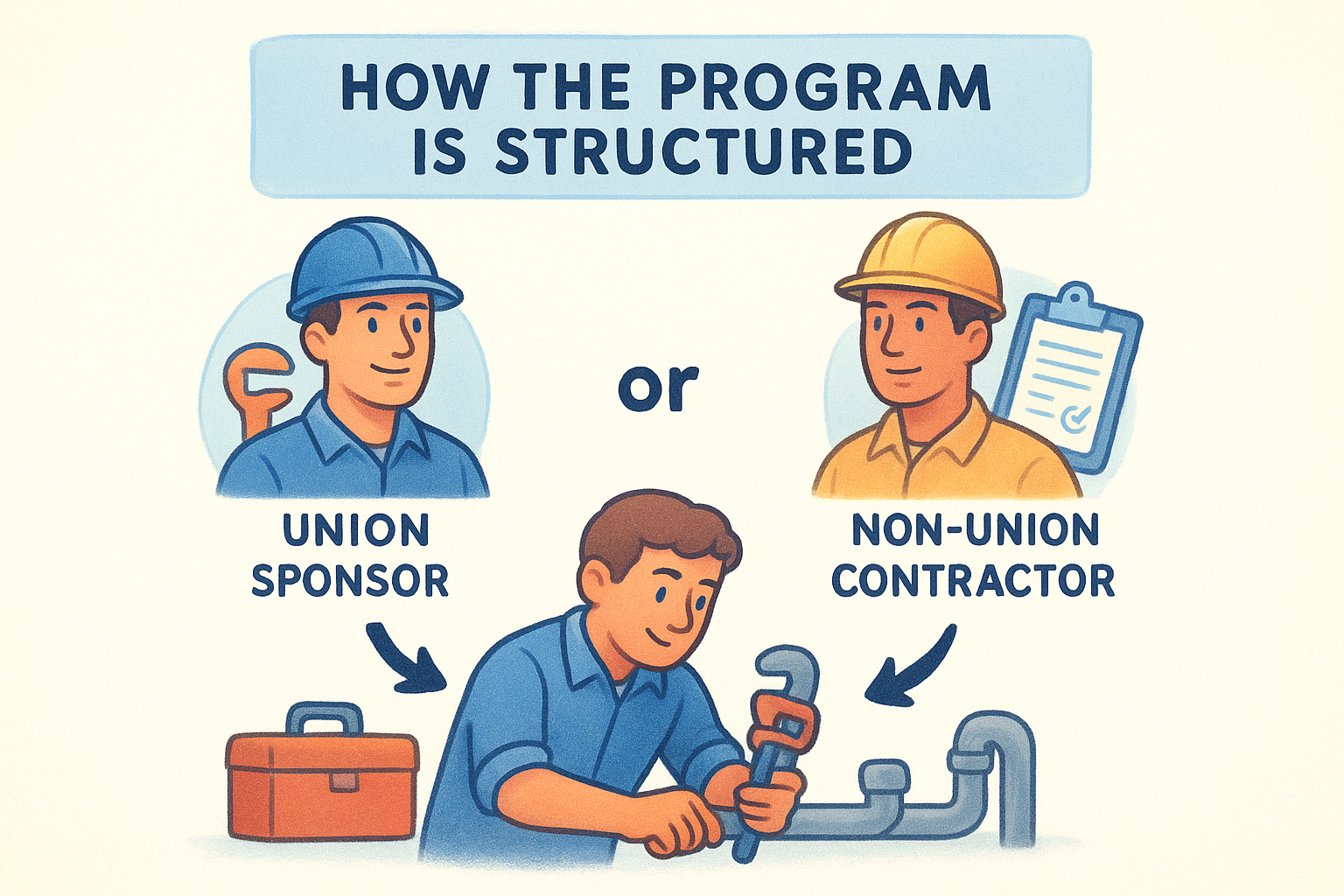
The key distinction between a union and non-union apprenticeship is not the quality of training but the wage scale, benefits structure, and contractor relationships that come with each path.
The programs are typically broken into one-year segments, called periods, and your pay rate increases at each step. By the time you complete all periods and pass your final competency reviews, you will have logged 2,000 hours or more per year in field training and hundreds of classroom hours on top of that.
What you actually do during an apprenticeship
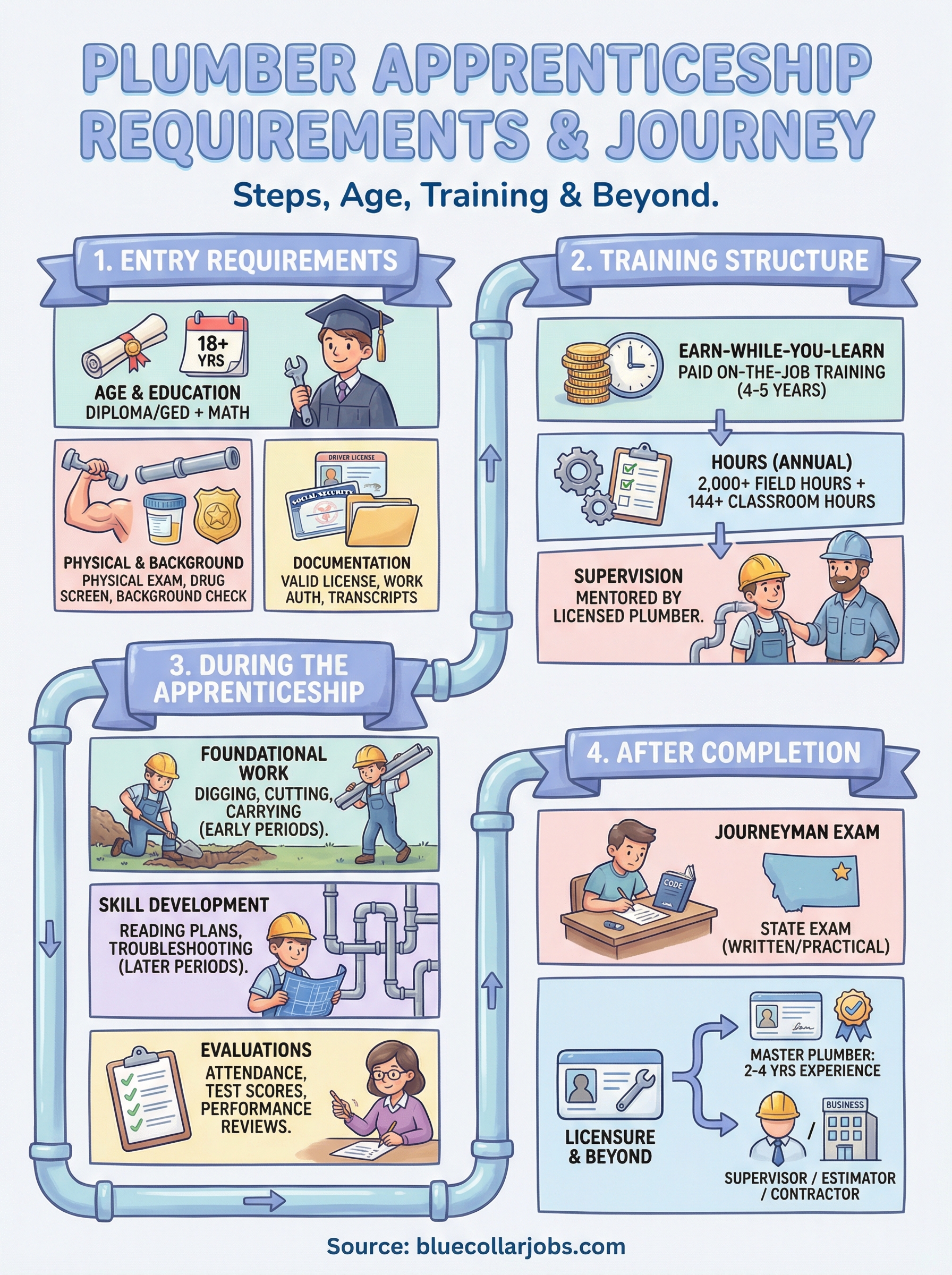
During the early periods, your work is foundational. You’ll be digging trenches, cutting and threading pipe, and carrying materials while you watch experienced plumbers handle the more complex tasks. As your skills develop, your responsibilities grow. By your third or fourth year, you’ll be reading plans, running your own sections of a job, and troubleshooting systems with minimal supervision.
The plumber apprenticeship requirements you’ll encounter throughout this process are not just about showing up. Program sponsors evaluate your attendance, your test scores, and your on-the-job performance at every period review. If you miss too many class sessions or fall behind on your hour documentation, you can be held back or removed from the program entirely. Taking the administrative side seriously from the beginning keeps you on track and moving forward on schedule.
Plumber apprenticeship entry requirements
Before you submit your application, you need to confirm that you meet the baseline plumber apprenticeship requirements set by the sponsoring organization and your state. Most programs share a common set of minimum standards, and missing even one can get your application rejected before anyone reviews your experience or background.
Age and education
Most programs require you to be at least 18 years old at the time of application. Some states allow 16-year-olds to enter pre-apprenticeship tracks, but the standard registered apprenticeship almost universally starts at 18. On the education side, you’ll need a high school diploma or a GED in every case. Programs also frequently ask for proof of one completed semester of algebra or an equivalent math assessment, since pipe sizing, pressure calculations, and layout work all rely on basic math skills.
If you don’t have a math credit on your transcript, many community colleges offer a short algebra course that satisfies this requirement at minimal cost.
Physical and background requirements
Plumbing is physically demanding, and most programs require you to pass a physical examination confirming you can lift heavy materials, work in confined spaces, and stay on your feet for extended shifts. You’ll also need to pass a drug screening before your placement begins. Some programs run a background check as well, though a prior record doesn’t automatically disqualify you. The program typically reviews the nature and timing of any offenses on a case-by-case basis.
Beyond the health and background checks, you’ll need a valid driver’s license and reliable transportation, since job sites are rarely accessible by public transit. Bring your Social Security card, proof of legal work authorization, and your diploma or GED certificate to your interview. Having these documents organized before you apply shows the program coordinator that you’re ready to start without delays.
How to find and apply for an apprenticeship
Once you’ve confirmed you meet the plumber apprenticeship requirements, your next move is finding a program that’s actively accepting applicants. Two primary sources cover the majority of registered apprenticeship opportunities in the United States: union-affiliated programs and non-union contractor associations. Knowing where to look cuts your search time significantly.
Where to look for programs
The U.S. Department of Labor’s ApprenticeshipUSA website lists registered apprenticeship programs by trade and state, and it’s the most reliable starting point for any candidate. You can filter by plumbing, check which sponsors are currently enrolling, and pull contact information and enrollment timelines directly from the site. Local union halls affiliated with the United Association of Plumbers and Pipefitters are another strong option, particularly if you want a structured wage progression and benefits package from day one.
If a program isn’t listed on a government or union site, verify its credentials with your state’s apprenticeship agency before you apply.
Independent contractor associations, such as the Plumbing-Heating-Cooling Contractors Association, also run their own accredited training programs. These non-union paths work well if you prefer flexibility in employer placement or live in a region where union programs carry long waitlists.
What the application process looks like
Most programs open applications on a fixed schedule, often once or twice per year, so timing matters. You’ll typically submit a completed application form, your high school diploma or GED transcript, and proof of your math credit. Some programs add an aptitude test covering basic math and reading comprehension before they invite you to an interview.
Your interview is straightforward. The committee wants to confirm you understand the commitment you’re making, that you can communicate clearly, and that you’ve gathered the required documents in advance. Showing up with organized paperwork and a direct answer on why you want to work in the trade puts you ahead of candidates who treat the interview as a formality.
Training hours, classroom work, and supervision
The training structure is one of the most concrete parts of the plumber apprenticeship requirements you’ll work through. Most registered programs require 2,000 field hours per year, which adds up to 8,000 to 10,000 total hours across the full four-to-five-year program. Every hour needs to be documented by your supervising journeyman or master plumber and submitted to your program sponsor on a regular schedule.
Field hours and what counts
Your field hours must be earned on active job sites under direct supervision of a licensed plumber. Time spent commuting, attending general safety briefings unrelated to your trade, or working outside your classification typically does not count toward your documented total. Your sponsor will give you a timesheet or an online logging system to record your hours, and both you and your supervisor need to sign off on each entry.
Keep your own copy of every signed hour log. Disputes over missing documentation can delay your advancement to the next period.
Classroom instruction
Alongside your field work, you’ll complete 144 or more classroom hours per year through your program’s technical training component. These sessions cover pipe materials, water pressure calculations, drainage systems, local and national plumbing codes, and blueprint and isometric drawing interpretation. Some programs deliver these classes in person at a union hall or training center, while others use hybrid formats with online coursework and in-person labs.
Test scores in these classes carry real weight. Program coordinators track your academic performance alongside your field hours, and falling below passing thresholds can hold you back from advancing to the next period. Treating the classroom work with the same seriousness you give your on-site shifts keeps both components on track, since your sponsor reviews both before signing off on your progression to the following year.
Licensing, exams, and moving up after apprenticeship
Completing every hour and classroom credit in the plumber apprenticeship requirements gets you to the finish line of your training, but it doesn’t automatically make you a licensed plumber. Once your program sponsor confirms you’ve satisfied all documented hours and passed your final period reviews, the next step is sitting for your journeyman plumber exam in the state where you intend to work.
The journeyman exam
Every state administers its own licensing exam, and the format varies. Most tests include a written component covering local plumbing codes, pipe sizing calculations, drainage principles, and safety regulations. Some states also require a practical skills demonstration. You’ll need to submit your completed training records and proof of program completion along with your exam application, so keeping your hour logs organized throughout your apprenticeship directly affects how quickly you can apply.
Check your state’s licensing board website for the exact exam format, fees, and scheduling windows before your final apprenticeship period ends.
Study materials aligned to your state’s adopted plumbing code are your best preparation resource. Many journeyman candidates use the codebook itself as an open-reference tool during the exam, which means familiarity with how the code is organized matters as much as memorizing specific rules.
What comes after journeyman
Earning your journeyman license lets you work independently on most plumbing systems without constant supervision. From there, career advancement typically follows one of two tracks: accumulating additional years of field experience to qualify for a master plumber license, or moving into supervisory and estimating roles within a plumbing contractor. A master plumber license requires passing a more advanced exam and, in most states, two to four years of journeyman-level work experience after you pass your initial exam. Some plumbers also pursue business licensing to run their own contracting operation, which adds a separate layer of state registration requirements depending on your location.
Next steps
You now have a complete picture of what plumber apprenticeship requirements involve, from the age and education minimums at the front end to the journeyman exam and master license path at the far end. Every piece of this process has a specific sequence, and understanding that sequence before you apply puts you ahead of most first-time candidates. Gather your documents early, confirm your state’s registration rules, and identify the programs in your area that are currently accepting applications.
Finding the right employer to sponsor your training is a practical next step you can take today. Apprentice-level plumbing positions are listed regularly by contractors and companies looking to bring on new talent and train them directly. Browse current openings and filter by trade and location at BlueCollarJobs.com to find employers actively hiring in your area. The job posting is already out there. Your move is to apply.

https://shorturl.fm/kzg8I