
If you’ve been scrolling through indeed plumbing jobs listings lately, you already know the situation: hundreds of posts, half of them outdated, and a lot of noise from unrelated roles. Indeed is massive, and that’s both its strength and its biggest problem. Finding local plumbing work that actually matches your skill level, pay expectations, and certifications can eat up hours you don’t have.
Here’s the thing, the plumbing trade is hiring aggressively right now. The Bureau of Labor Statistics projects steady demand through the decade, and contractors across the country are competing for licensed plumbers. The jobs are out there. But the way most people search for them is broken. They type a keyword, pick a city, and hope for the best. That approach leaves quality opportunities buried under sponsored posts and stale listings.
That’s exactly why we built bluecollarjobs.com, a job board made specifically for skilled trades like plumbing, HVAC, and electrical work. We cut the white-collar clutter and let you filter by trade, experience level, and location from the start. But whether you’re using Indeed, our platform, or both, the tips below will help you work smarter. This article breaks down 10 practical strategies to speed up your plumbing job search, land more interviews, and stop wasting time on listings that go nowhere.
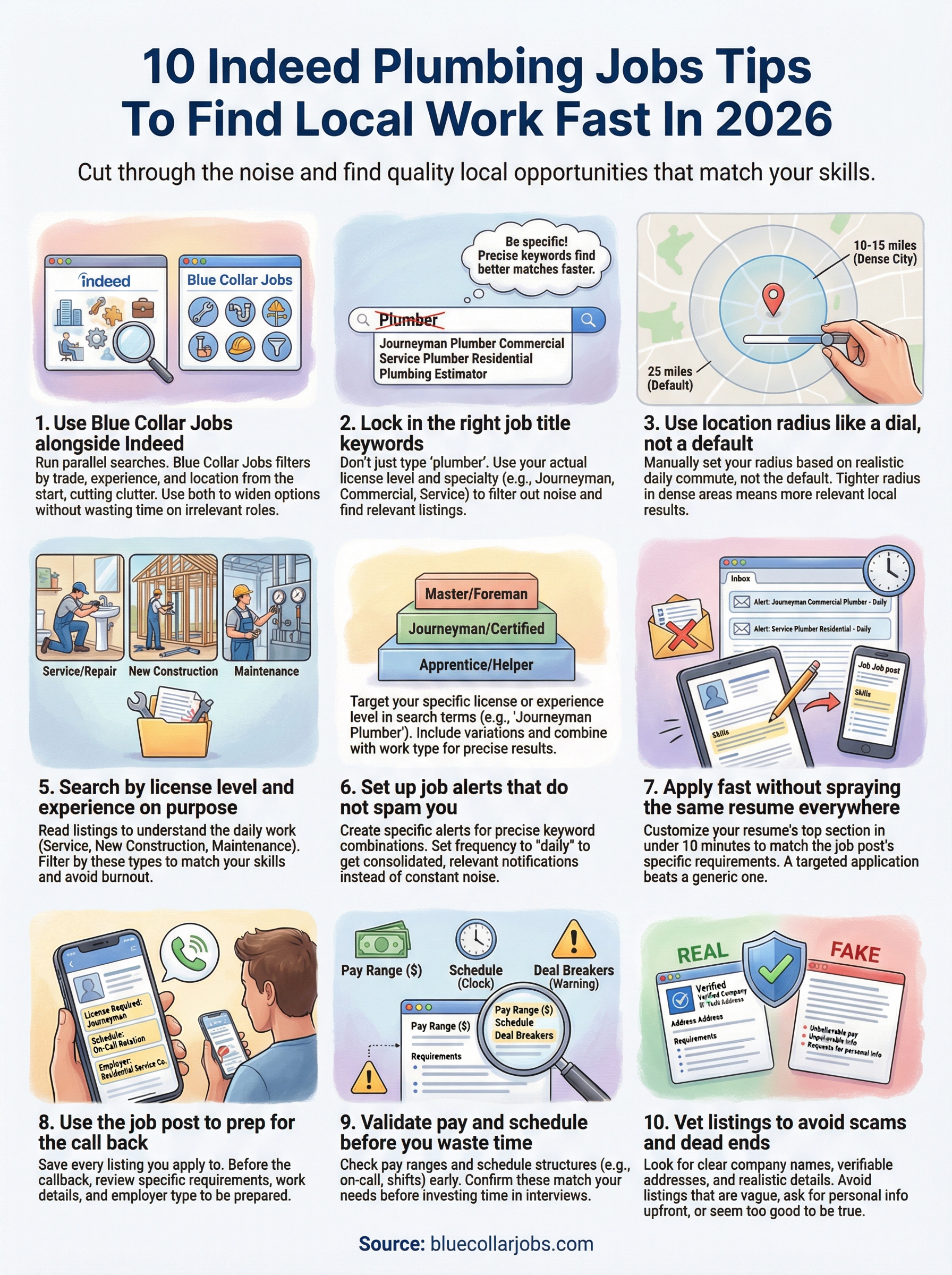
1. Use Blue Collar Jobs alongside Indeed
Indeed aggregates listings from across the web, which means you’re sifting through general labor posts, staffing agency reposts, and white-collar adjacent roles that don’t belong in your search. Running a parallel search on bluecollarjobs.com while you browse indeed plumbing jobs keeps your options wide without wasting your attention on roles that don’t fit the trade. Both platforms have value, but they work differently, and combining them puts you ahead of candidates who rely on just one.
What to do
Open both platforms at the same time. On Blue Collar Jobs, filter by Plumbing under trade category, then set your state or region. On Indeed, use the keyword strategies covered later in this article. Check both feeds daily, especially early in the week when employers tend to post new openings. Save or bookmark any listing worth revisiting so you aren’t re-searching the same ground twice.
Here’s a simple workflow to keep both searches organized:
- Set your Blue Collar Jobs trade and location filters once, then bookmark the results URL
- Run your Indeed search with saved alerts (covered in Tip 6)
- Review new postings on both platforms each morning before 9 AM
- Apply the same day to any listing that matches your license level and target pay range
Why it speeds up local results
Blue Collar Jobs is built around trade-specific categories and geographic filters, which means listings are already pre-sorted before you touch a single filter. On Indeed, a plumbing search can surface results from counties two hours away or from industries you’ve never worked in. Blue Collar Jobs limits results to what you actually do, which cuts your daily review time significantly.
The less time you spend filtering out irrelevant listings, the more time you spend reading the ones worth applying to.
That speed advantage compounds across a full week of searching. If you’re reviewing 50 listings on Indeed and 20 on Blue Collar Jobs, there’s a strong chance those 20 are higher-quality matches. Fewer listings reviewed with better precision beats more listings reviewed with poor signal every time, especially when you’re trying to land interviews fast.
When to prioritize it over Indeed
Prioritize Blue Collar Jobs when you hold a specific license or certification, like a Journeyman or Master Plumber credential, because those experience-level filters are built directly into the platform. Employers who post there tend to be smaller shops and regional contractors actively seeking licensed tradespeople, not applicants who happened to stumble onto the right search term. If salary transparency matters to you, Blue Collar Jobs prominently displays pay ranges in search results, so you know the range before you click a single listing.
2. Lock in the right job title keywords
The search term you type changes everything. Most plumbers type "plumber" and stop there, which floods your results with unrelated posts, broad labor listings, and roles that require zero trade experience. Choosing precise keywords before you search cuts through that noise and surfaces the listings actually worth your time on indeed plumbing jobs and elsewhere.
What to do
Start by matching your search term to your actual job title or license level. If you hold a Journeyman license, search "journeyman plumber" rather than just "plumber." If you specialize in commercial work, add that word to the query. The more specific your term, the tighter the results, and the less time you spend skipping over posts that don’t apply to you.
The right keyword doesn’t just find more jobs, it finds the right ones faster.
Keyword combos that pull better matches
Some combinations consistently outperform single-word searches. Try pairing your specialty or license level with a work setting to get sharper results.
| Keyword Combo | Best Use |
|---|---|
| Journeyman plumber commercial | Licensed plumbers targeting commercial contractors |
| Plumber apprentice helper | Entry-level candidates without full licensure |
| Master plumber foreman | Experienced plumbers seeking leadership roles |
| Service plumber residential | Technicians focused on home repair and maintenance |
| Plumbing estimator | Those moving toward office-side or project roles |
Mistakes that hide good listings
Typing only a trade name without any qualifier is the most common mistake. It pulls every seniority level into one pile, making it hard to spot relevant roles. Another mistake is using abbreviations or informal terms like "plumbing tech" or "pipe fitter" interchangeably, since employers don’t post consistently. Run multiple searches with different keyword combos rather than assuming one search covers all available postings.
3. Use location radius like a dial, not a default
Indeed defaults to a 25-mile radius, and most job seekers never touch it. That setting works fine in some markets but completely misrepresents what’s available in dense cities or rural regions. Treating the radius as an active variable rather than a fixed starting point gives you real control over the results you see when searching indeed plumbing jobs, and it prevents you from missing solid local opportunities hiding just outside an arbitrary boundary.
What to do
Go into your location filter and manually set the radius before every new search, not just once when you first set up your account. Base it on how far you’re genuinely willing to drive for daily work, not on what seems reasonable from a map. If you’re in a high-density city, a 10-mile radius often returns more results than you can realistically review. If you’re in a rural area, you may need 50 miles just to surface a handful of relevant listings.
Your radius should match your real commute limit, not the platform’s guess at it.
How radius changes job quality and commute
A wide radius pulls in listings that look strong on screen but translate into 90-minute drives each way. That commute adds up fast and can make an otherwise good job unsustainable within months. A tight radius gives you an honest picture of your immediate local market, which helps you decide whether to negotiate harder on pay, look at relocating, or expand your search intentionally rather than by accident.
Quick radius settings for common situations
Use this table as a starting benchmark and adjust based on your actual daily drive tolerance and how active the local market is.
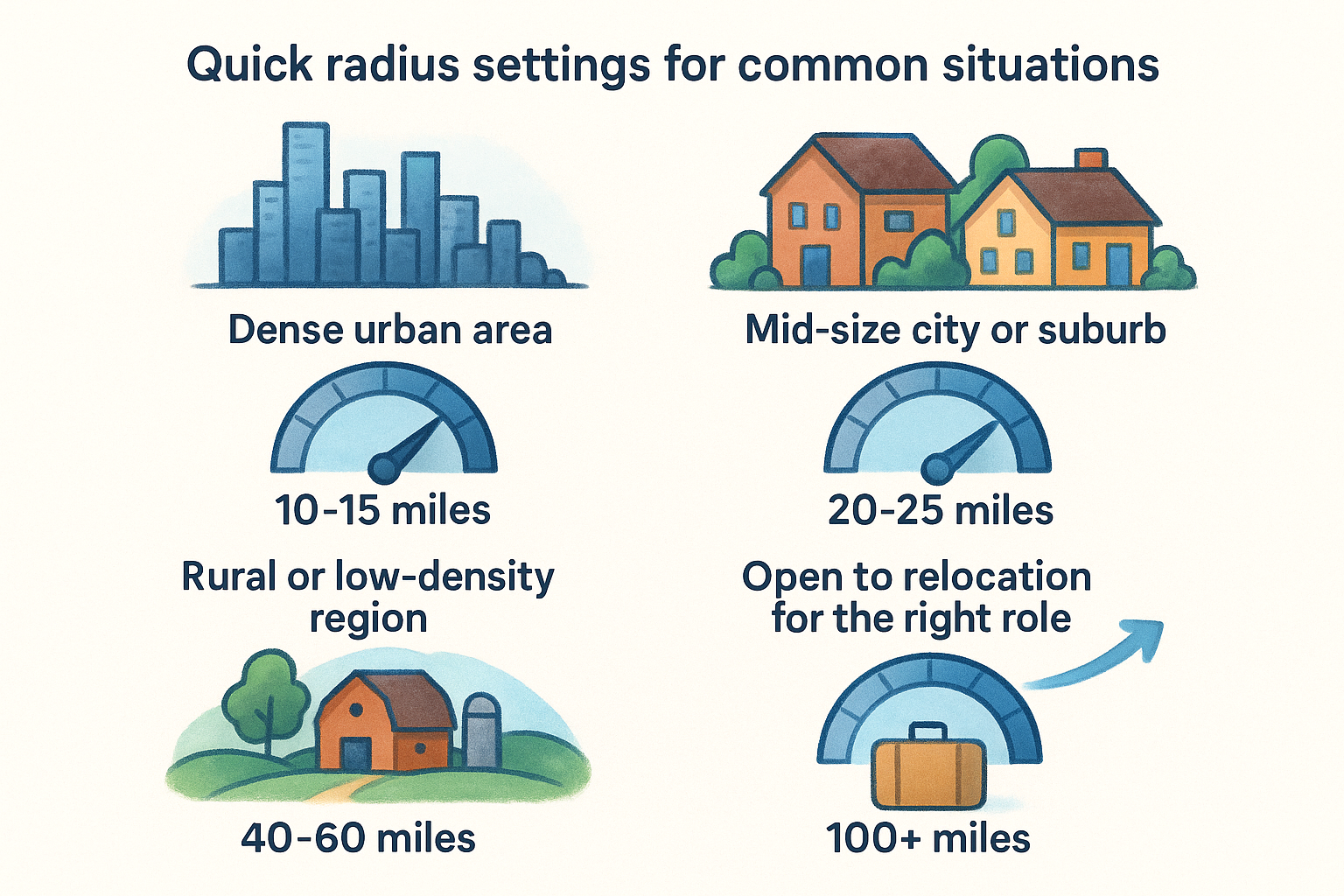
| Situation | Suggested Radius |
|---|---|
| Dense urban area (LA, Houston, Chicago) | 10-15 miles |
| Mid-size city or suburb | 20-25 miles |
| Rural or low-density region | 40-60 miles |
| Open to relocation for the right role | 100+ miles |
4. Filter for the work type you actually want
Not all plumbing work is the same, and a service call in a residential home looks nothing like roughing in pipe on a new commercial build. When you search indeed plumbing jobs without filtering by work type, you end up reading listings that technically match your trade but not your day-to-day reality. Narrowing by work type early saves you from interviewing for jobs that would burn you out in a matter of months.
What to do
Read every listing past the title before you apply. Look for language that tells you what the daily work actually involves, not just what license or certification they want. On Indeed, you can add terms like "service," "commercial," or "new construction" directly into the search bar to pre-filter results before you touch any other setting. Use this quick checklist when reviewing any listing:
- What type of work dominates the role (repair, install, maintenance)?
- What is the primary work environment (residential, commercial, industrial)?
- Does the schedule match your availability (shift work, on-call, standard hours)?
How to separate service, new construction, and maintenance
Each work type attracts a different kind of employer and daily environment. Here’s how to identify them fast using the language in the posting:
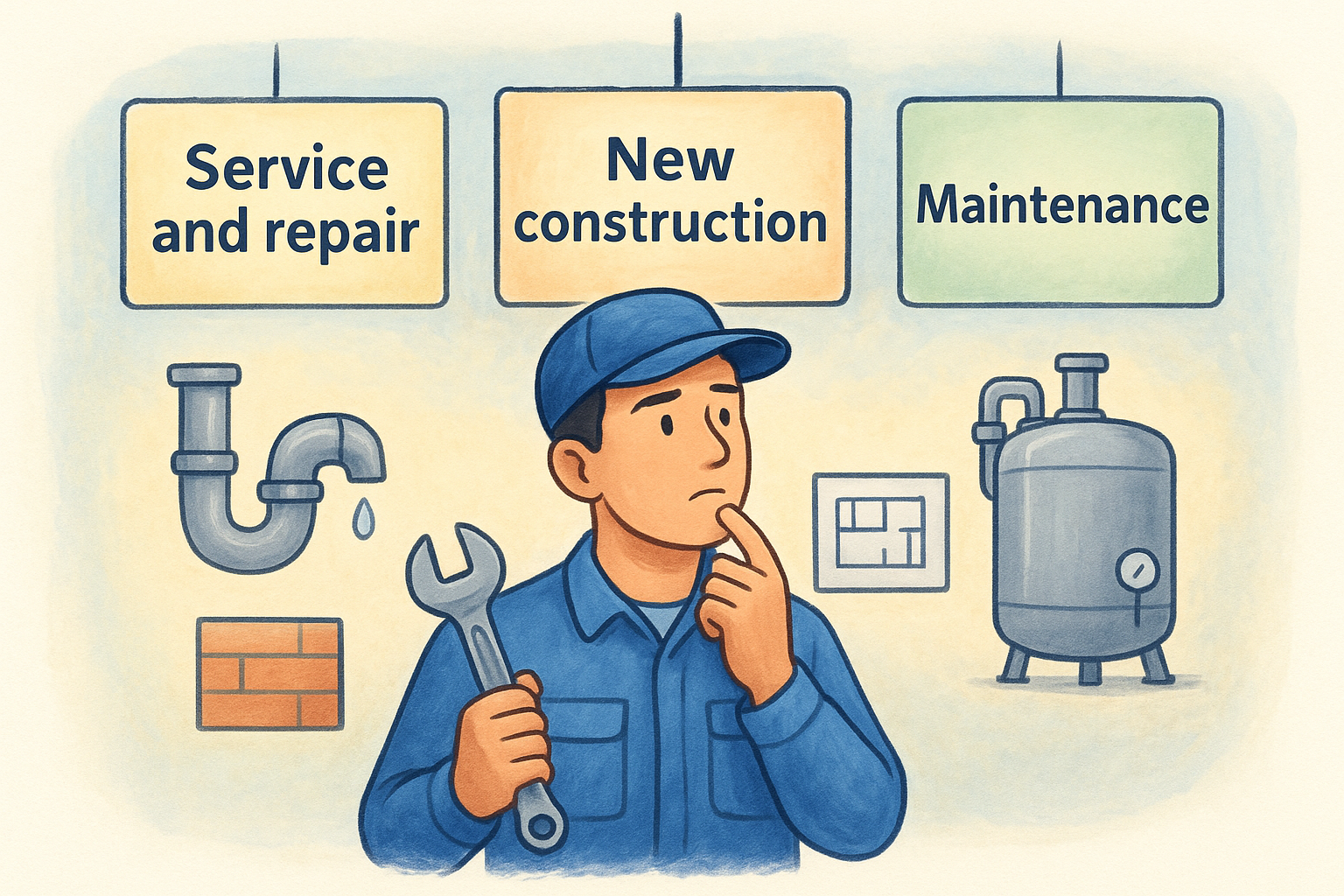
| Work Type | Key Indicators in the Posting |
|---|---|
| Service and repair | "service calls," "troubleshooting," "residential," "on-call" |
| New construction | "rough-in," "ground-up," "blueprints," "commercial build" |
| Maintenance | "facility," "preventive maintenance," "institutional," "hospital" |
Maintenance roles often come with more predictable schedules, while service work typically involves variable call volumes and direct customer contact.
The job title tells you the trade; the job description tells you the actual job.
Red flags in vague job types
Some postings deliberately avoid specifying work type because the employer wants flexibility to move you across multiple sites or roles without committing to one clear description. Watch for listings that use only generic phrases like "all plumbing duties" or "various tasks as assigned" with no breakdown of what the day actually looks like.
If a posting can’t tell you what you’ll be doing, ask directly before you invest time in the application. A real employer with a real role can answer that question without hesitation.
5. Search by license level and experience on purpose
Most plumbers search by trade and location, then sort through whatever comes back. That approach works until you’re a licensed Journeyman reading through apprentice-level listings that pay half what you’re worth. Targeting your license level intentionally in your search terms filters out mismatched roles before they ever reach your screen, saving you real time when browsing indeed plumbing jobs.
What to do
Add your license level or experience tier directly to your search query. Instead of searching "plumber near me," search "journeyman plumber" or "master plumber" depending on where you stand in the trade. Combining your license level with a work type, like "journeyman plumber service" or "master plumber commercial," narrows results even further so the listings you read are actually relevant to what you bring to the table.
Terms that map to apprentice, journeyman, master
Employers don’t always use consistent language, so knowing the common variations helps you catch every relevant listing.
| Experience Level | Common Terms in Postings |
|---|---|
| Apprentice / Entry | "helper," "apprentice," "trainee," "entry-level plumber" |
| Journeyman | "licensed plumber," "journeyman," "journeyman plumber," "certified plumber" |
| Master / Senior | "master plumber," "lead plumber," "foreman," "plumbing supervisor" |
Running separate searches for each variation ensures you don’t miss listings where employers swapped the standard term for something looser.
Check all variations in a single session rather than assuming one search covers the full picture. Employers post inconsistently, and a single keyword sweep rarely captures everything.
How to handle listings with unclear requirements
Some postings skip license requirements entirely and just say "experience required." When that happens, check the pay range first, because compensation usually signals the expected level. A posting offering $35 to $45 per hour likely wants a licensed tradesperson, not a helper. If the listing still isn’t clear, call before applying and ask directly what certification the role requires. That single call saves you from submitting an application that goes nowhere.
6. Set up job alerts that do not spam you
Job alerts sound useful until your inbox fills with 20 irrelevant listings every morning and you start ignoring all of them. Setting alerts correctly on Indeed means you get notified only about postings worth opening, not every tangentially related result that happens to trigger a keyword match.
What to do
Go to Indeed, run your best keyword search for indeed plumbing jobs with your location and radius set exactly as you want them, then save that search as an alert. Set the delivery frequency to daily, not immediately, so you receive one consolidated email instead of individual pings every time a new post goes live. Use this setup checklist before saving any alert:
- Name each alert after the specific keyword so you know what it covers without opening the email
- Start with no more than three active alerts to keep your inbox manageable
- Review and refresh your alert settings every two weeks as your search evolves
Alert settings that catch new local postings fast
Use one alert per keyword combination rather than one broad alert that tries to cover everything. A journeyman plumber in a large metro might run three separate alerts: one for "journeyman plumber commercial," one for "service plumber residential," and one for "licensed plumber." That approach keeps each alert tight and focused without too much overlap across your daily emails.
Specific alerts return specific results; broad alerts return noise.
How to fix irrelevant alerts
If an alert keeps pulling in listings that don’t match your trade or experience level, edit the keyword rather than deleting the alert and starting over. Narrowing the radius by 10 miles often changes result quality significantly. You can also exclude terms on Indeed by adding a minus sign before a word in the search bar before saving, so a Journeyman searching for service roles could add "-helper" to drop entry-level posts from every alert automatically.
7. Apply fast without spraying the same resume everywhere
Speed matters when a strong listing goes up on indeed plumbing jobs, but submitting the exact same resume to every posting without any adjustment is a fast way to get ignored. Employers hiring for skilled trades read dozens of applications, and a generic document that could apply to any shop rarely makes it past the first review. The goal is to move quickly and still make the application feel like it was written for that specific role.
What to do
Pull up the job posting before you open your resume file. Read the full description once to identify the two or three requirements the employer emphasizes most, such as a specific license, a work setting, or a particular skill. Then make one targeted adjustment to your resume summary or skills section that reflects exactly what they called out. That single change takes less than ten minutes and puts your application ahead of the stack of unmodified submissions.
A targeted application that takes 10 minutes beats a generic one that takes 30 seconds, every time.
What to customize in under 10 minutes
Focus your edits on the top third of your resume since that’s what employers read first. Swap one or two bullet points to lead with experience that matches the posting’s priority, whether that’s commercial rough-in, residential service calls, or facility maintenance work. Mirror the language in the posting when describing your skills, because many employers search submitted resumes for specific terms before reading them manually.
Common application mistakes that cost callbacks
Sending a resume with a generic objective statement like "seeking a plumbing position" signals that you didn’t read the posting. Another common problem is leaving out your license type and number, which forces the employer to follow up just to confirm basic qualifications. Both mistakes delay the callback or eliminate you before the phone ever rings.
8. Use the job post to prep for the call back
Most plumbers apply and then mentally move on, treating the callback as a fresh conversation. That’s a missed opportunity. The job post you found through indeed plumbing jobs or any other source is a direct preview of what the employer cares about most, and reading it carefully before the call puts you ahead of every candidate who forgot the details the moment they hit submit. Preparation before the callback is free and fast, and it shows the employer you’re serious without you having to say so directly.
What to do
Screenshot or save every listing you apply to, either as a PDF or in a notes folder on your phone. Employers and recruiters often call within 24 to 48 hours of posting a new role, which means the listing may already be altered or removed by the time your phone rings. Keeping a local copy ensures you can pull up the exact details in seconds rather than scrambling for context while someone waits on the other end of the line.
Details to pull from the posting before you apply
Before you submit anything, extract the specific requirements and work details that tend to surface immediately in a callback. Capture these three areas every time:

- License and certification requirements so you can confirm yours match what they listed
- Work environment and schedule specifics like shift structure, on-call expectations, or travel
- Employer type, whether it’s a residential service company, commercial contractor, or facility maintenance team
Knowing the posting cold turns a callback from a surprise into a conversation you already know how to navigate.
What to ask when the employer calls
Use the call to confirm anything the posting left vague, particularly around pay structure and start date. Ask about the first 90 days, including how new hires get onboarded and what tools or materials the company supplies. Those two questions signal that you’re evaluating the role seriously, not just accepting whatever comes first.
9. Validate pay and schedule before you waste time
Pay and schedule problems are the most common reasons a plumber accepts a job only to leave within three months. Before you invest time in interviews, you need to confirm the actual compensation structure and daily schedule match what you’re looking for. Skipping this step on indeed plumbing jobs listings means you can easily spend a week pursuing a role that pays less than your current situation or requires hours that don’t work for your life.
What to do
Look at the pay range and schedule details in the posting before you write a single word of your application. If the listing doesn’t include pay, that’s information too; it usually means the employer wants to anchor the conversation before you set expectations. Make a quick note of the schedule structure, whether the role is standard 40-hour weeks, rotating shifts, or on-call, so you know what you’re walking into before the phone call.
How to read pay ranges, commission, and weekly pay
Pay ranges on job boards often reflect the full possible window, not what a new hire actually starts at. The bottom number is typically your realistic starting point, not the top. Some postings combine hourly pay with commission or performance bonuses, which can look attractive on screen but add income instability depending on call volume or sales targets.
A wide pay range tells you the employer has flexibility; it also means you need to negotiate early rather than hoping the offer lands near the top.
Deal breakers to confirm early
On-call requirements and weekend rotations are the most commonly misunderstood parts of a plumbing role, and they rarely appear in bold on the listing. Confirm overtime expectations, tool allowances, and whether the company provides a vehicle before you spend two hours in an interview for a role that doesn’t fit your situation.
10. Vet listings to avoid scams and dead ends
Not every listing you find when browsing indeed plumbing jobs represents a real job at a real company. Some posts come from staffing agencies that haven’t filled a role in months, others are fabricated to collect personal information, and some are legitimate listings from companies that already hired someone and never removed the post. Knowing how to spot these problems before you apply saves your time and protects your personal information.
Signs a posting is real and staffed by a real shop
A legitimate employer leaves clear signals in the posting itself. The company name is specific, not generic. The description includes actual license requirements, a named service area, and a realistic pay range. Look up the company name before you apply; a real plumbing shop will have a website, a Google Business Profile, or at minimum a verifiable phone number tied to a physical address.
| Indicator | What It Means |
|---|---|
| Named company with verifiable address | Real employer, not a placeholder post |
| Specific license requirements listed | Employer knows exactly what the role requires |
| Realistic pay range tied to experience | Legitimate offer, not a bait listing |
| Contact name or direct email included | Someone actual is managing the hire |
What to do if something feels off
If a listing promises unusually high pay with no clear requirements, treat it as a warning sign. Plumbing pays well, but a post offering significantly more per hour than every comparable listing without asking for any credentials is not a real offer.
A real employer can answer basic questions about the role in under two minutes; one who can’t probably isn’t running a real shop.
Never send personal documents like your Social Security number or banking details through a job platform before you’ve spoken with the employer by phone and confirmed their business exists. If you can’t verify the company after a quick search, skip the listing and move on.
Next steps
Searching through indeed plumbing jobs takes discipline, but the 10 tips in this article give you a clear, repeatable system to follow every day. Pick two or three strategies that match your current situation and put them into practice today before moving on to the rest. The plumbers who land interviews fastest are the ones who act immediately on what they find, not the ones who spend another week adjusting their filters without submitting a single application.
Your next move is straightforward. If you want to cut straight to listings built specifically for the trade, browse plumbing jobs on Blue Collar Jobs where every posting is already filtered by trade, experience level, and location before you touch a single setting. No general labor clutter, no vague postings that eat up your morning. The right role is available right now, and you have everything you need to go find it.

https://shorturl.fm/zBBCv
https://shorturl.fm/d0BEv