
If you’ve ever wondered what is a welding job, the short answer is: it’s a skilled trade career where you join metal parts together using heat, pressure, or both. But that one-liner barely scratches the surface. Welding covers a wide range of roles, from structural work on skyscrapers to underwater pipeline repairs, each with its own set of tools, techniques, and certifications.
Welding is also one of the trades where demand stays consistently strong. Infrastructure projects, manufacturing plants, shipyards, and energy companies all need welders, and many struggle to fill open positions. That gap between supply and demand means solid pay, real job security, and clear paths for advancement for people willing to learn the craft.
In this guide, we break down what welders actually do day-to-day, what you can expect to earn, the different career paths available, and how to get started. Whether you’re exploring your first trade or considering a switch, bluecollarjobs is built to help you find the right fit, we list welding and other skilled trade positions across every U.S. state, so you can move from research to applications in one place.
What a welding job includes
When people ask what is a welding job, they usually expect a simple answer involving a torch and some sparks. The reality is more involved. A welding job requires you to read and interpret technical blueprints and weld symbols, select the right process and materials for the task, and consistently produce joints that meet strict quality standards. You’re not just melting metal together. You’re responsible for structural integrity that can affect buildings, vehicles, pipelines, and more.
Core technical skills
Every welding role expects you to bring a working knowledge of metallurgy and heat control. Different metals behave differently under heat, and welding the wrong way can weaken a joint or warp an entire structure. You need to know how to set up equipment, maintain a steady hand or machine feed, and inspect your own work. Quality control is part of the job, not an afterthought, because welds on critical projects often get tested with X-rays, ultrasound, or pressure checks before anyone signs off.
The ability to read a weld symbol on a blueprint is one of the most underrated skills a welder can have, and employers notice it immediately.
Strong attention to detail and physical endurance are also part of the package. Many welding jobs require you to weld overhead, in tight spaces, or for extended shifts while wearing heavy protective gear.
Welding processes you’ll encounter
Most welding jobs involve one or more of four main processes. Each one suits different materials and applications:
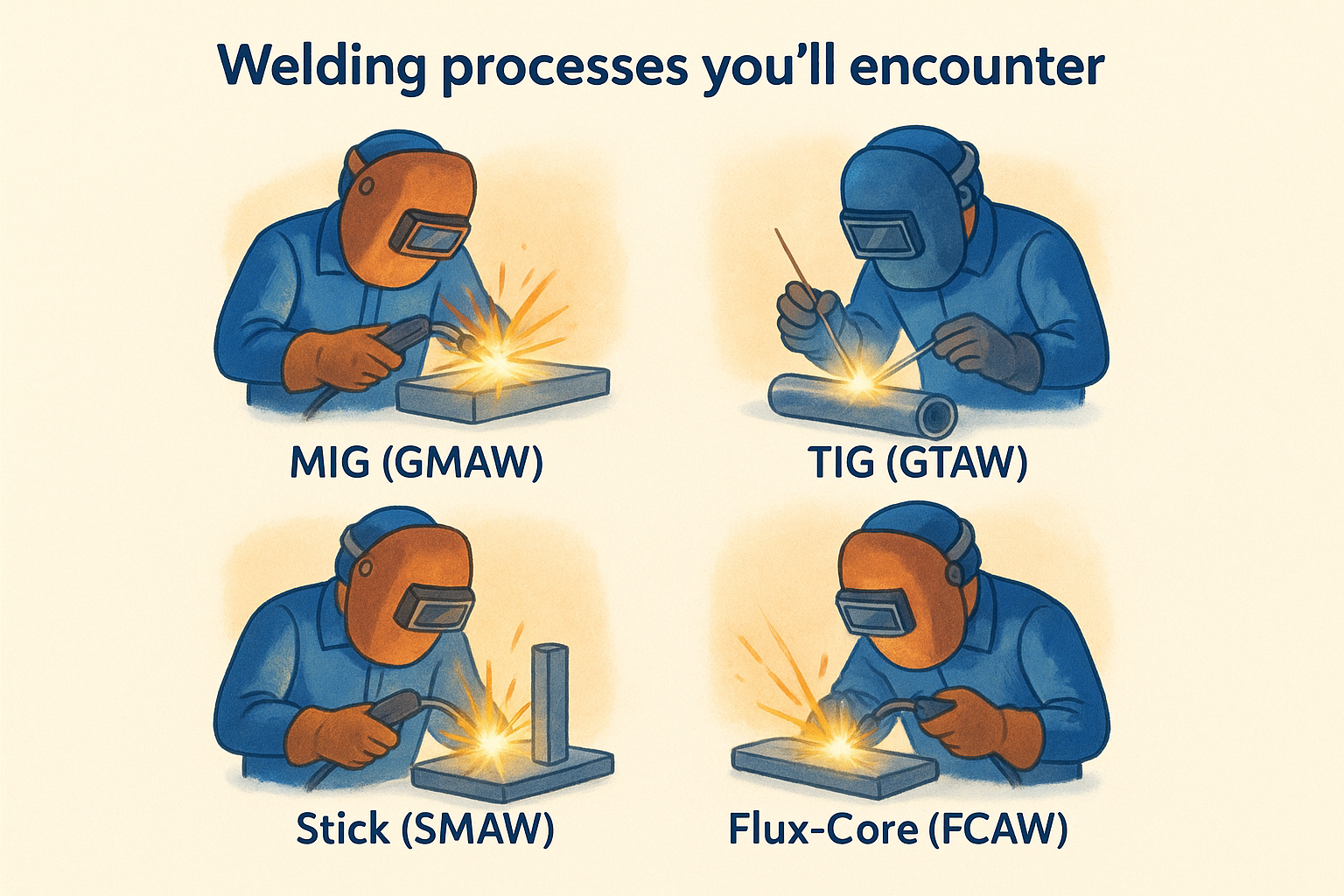
- MIG (GMAW): Fast, versatile, and common in automotive and manufacturing work
- TIG (GTAW): Precise and clean, used for stainless steel and aluminum in aerospace or food-grade equipment
- Stick (SMAW): Reliable outdoors and on structural steel, popular in construction and pipework
- Flux-Core (FCAW): Similar to MIG but better suited for thicker metals and windy outdoor conditions
Knowing more than one process makes you significantly more competitive when applying for positions. Many employers prefer welders who can switch between methods depending on the project requirements, and that flexibility often leads to higher pay.
Certifications that open doors
Your certifications directly affect which jobs you can apply for and what rate you can command. The American Welding Society (AWS) offers widely recognized credentials, with the Certified Welder (CW) program being one of the most common starting points. From there, you can pursue specialized certs in structural welding or pipe welding, or work toward specific code qualifications like D1.1 for structural steel. Some positions in aerospace or energy require additional qualification testing before you touch a torch on the job.
Daily duties and work settings
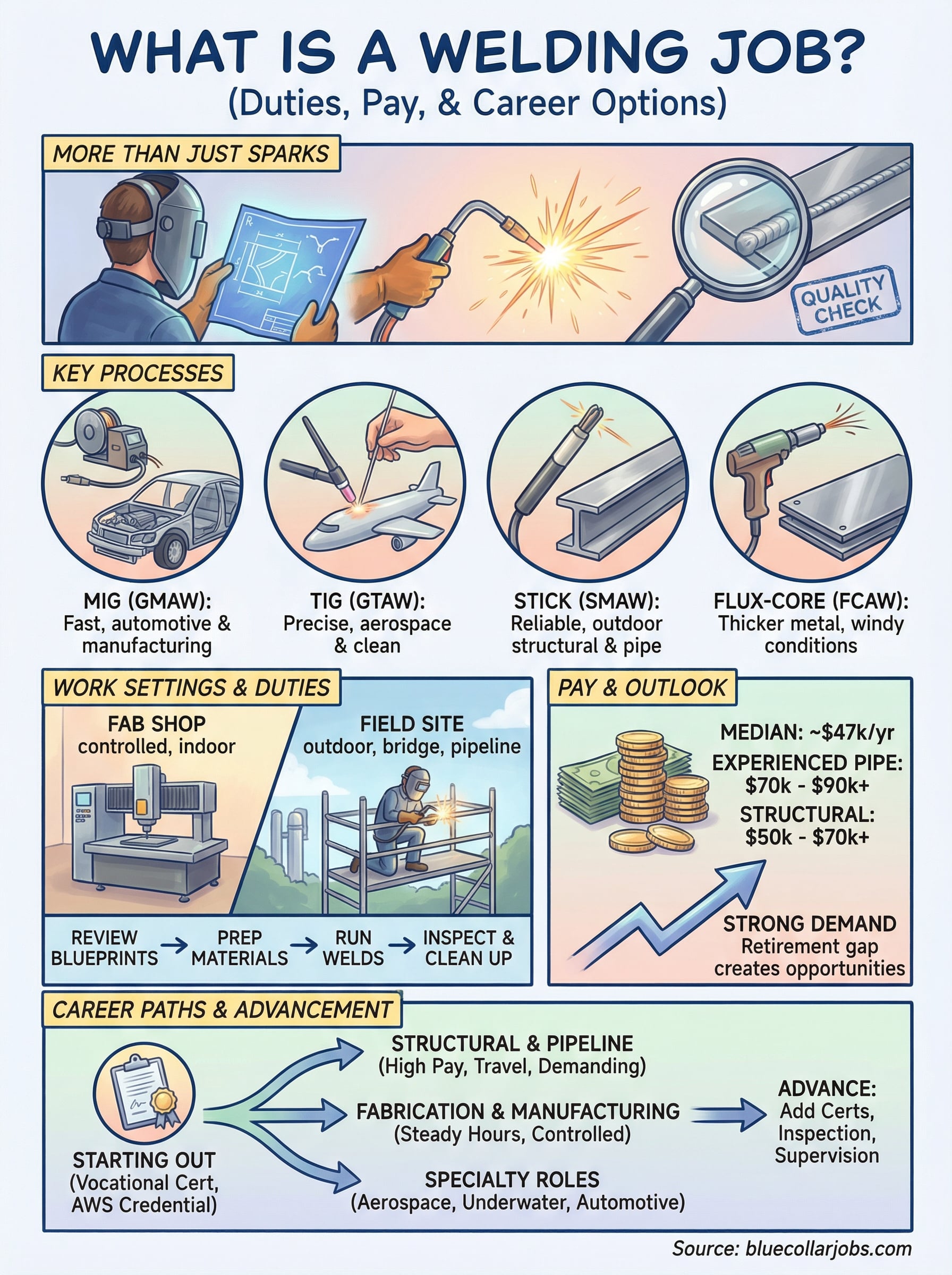
Understanding what is a welding job on a daily basis means looking past the certifications and into the actual work. Your shift typically starts with reviewing work orders and blueprints, then gathering the right equipment, protective gear, and consumables for the task ahead. You spend most of your time positioning metal components, running welds, and inspecting your finished joints for flaws before moving on. Cleanup, equipment checks, and logging completed work round out the typical day.
Where welders work
Your work setting depends heavily on your specialty and the type of employer you work for. Manufacturing and fabrication shops offer a more controlled environment with consistent hours, climate-controlled floors, and predictable workflow. Structural and pipeline welders work outdoors on job sites, often dealing with weather, heights, and physically demanding conditions. Shipyard welders frequently work in cramped hull sections or dry docks, while industrial maintenance welders move through plants and facilities repairing equipment on the fly. Travel is common in some pipeline and shutdown roles, where you follow the work across regions for weeks at a time.
The setting you choose affects everything from your daily physical demands to your take-home pay, so it’s worth thinking through before you commit to a specialty.
Physical and safety demands
Welding is physically demanding, and ignoring proper precautions leads to injuries fast. You wear heavy personal protective equipment including a welding helmet, gloves, and flame-resistant clothing throughout your entire shift. Many positions require you to weld in awkward positions, such as overhead, on scaffolding, or inside confined spaces for hours at a time. Following lockout/tagout procedures, ventilation standards, and fire safety protocols is non-negotiable on any serious job site.
Pay, hours, and job outlook
When you ask what is a welding job worth financially, the honest answer is: it depends. Your certifications, specialty, and work setting play a bigger role in your earning potential than almost anything else. Entry-level fabrication and high-demand pipeline roles exist within the same trade but can pay vastly different wages, so understanding that spread before you commit to a path matters.
What welders earn
According to the Bureau of Labor Statistics, the median annual wage for welders, cutters, solderers, and brazers sits around $47,000. That number does not reflect the ceiling. Experienced welders in high-demand sectors regularly earn considerably more depending on their specialty and willingness to travel:
- Structural welders: $50,000 to $70,000+
- Pipe welders (energy/industrial): $70,000 to $90,000+ with overtime
- Entry-level fabrication: $35,000 to $42,000
Certifications in multiple welding processes give you real negotiating leverage when you apply for positions that compete for qualified candidates.
Hours and job outlook
Your schedule depends heavily on the industry you join. Manufacturing and fabrication shops typically offer steady 40-hour weeks with predictable hours and a consistent work environment. Pipeline and shutdown welders, by contrast, often work 50 to 60 hours per week during active projects, which pushes annual income considerably higher through overtime pay. Travel is common in those roles, which suits some workers and rules it out for others.
The long-term outlook for the trade is strong. The Bureau of Labor Statistics projects steady demand through the decade, driven by infrastructure investment and domestic manufacturing. The bigger factor working in your favor is the retirement gap: a large portion of experienced welders are aging out, and the pool of incoming talent has not kept pace. Fewer qualified candidates means more open positions and faster hiring for workers who show up with the right skills and credentials.
Types of welding jobs and specialties
Part of understanding what is a welding job is recognizing that the title covers a wide range of distinct roles. Your specialty determines your work environment, earning potential, and the certifications you’ll need to pursue, so choosing a direction early helps you build the right skill set faster.
Structural and pipeline welding
Structural welders work on buildings, bridges, and heavy equipment, typically using Stick or Flux-Core processes on carbon steel. The work is physically demanding, often outdoors, and requires you to follow strict welding codes like AWS D1.1. Pipeline welders operate in the energy sector, joining sections of oil, gas, or water lines under tight tolerances. These roles frequently involve travel and extended project schedules, which is why they rank among the highest-paying positions in the trade.
Pipeline welding certifications are some of the most valuable credentials you can hold, and they typically require passing a rigorous qualification test before you start any production work.
Manufacturing, fabrication, and specialty roles
Fabrication welders work in shop environments building components from raw metal stock, usually with MIG or TIG processes depending on the material. The hours are consistent and the environment is more controlled than field work, which suits workers who prefer stability over travel. Specialty roles expand the options further:
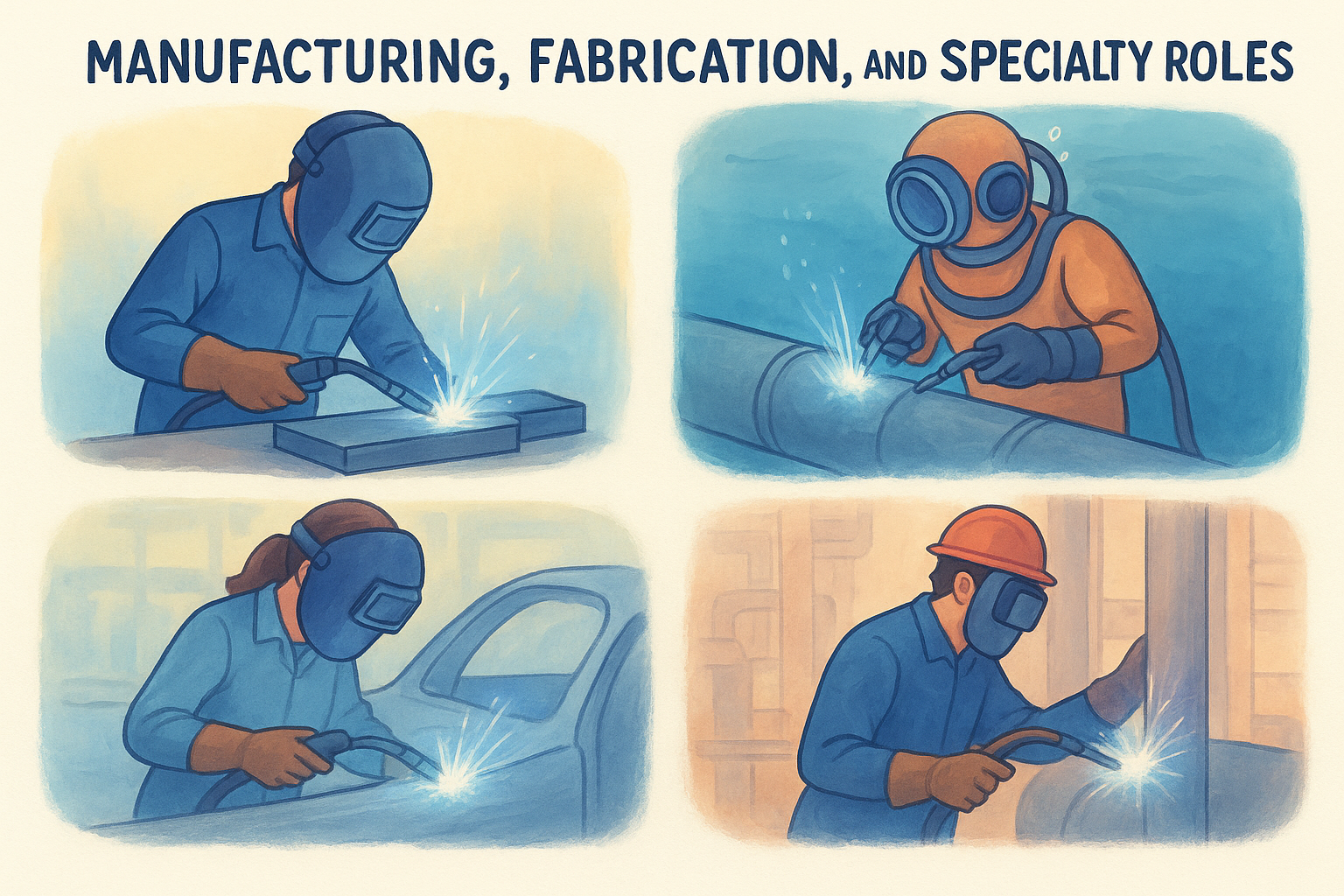
- Aerospace welding: TIG-heavy work on aluminum and titanium with tight quality requirements
- Underwater welding: Requires commercial diving certification on top of welding qualifications
- Automotive welding: Focuses on body panels and frames, often in manufacturing plant settings
- Maintenance welding: Repair-focused work inside industrial plants, refineries, or large facilities
Each path rewards different combinations of skill and certification, so targeting one early gives your training a clear direction.
How to start and move up in welding
Understanding what is a welding job on a practical level includes knowing how to enter the trade and grow within it. Most welders start through a vocational program or community college, where you can earn a welding certificate in six months to a year. These programs cover core processes like MIG and Stick, basic blueprint reading, and safety standards, giving you enough foundation to pass an entry-level qualification test and start working.
Building your entry-level credentials
Your first certification matters more than your first job title. Pursuing an AWS Certified Welder credential gives hiring managers a concrete way to evaluate your skills, and it signals that you’ve been tested against an industry standard. Many employers also hire through apprenticeship programs tied to unions or contractor associations, which pay you while you train and often lead directly to full-time placement.
- Get certified in at least two welding processes before applying
- Target entry-level fabrication or maintenance roles to build hours
- Keep a written log of every process, position, and material you weld
Advancing your career over time
Moving up in welding comes down to adding certifications and accumulating verifiable experience. Once you have a few years in the field, you can pursue pipe welding qualifications, structural codes, or specialty endorsements that push your earning potential considerably higher.
Welders who document their qualifications and keep certifications current consistently land better opportunities faster than those who rely on experience alone.
Beyond field roles, many experienced welders transition into welding inspection, supervision, or quality assurance, which requires additional credentials like the AWS Certified Welding Inspector designation but opens up new responsibilities and higher pay without the same physical demands of daily production work.
Next steps
Now you have a clear picture of what is a welding job across every level, from entry-level fabrication to high-paying pipeline roles. The trade rewards people who stay certified, build hours across multiple processes, and target specialties that match their schedule and income goals. Your next move is straightforward: get your first certification, identify the specialty that fits your life, and start applying to positions that match your current skill level.
Finding the right role gets easier when you’re looking in the right place. Bluecollarjobs.com lists welding and skilled trade openings across every U.S. state, organized by trade, experience level, and location, so you spend less time sorting through irrelevant listings and more time applying to positions that actually fit. Whether you’re just starting out or looking to move into a higher-paying specialty, browse current welding job listings and take the next step in your trade career today.

https://shorturl.fm/ZENjZ
https://shorturl.fm/iVzWf