

What you earn as an HVAC technician depends heavily on where you work. The gap between the highest and lowest-paying states can be $30,000 or more per year, which makes understanding HVAC technician salary by state essential before you accept a job offer or plan a relocation.
We built bluecollarjobs to help skilled trade workers like you find roles that match your experience, certifications, and salary expectations, with full pay transparency upfront. HVAC is one of the most in-demand trades we list, and compensation questions are consistently the top concern among technicians browsing our job board.
This guide breaks down 2026 hourly and annual HVAC technician pay across all 50 states. You’ll see where the money is strongest, which states fall behind, and what factors, like cost of living and licensing requirements, actually influence your take-home pay. Use it to make a smarter career move, whether that’s negotiating a raise or targeting a new market entirely.
1. Blue Collar Jobs salary ranges by state
Before you dig into any national average, it helps to look at what employers are actually paying right now in your target state. Aggregated data lags the market by months. Live job listings on bluecollarjobs.com show you what companies are posting today, which gives you a more accurate baseline when you research hvac technician salary by state.
What salary info you can pull from live listings
Every HVAC listing on bluecollarjobs includes the pay range the employer is willing to offer, not a blended average from a survey conducted six months ago. You can see whether a company is offering $22 an hour or $38 an hour for the same job title in the same city, which tells you immediately what the local market looks like. Many listings also specify pay type (hourly, salary, or piece-rate) and whether overtime is expected, so you know the structure before you ever apply.
Real-time job postings give you a negotiation edge that salary surveys simply cannot match.
How to filter HVAC jobs by state, level, and license
The bluecollarjobs search filters let you narrow results by state and then layer on experience level and license type. If you hold a Journeyman or Master license, filtering to those tiers immediately removes entry-level listings that would skew your expectations downward. You can also sort by employment type if you want to compare what full-time roles pay versus contract work in the same region.
Here is a quick breakdown of the filters worth using together:
- State + Trade: Start here to isolate your actual market
- Experience level: Choose Apprentice, Journeyman, Master, or Foreman to match your credentials
- License type: Listings often specify required certifications, so filter to roles that match what you hold
- Employment type: Full-time, part-time, and contract listings often carry different base pay structures
What to watch for in posted ranges and pay types
Wide pay ranges in a single listing usually signal that the employer has flexibility and is testing the market. A range like $24 to $42 per hour often means the lower end is for someone entering the role and the upper end is for a candidate who brings specific certifications or commercial experience. Narrow ranges indicate the company has a fixed budget and less room to negotiate. Also check whether the posted rate is base pay only or includes a per-diem, truck allowance, or tool stipend, because those add-ons can shift total compensation by $5,000 to $10,000 annually.
2. National HVAC pay snapshot for 2026
Understanding the national baseline helps you interpret hvac technician salary by state data accurately. Before you compare state figures, you need to know what the country-wide numbers actually mean and where your current or target pay sits relative to the field.
Average annual pay vs median pay and why they differ
The national median annual salary for HVAC technicians in 2026 sits around $58,500, while the average lands closer to $63,000. The gap exists because a smaller group of highly paid commercial and industrial techs pulls the average upward. Median is the more useful number for most technicians since it reflects what the middle earner actually takes home, not what the top 10% earns.
Use the median as your floor when negotiating, not your ceiling.
Typical hourly rates and how overtime changes take-home pay
Hourly rates nationally range from roughly $20 at the entry level to $38 or more for experienced Journeymen and Masters. The important piece most technicians overlook is overtime. Many HVAC roles, especially in residential service, carry significant overtime hours during peak seasons. A technician earning $27 per hour base who logs 15 overtime hours per week from June through August can add $10,000 or more to annual earnings during those months alone.
Seasonal demand means your W-2 total will often exceed what a straight hourly calculation suggests.
Benefits and perks that materially raise total compensation
Base pay tells only part of the story. Employer-paid health insurance, retirement matching, and vehicle allowances can add $8,000 to $15,000 in annual value depending on the company. Tool stipends, phone allowances, and paid training for certification renewals are common in larger firms and offset real out-of-pocket costs. When you evaluate any offer, calculate total compensation, not just the hourly rate, before you decide.
3. 2026 HVAC technician salary by state
The numbers below give you a working baseline for hvac technician salary by state across the entire country. These figures reflect 2026 market data and represent median pay for a Journeyman-level technician working full-time.
State-by-state table with hourly and annual pay
Use this table to quickly locate your state and compare it against neighboring markets. All figures represent median Journeyman pay before overtime.
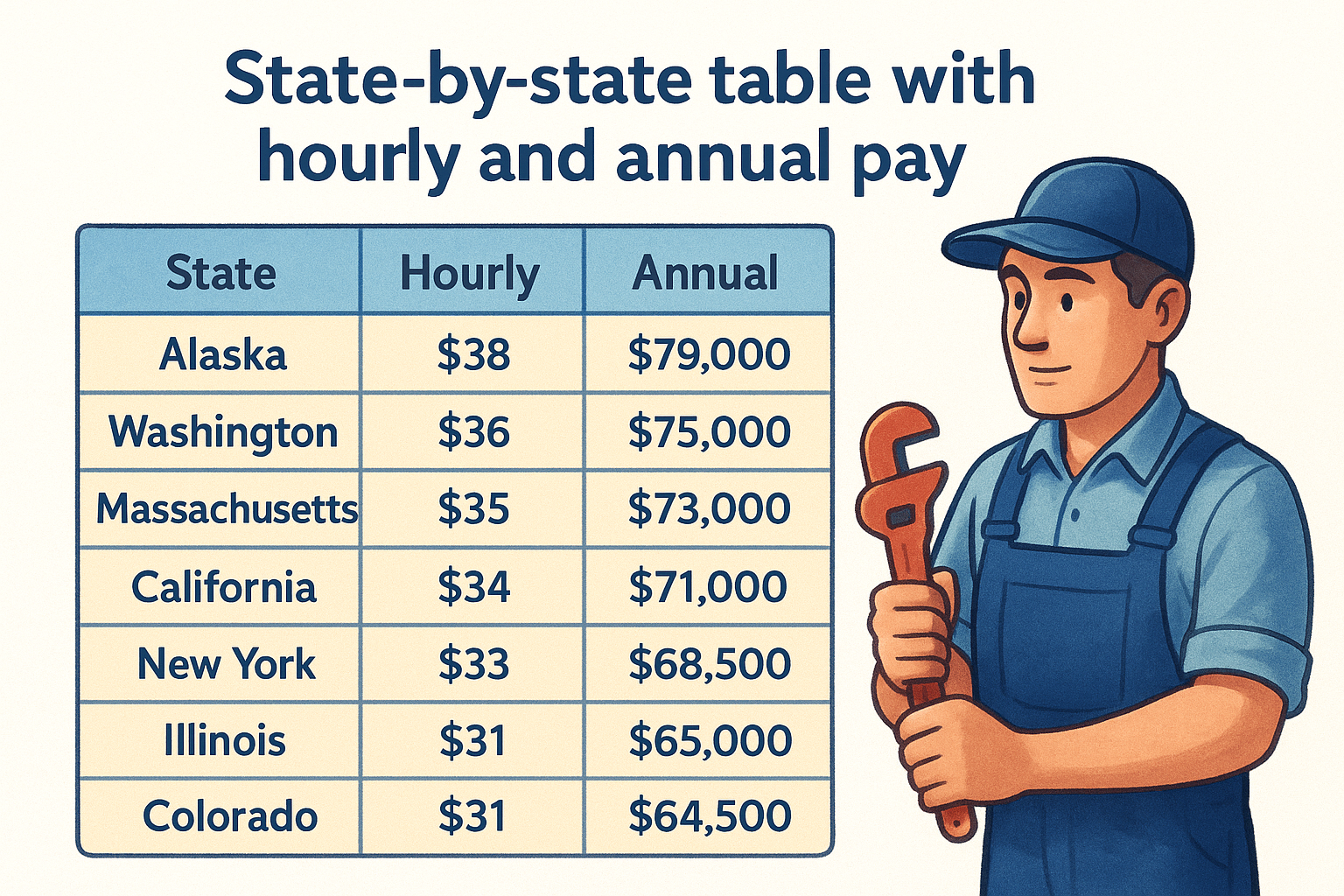
| State | Hourly | Annual |
|---|---|---|
| Alaska | $38 | $79,000 |
| Washington | $36 | $75,000 |
| Massachusetts | $35 | $73,000 |
| California | $34 | $71,000 |
| New York | $33 | $68,500 |
| Illinois | $31 | $65,000 |
| Colorado | $31 | $64,500 |
| Texas | $27 | $56,000 |
| Florida | $26 | $54,000 |
| Alabama | $23 | $47,500 |
| Arkansas | $22 | $46,000 |
| Mississippi | $21 | $44,000 |
Highest-paying states at a glance
Alaska, Washington, and Massachusetts consistently top the list. Strong union presence, high construction activity, and licensing requirements that reduce the available labor pool all push pay upward in these markets. California and New York follow closely, driven by commercial project volume and prevailing wage rules on public work.
High-paying states often have stricter licensing requirements, which means your credentials directly affect your access to those markets.
Lowest-paying states at a glance
Mississippi, Arkansas, and Alabama sit at the bottom of the pay range. Lower costs of doing business and less union density keep wages suppressed, though demand for qualified techs is growing in all three states as residential construction expands.
How to adjust a state salary for cost of living
A $71,000 salary in California buys considerably less purchasing power than $56,000 in Texas once you account for housing, taxes, and daily expenses. Use the Bureau of Labor Statistics regional price parities to convert any state salary into a real-dollar comparison before you make a relocation decision.
4. Top-paying metro areas and why they pay more
State averages tell you the floor, but metro-level data tells you where the real money is. The highest-paying cities for HVAC work can sit $8,000 to $15,000 above their state median, which means targeting the right city matters as much as targeting the right state when you research hvac technician salary by state.
Cities that commonly top HVAC pay lists
A handful of metros consistently lead HVAC compensation across the country. San Francisco, Seattle, Boston, Chicago, and New York City each offer Journeyman-level pay well above their state averages. Anchorage also ranks near the top, driven by a limited local labor pool and harsh climate conditions that create year-round demand for skilled technicians.
- San Francisco, CA: $40-$45/hr for experienced Journeymen
- Seattle, WA: $38-$43/hr, driven by commercial construction volume
- Boston, MA: $37-$42/hr, strong union presence
- Chicago, IL: $35-$40/hr, large industrial and commercial base
- New York City, NY: $36-$41/hr, prevailing wage rules apply on public projects
Union density, prevailing wage, and large projects
These cities pay more for specific, measurable reasons. High union membership rates lock in wage floors through collective bargaining agreements, which protect pay even when project work slows down. Prevailing wage laws on public construction projects require contractors to match locally set rates, and those rates are almost always higher than what a non-union shop would offer independently.
Prevailing wage rules can raise your effective hourly rate by $6 to $12 compared to residential work in the same city.
Long commutes, on-call schedules, and demand spikes
Top metros also compensate for difficult working conditions that smaller markets rarely require. Traffic delays, tight deadlines, and mandatory on-call availability are standard in dense urban environments. Many employers in these cities offer additional pay for emergency calls, weekend work, and drive time, which adds real income beyond the posted base rate.
5. Lowest-paying states and how techs boost income there
Low state averages do not mean you are stuck at the bottom of the hvac technician salary by state range. Understanding why certain markets pay less gives you a clear path to either earning more where you are or making a calculated decision to move.
Common reasons pay runs lower in some markets
States like Mississippi, Arkansas, and Alabama pay less primarily because of lower union density and a higher ratio of residential work to commercial and industrial projects. Residential service calls pay less than commercial contracts, and markets with limited large-scale construction activity simply generate fewer high-paying positions. Lower housing costs in these regions also give employers less pressure to raise wages to attract candidates.
Add-on skills that raise pay fastest in lower-pay states
The fastest way to increase your earnings in a lower-pay market is to hold certifications that few local technicians carry. EPA 608 certification is a baseline everywhere, but adding skills in commercial refrigeration, building automation systems, or VRF (variable refrigerant flow) technology places you in a much shorter candidate pool. Employers in these markets often struggle to find techs with those credentials and will pay above their posted range to get them. Overtime availability during peak cooling season also gives you a meaningful income boost without requiring a job change.
Specialized certifications can raise your effective pay by $5 to $8 per hour in markets where those skills are scarce.
When relocation pays off and how to estimate the break-even
Relocation makes financial sense when the pay increase exceeds your moving costs within 12 to 18 months. Calculate your current annual earnings, compare them to your target state median, then subtract estimated moving expenses and any higher housing costs. If the net gain is positive within two years, the move is worth serious consideration.
6. Pay by experience level and job type
Your experience level and the type of work you perform have just as much influence on your paycheck as the state you work in. Understanding where each role sits on the hvac technician salary by state spectrum helps you set realistic expectations and identify your next income target.
Apprentice and helper pay ranges
Apprentices and helpers typically earn between $15 and $20 per hour nationally, with pay rising as they log documented field hours. Most programs tie raises directly to completed training milestones, so consistent progress through coursework accelerates your income faster than time alone.
Entry-level, mid-level, and senior technician pay ranges
Entry-level technicians with EPA 608 certification generally earn $20 to $26 per hour. Mid-level Journeymen land in the $26 to $35 range, while senior technicians with Master licenses regularly push past $38 per hour in competitive markets. Here is how the tiers break down:
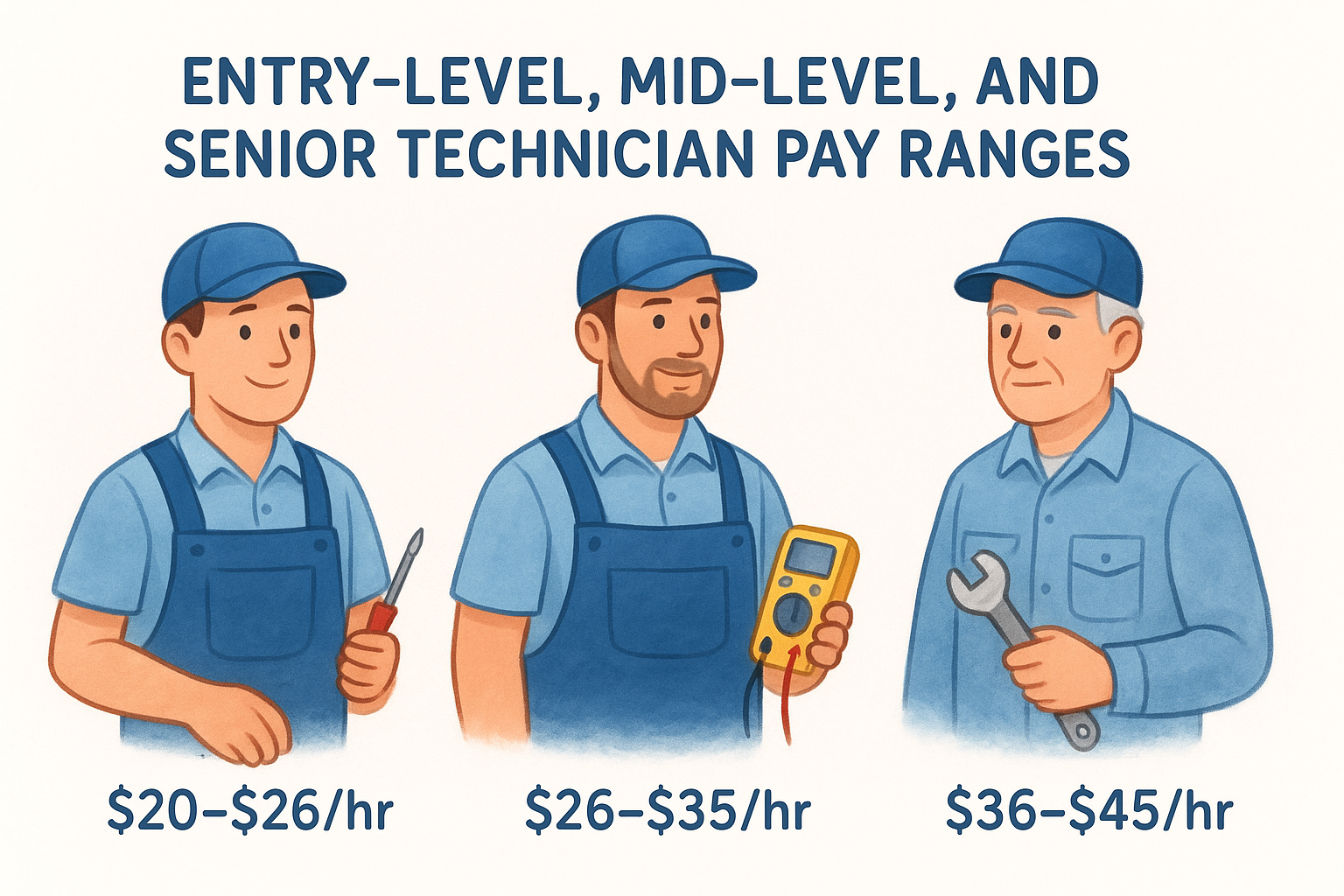
- Apprentice/Helper: $15-$20/hr
- Entry-level (1-3 years): $20-$26/hr
- Mid-level Journeyman (4-8 years): $26-$35/hr
- Senior/Master (8+ years): $36-$45/hr
Your license level is the single fastest lever you can pull to move from one pay tier to the next.
Installer vs service vs commercial and refrigeration pay
Installation roles pay slightly less than service roles because diagnostic skill and callback efficiency command a direct premium. Commercial work pays more than residential in nearly every market, and refrigeration-certified technicians consistently earn at the top of the pay scale due to the specialized knowledge and liability those systems carry.
Lead tech, foreman, and supervisor pay ranges
Lead technicians generally earn $35 to $42 per hour, reflecting their added responsibility for job quality and crew oversight. Foremen and supervisors move into salaried roles between $70,000 and $95,000 annually in most markets, with bonuses tied to project completion at larger commercial firms.
7. How to use state pay data to get paid more
Raw salary data only helps you if you put it to work. The hvac technician salary by state numbers in this guide give you a real foundation to negotiate from, but you need to know exactly how to use them when it counts.
Negotiation numbers to bring to an interview
Walk into every interview with your state’s median Journeyman pay and the top-metro rate for your area printed or saved on your phone. When an employer names a number, compare it directly against those figures. If the offer sits below the median, you have objective data to reference rather than a gut feeling.
Citing specific market data shifts the conversation from opinion to fact, which is a significantly stronger negotiating position.
Certifications and licenses that move the needle
EPA 608, Master HVAC licenses, and commercial refrigeration credentials create the most measurable pay jumps. Adding a building automation or VRF certification in a state where few technicians hold it puts you in a short candidate pool, which gives you direct leverage to ask for $4 to $8 more per hour than the posted rate.
Pay structures to compare: hourly, piece-rate, commission
Not all pay structures reward the same skills equally. Hourly pay with overtime benefits technicians who work in markets with strong seasonal demand spikes. Piece-rate and commission structures can pay more if you work quickly and accurately, but they shift financial risk onto you during slow periods. Compare the expected annual total across all three structures before you accept any offer.
Questions to ask to avoid a "good rate, bad schedule" job
Ask employers directly about average weekly hours, on-call frequency, and whether the posted rate includes drive time. A $34 per hour rate that requires 60-hour weeks and unpaid travel time often pays less per effective hour than a $30 rate with a clean 45-hour schedule and a company truck.

Next steps
You now have a complete picture of hvac technician salary by state, from the top-paying metros in Alaska and Washington down to the lower-paying markets in Mississippi and Arkansas. That data only moves the needle if you act on it. Use the state figures and experience-level ranges in this guide as your starting point for every salary conversation going forward.
Your next move is straightforward. Check what employers are actively posting in your target state right now, filter by your license level, and compare those live ranges against the benchmarks here. Real-time listings reveal what companies are actually willing to pay today, not what a survey reported six months ago.
If you are ready to find a role that matches your skills and your salary target, browse open HVAC jobs on bluecollarjobs.com and filter by state, experience level, and pay range to line up your next career move with confidence.

1 thought on “HVAC Technician Salary By State: 2026 Hourly & Annual”