
Welding is one of the most in-demand skilled trades in the country right now, with employers across construction, manufacturing, and energy sectors competing for qualified candidates. Yet knowing how to find welding jobs that match your skill level, certifications, and location isn’t always straightforward. Many welders end up stuck scrolling through generic job boards cluttered with irrelevant listings.
The truth is, landing a solid welding gig comes down to knowing where to look and how to position yourself. Whether you’re a freshly certified welder looking for your first shop position or an experienced pipe welder chasing higher pay, the approach matters. A targeted search beats a scattered one every single time.
That’s exactly why we built bluecollarjobs, to cut through the noise and connect skilled tradespeople with employers who actually need them. In this guide, we’ll walk you through nine proven ways to find welding jobs faster, from leveraging trade-specific job boards to networking strategies that most candidates overlook.
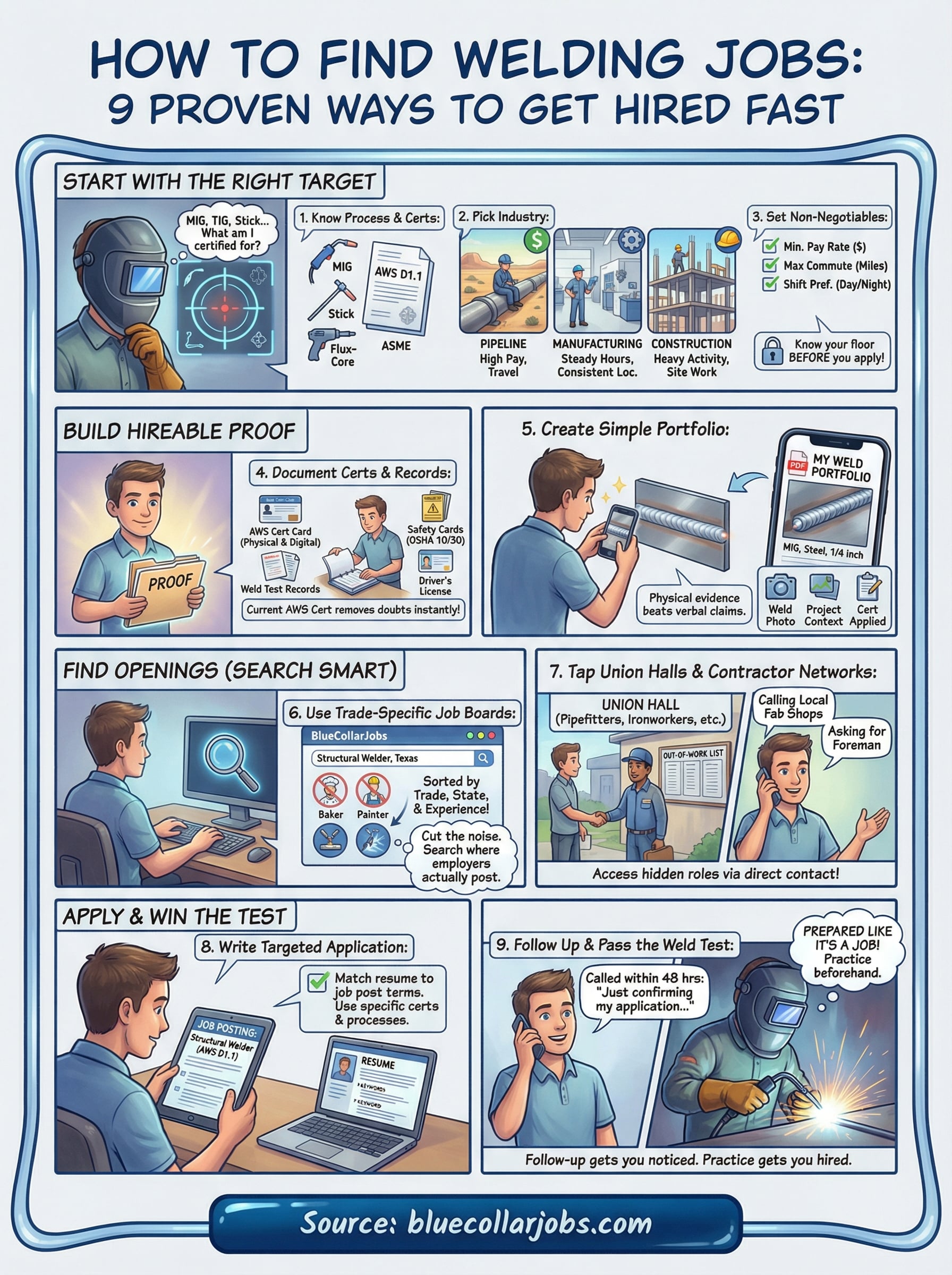
Start with the right welding job target
Most welders jump straight into searching without defining what they actually want. That approach wastes time and often lands you in roles that don’t fit your skill set or pay expectations. Before you learn how to find welding jobs effectively, you need to get specific about your target so every step after this one is pointed in the right direction.
Know your welding process and certification level
Your welding certifications and the processes you’ve mastered are the foundation of your job search. Employers in structural steel aren’t hunting for TIG welders with thin-metal experience, and aerospace shops won’t be satisfied with someone who only runs flux-core. Knowing exactly what you’re certified for narrows your search immediately and helps you filter out listings that won’t pan out.
| Process | Common Industries | Common Certification |
|---|---|---|
| MIG (GMAW) | Automotive, fabrication | AWS D1.1 |
| TIG (GTAW) | Aerospace, piping | AWS D1.1, ASME Section IX |
| Stick (SMAW) | Construction, pipeline | AWS D1.1, API 1104 |
| Flux-Core (FCAW) | Shipbuilding, heavy fabrication | AWS D1.1 |
Pick your industry before you search
Different industries offer very different pay scales, work environments, and schedules. Pipeline welding pays some of the highest rates in the trade but demands travel and unpredictable hours. Manufacturing shops offer steady schedules and consistent locations but may pay less per hour than field work. Knowing which environment fits your life makes your search faster and your applications far more focused.
The clearest candidates get hired first. Employers can immediately tell the difference between someone who wants "a welding job" and someone who specifically wants their open pipe welding role.
Your industry target also shapes where you look. Structural and pipeline roles concentrate in states with heavy construction activity like Texas and Louisiana, while manufacturing positions cluster near industrial corridors across the Midwest and Southeast.
Set your non-negotiables before you apply
Write down your minimum acceptable pay rate, your maximum commute or travel tolerance, and your shift preferences before you send a single application. These are not details to work out on an offer call. Knowing your floor in advance keeps you from accepting a role that burns you out within six months.
A simple target sheet keeps you honest throughout your search:
- Minimum hourly rate: $___
- Maximum one-way commute: ___ miles (or willing to travel: yes / no)
- Shift preference: days / nights / rotating
- Employment type: full-time / contract / both
- Required certifications you already hold: ___
Build hireable proof fast
Once you know your target, the next step is making sure employers trust you before they meet you. Hireable proof means the combination of documented certifications, verifiable work history, and physical evidence of your welding skills. Knowing how to find welding jobs gets you in the door faster when you arrive with credentials that speak for themselves before you say a word.
Get your certifications documented and current
AWS certifications are the industry standard that most structural, fabrication, and pipeline employers require before they’ll schedule an interview. Your certifications expire, so check your current status before you apply to anything. Showing up with lapsed paperwork kills your chances immediately, even if your actual skill is strong.
Current, documented AWS certification removes one of the biggest hiring objections before the conversation even starts.
Keep these documents ready to send or show at any moment:
- AWS certification card: carry a physical copy and a digital photo
- Weld test records: request copies from past employers or testing labs
- Safety cards: OSHA 10 or OSHA 30 (required on most construction sites)
- Driver’s license: necessary for most field and pipeline positions
Create a simple welding portfolio
Most welders skip this step, which means doing it puts you ahead of the majority of applicants before the weld test even starts. A portfolio doesn’t need to be complex. Take clear photos of your best welds, note the process and base material for each one, and organize them into a single PDF or a folder on your phone.
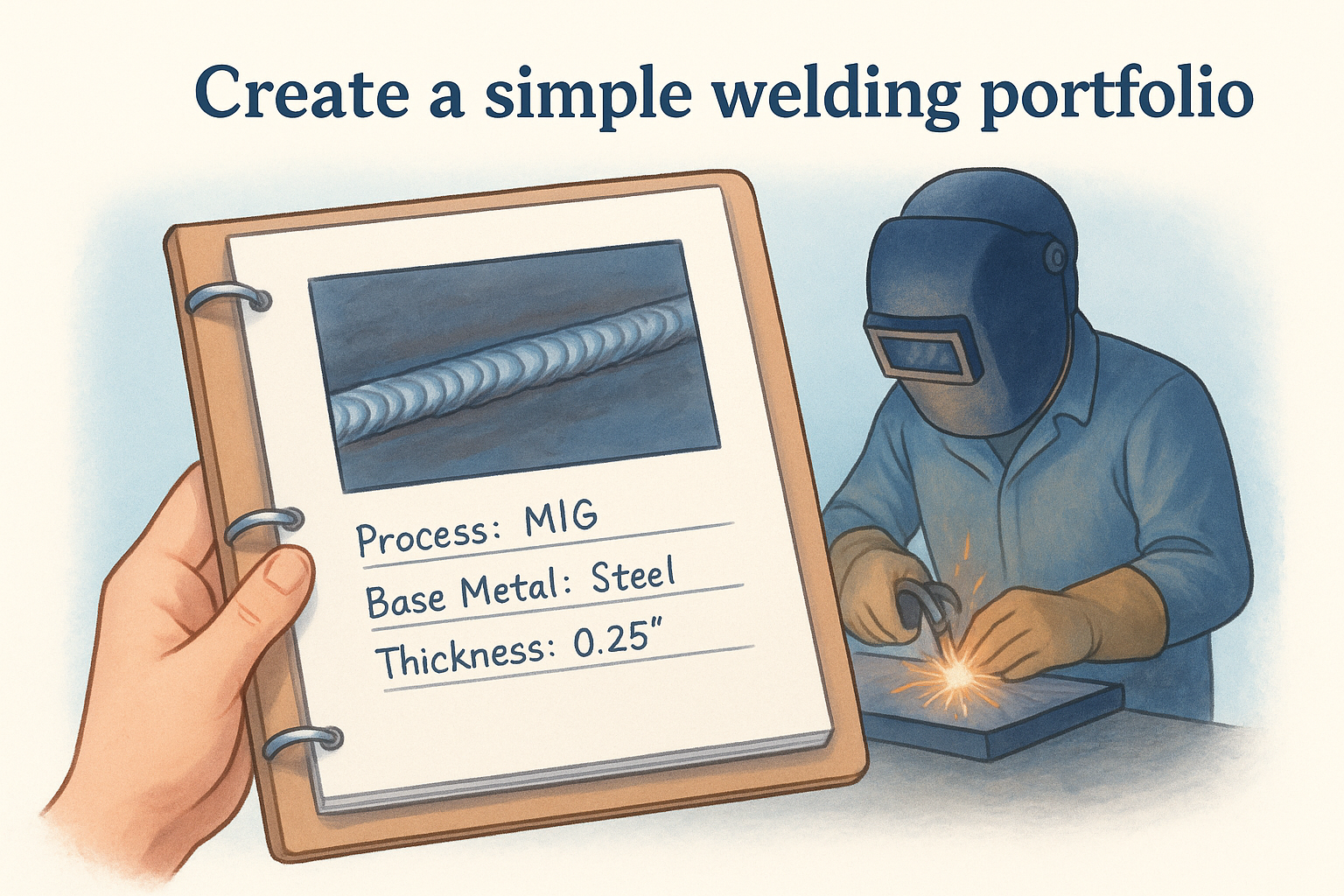
Use this basic structure for each entry:
| Item | Details to include |
|---|---|
| Weld photo | Process, base metal, thickness |
| Project context | Industry, employer (if permitted), year |
| Certification applied | AWS code, test position |
Bring this document to every interview and weld test. Employers consistently remember candidates who show up with physical evidence of their work rather than relying on verbal claims alone.
Find welding openings that match your goals
Knowing how to find welding jobs that match your certifications and goals comes down to where you search. Generic job boards mix welding listings with dozens of unrelated skilled trades, making it hard to filter for the specific process, certification level, or industry you want. Starting with trade-focused sources saves you hours of sorting through postings that will never convert into interviews.
Searching on the right platforms from the start cuts your time-to-hire significantly compared to scrolling through general job sites.
Use trade-specific job boards first
Trade-specific job boards surface welding roles sorted by process, experience level, and location without the noise. BlueCollarJobs organizes listings by trade category and state, so you immediately see structural welder roles in Texas or TIG positions in the Southeast rather than a cluttered feed of unrelated listings. When you search on platforms built for skilled trades, your certifications match directly against what employers actually posted.
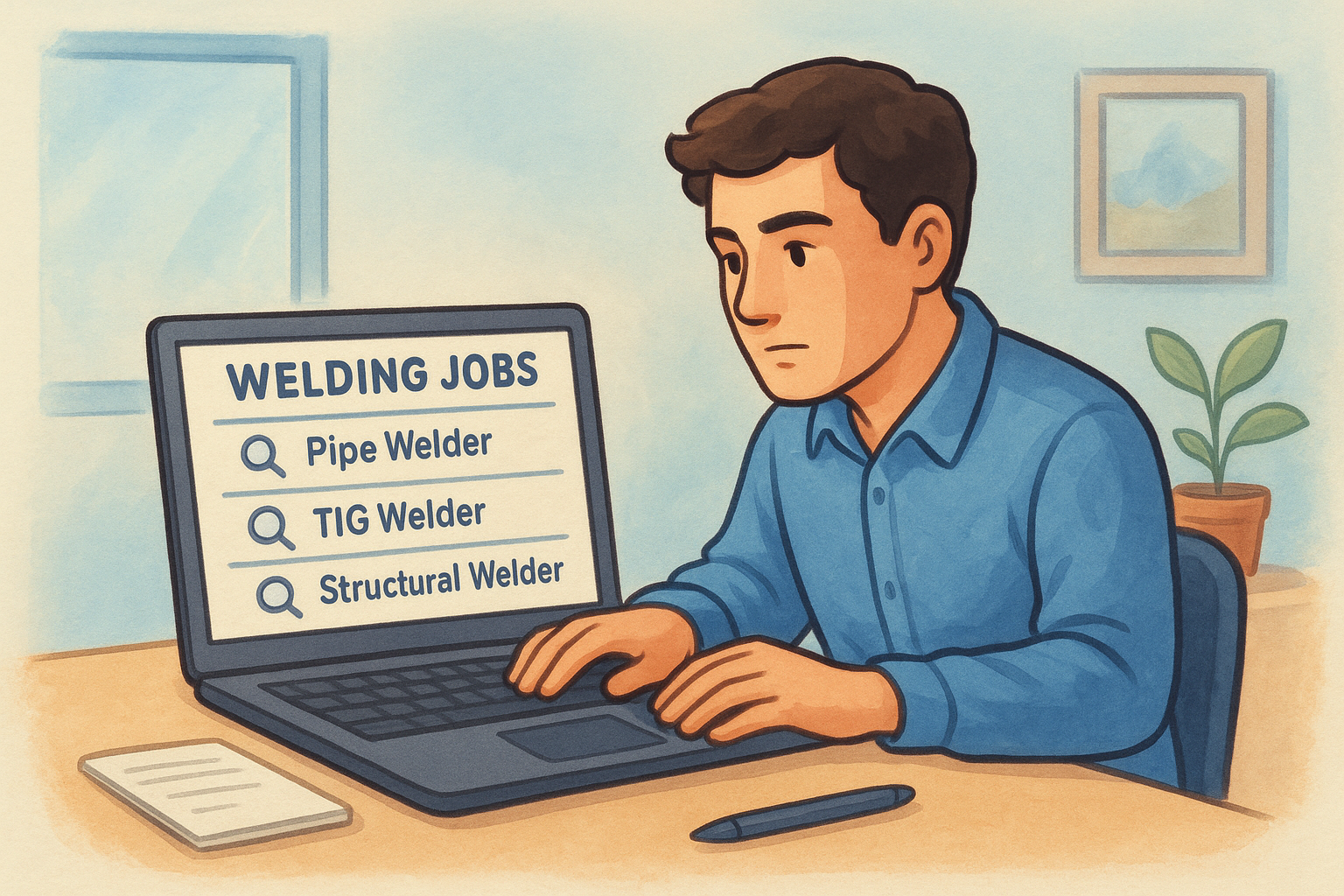
Keep your search organized with a simple tracking sheet:
| Platform | Search terms used | Date searched | Roles found |
|---|---|---|---|
| Trade-specific board | "Pipe welder, Texas" | 2026-03-24 | 4 |
| Union job board | "Journeyman welder" | 2026-03-24 | 2 |
| Direct employer site | "Structural welder" | 2026-03-24 | 1 |
Tap union halls and contractor networks
Union halls are one of the most underused resources for qualified welders. If you hold a journeyman card, walk into your local Boilermakers, Pipefitters, or Ironworkers hall and check their out-of-work list. Union dispatchers move fast when skilled welders show up in person, and many high-paying field roles never appear on any public job board.
Contractor networks work the same way. Call local fabrication shops and mechanical contractors directly, ask for the foreman or shop supervisor, and lead with your certifications. Many contractors keep internal call lists of welders they contact before they ever post an opening anywhere.
Apply, follow up, and win the weld test
Once you know how to find welding jobs that match your certifications, the way you apply separates you from the stack of resumes that get skipped. A targeted application takes ten minutes longer than a generic one and significantly improves your callback rate.
Write a targeted application for each role
Read the job posting carefully before you apply. Pull out the specific processes, certifications, and experience levels the employer listed, then match your resume language to those exact terms. If the posting says "structural welder with AWS D1.1 certification," your resume should reflect that specific credential and process in plain language, not buried in a general skills list.
Use this short checklist before you submit:
- Resume includes the exact certifications the job posting requests
- Work history shows relevant processes (MIG, TIG, Stick, FCAW)
- Contact info is current and correct
- Portfolio PDF is attached if the role is in fabrication or specialty work
Follow up within 48 hours
Most applicants never follow up, which means a single phone call or email puts you in a small group of candidates who showed actual interest. Call the shop directly, ask for the hiring manager or foreman, and confirm your application arrived. Keep the message short: your name, the role you applied for, and your top certification.
A brief follow-up call after submitting your application consistently moves qualified welders to the top of the callback list.
Pass the weld test by preparing like it’s a job
Many employers require a weld test before any formal offer. Treat it as seriously as the job itself. Ask in advance what process and position they’ll test, review the relevant AWS code, and run practice welds on similar base material at home or at a local fab shop. Showing up practiced and prepared tells the employer exactly what kind of worker they’re hiring.
You’re ready to get hired
You now have a complete system for how to find welding jobs that match your certifications, pay expectations, and career goals. The process works when you follow it in order: define your target first, build your hireable proof, search on trade-focused platforms, and apply with intention.
Most welders who struggle to get hired skip one of these steps. They either apply without direction, search on the wrong platforms, or show up to a weld test unprepared. Every step in this guide exists to close those gaps and put you in front of the right employers faster.
Your next move is straightforward. Start your search where skilled trade employers actually post open roles. Browse welding jobs on BlueCollarJobs to find positions sorted by trade, state, and experience level, so your next application goes directly to a job that fits your certifications and goals.

https://shorturl.fm/IT8ps
https://shorturl.fm/5vzIq