
Hospitals run 24/7, and so do their HVAC systems. Operating rooms need precise temperature control. Pharmacies require strict humidity levels. Isolation rooms depend on negative air pressure to prevent contamination. When any of that fails, patient safety is on the line, which is exactly why hospital HVAC jobs pay more and offer stronger job security than most other HVAC roles in the field.
If you’re an HVAC technician or mechanic looking to move into healthcare facilities, you’re probably wondering what the pay looks like, what certifications you need, and where to actually find these openings. Good news: hospital HVAC positions are growing, and facilities across the country are actively hiring. The challenge is knowing where to look and how to stand out as a candidate.
That’s what this guide covers, and it’s exactly the kind of specialized trade work we focus on here at bluecollarjobs. We’ll walk you through real salary data, required qualifications, what the day-to-day work looks like, and how to land a hospital HVAC role near you. Whether you’re a journeyman ready to specialize or an apprentice planning your next move, this guide gives you a clear path forward.
What hospital HVAC jobs include
Hospital HVAC technicians do more than fix broken equipment. You’re responsible for maintaining the environmental conditions that keep patients alive and staff safe. That means working across a wide range of systems under strict operational requirements that don’t apply in most other commercial buildings. Understanding the full scope of this work is the first step to deciding whether hospital HVAC jobs are the right move for your career.
The systems you’ll maintain
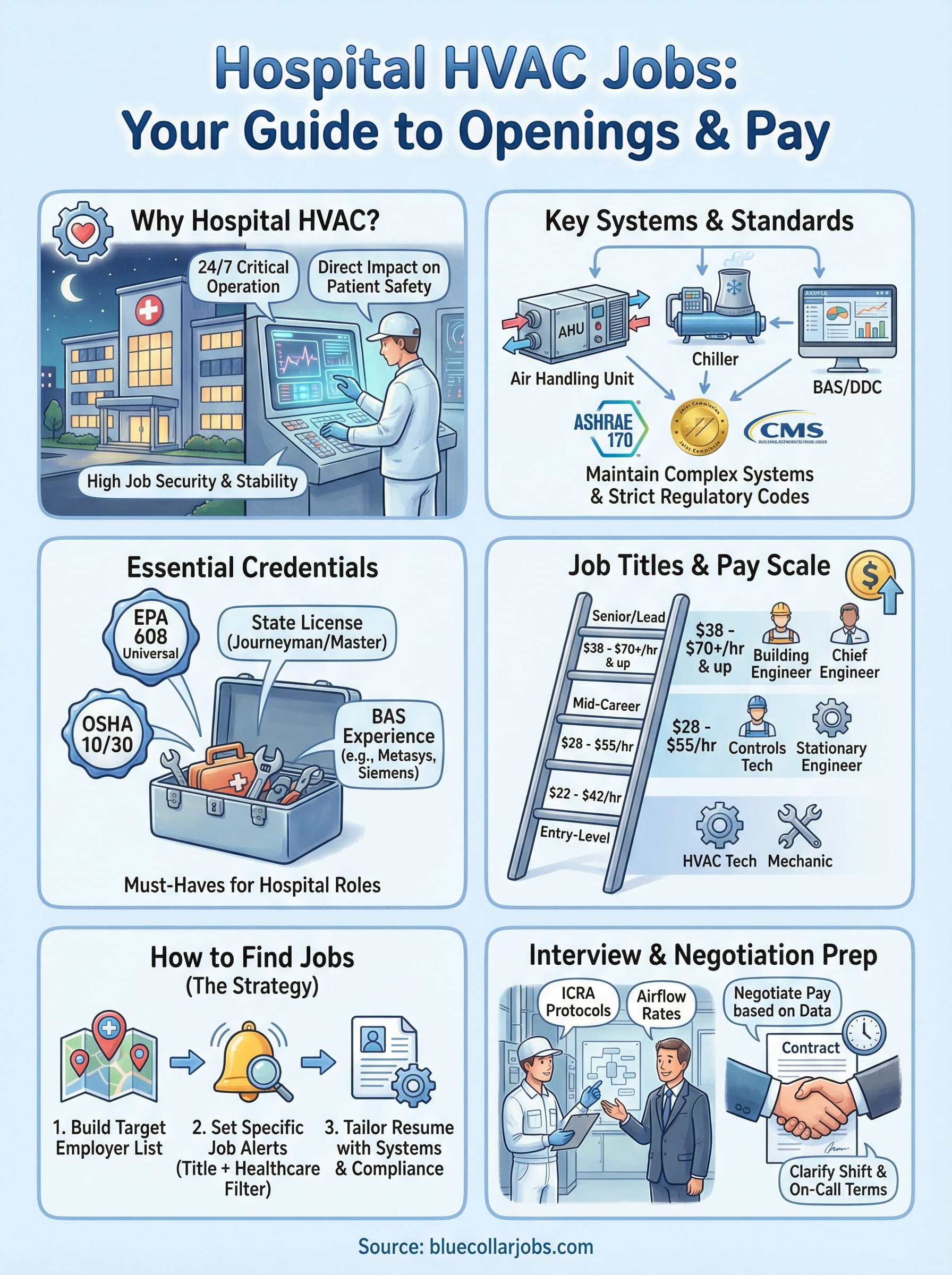
A typical hospital runs a complex mix of mechanical systems, and you’ll be expected to know your way around most of them. Air handling units (AHUs) are the backbone of hospital HVAC, distributing conditioned air throughout each wing and department. Beyond those, you’ll also work with chillers, boilers, cooling towers, variable air volume (VAV) boxes, and direct digital controls (DDC) that monitor and automate building performance in real time.
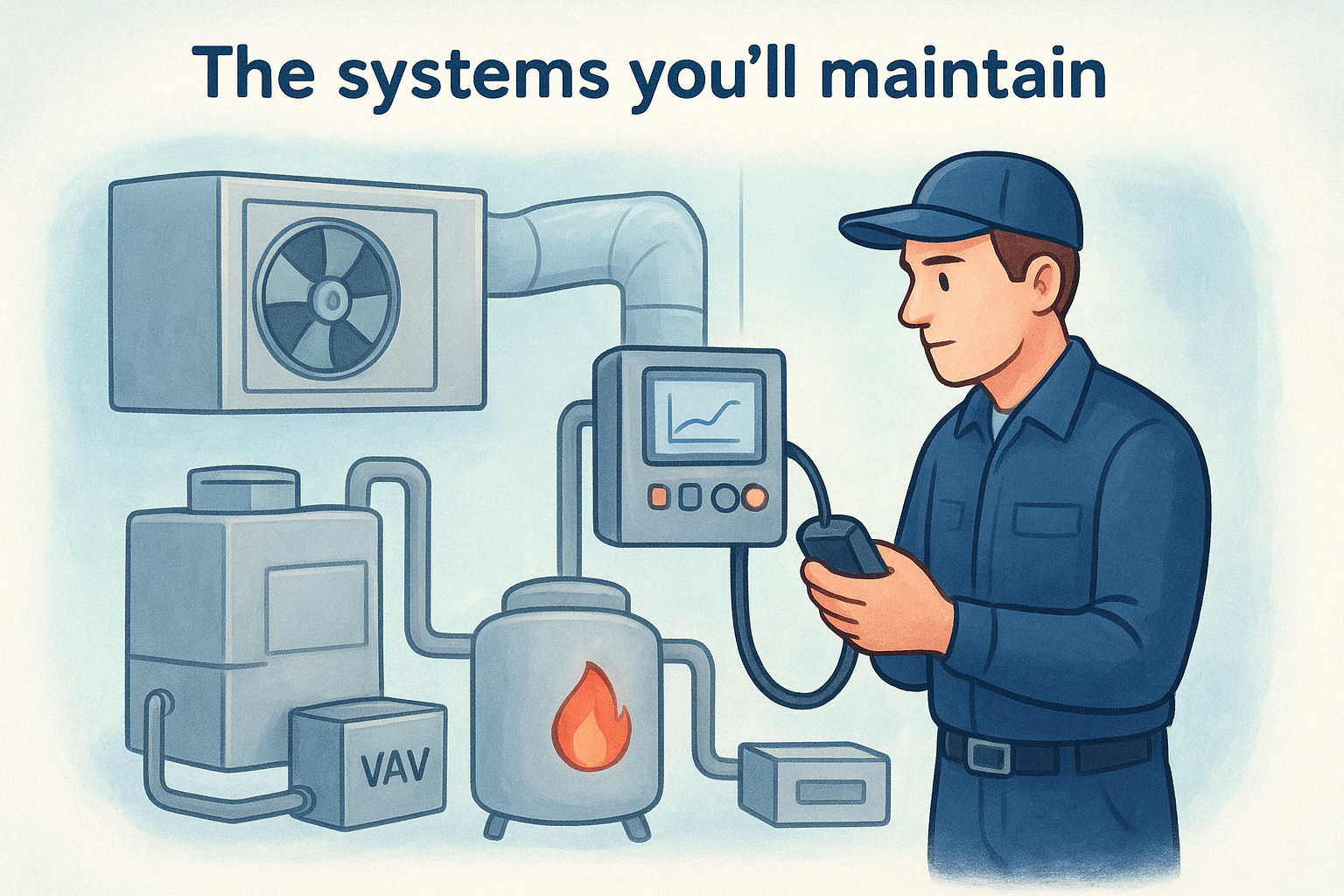
Here’s a breakdown of the core systems you’ll encounter in a typical hospital setting:
- Air handling units (AHUs): Regulate temperature, humidity, and filtration across departments
- Chillers and cooling towers: Handle large-scale cooling loads, especially in surgical suites and server rooms
- Boilers: Provide heat and hot water throughout the facility
- VAV boxes: Control airflow volume to individual zones and rooms
- DDC/BAS systems: Building automation systems that let you monitor and adjust conditions remotely
- Exhaust and pressurization systems: Maintain negative or positive pressure in isolation rooms, operating rooms, and lab spaces
Regulatory standards that govern your work
Working in a hospital means your output is subject to regulations that carry real consequences if ignored. ASHRAE Standard 170 sets the minimum ventilation requirements for healthcare facilities, covering everything from air change rates per hour to filtration efficiency ratings. Hospitals also follow guidelines from the Joint Commission, which conducts regular facility inspections and can pull accreditation if mechanical systems fall short of standards.
ASHRAE 170 and Joint Commission standards aren’t optional guidelines; they’re the rules your work will be measured against every time an inspection happens.
You’ll also run into requirements from the Centers for Medicare and Medicaid Services (CMS) and local building codes that add another layer of compliance to your daily work. Knowing that an operating room requires a minimum of 20 air changes per hour, or that a positive-pressure room requires HEPA-level filtration, signals to employers that you’re already thinking at their level. Learning these standards before you apply is one of the fastest ways to separate yourself from other candidates.
How hospital HVAC differs from commercial work
Commercial HVAC work has downtime built in. You can shut down a system in an office building overnight, run your maintenance, and finish before anyone arrives the next morning. Hospitals never go offline, which means you’re often performing repairs and preventive maintenance on live systems without disrupting patient care. That requires a higher level of planning, direct coordination with nursing staff, and strong situational awareness on every job.
Infection control procedures add another layer that separates hospital work from everything else. Any time you open a ceiling, cut into ductwork, or disturb a space near a patient care area, you may be required to set up an infection control risk assessment (ICRA) barrier. These aren’t bureaucratic formalities. They protect immunocompromised patients from mold spores and airborne debris that could cause serious illness or death. If you haven’t worked under ICRA protocols before, expect formal training on this process during your hospital onboarding period.
Typical titles and what they pay
Before you start applying for hospital HVAC jobs, you need to know what titles to search for. Hospitals don’t always use the same terminology as commercial contractors, and if you search only for "HVAC technician," you’ll miss a large portion of open roles. Knowing the correct titles and their pay ranges helps you search smarter and negotiate from a stronger position.
Common job titles in healthcare HVAC
Facilities departments across hospitals and health systems use a range of titles depending on their size and structure. The most common ones you’ll encounter on job boards and hospital careers pages include:
| Job Title | Common Abbreviation | Typical Focus |
|---|---|---|
| HVAC Technician | HVAC Tech | General maintenance and repair |
| HVAC Mechanic | N/A | Mechanical systems and equipment |
| Stationary Engineer | SE | Boilers, chillers, and central plant |
| Building Engineer | BE | Full facility systems oversight |
| Facilities Maintenance Technician | FMT | Multi-trade support including HVAC |
| HVAC Controls Technician | Controls Tech | DDC and building automation systems |
| Chief Engineer | N/A | Supervises all facilities staff |
If a posting says "Building Engineer" or "Stationary Engineer," it almost always requires HVAC experience, even when the title doesn’t say so directly.
Larger health systems like university hospitals or multi-campus networks often post roles under a facilities or plant operations department, so filter your search by department when the platform allows it.
Pay ranges by title and experience
Pay in hospital HVAC scales based on your experience level, license type, and the size of the facility. Union hospitals in high-cost metro areas tend to pay at the top of these ranges, while smaller regional hospitals may land in the middle. Here’s a realistic breakdown based on current market data:
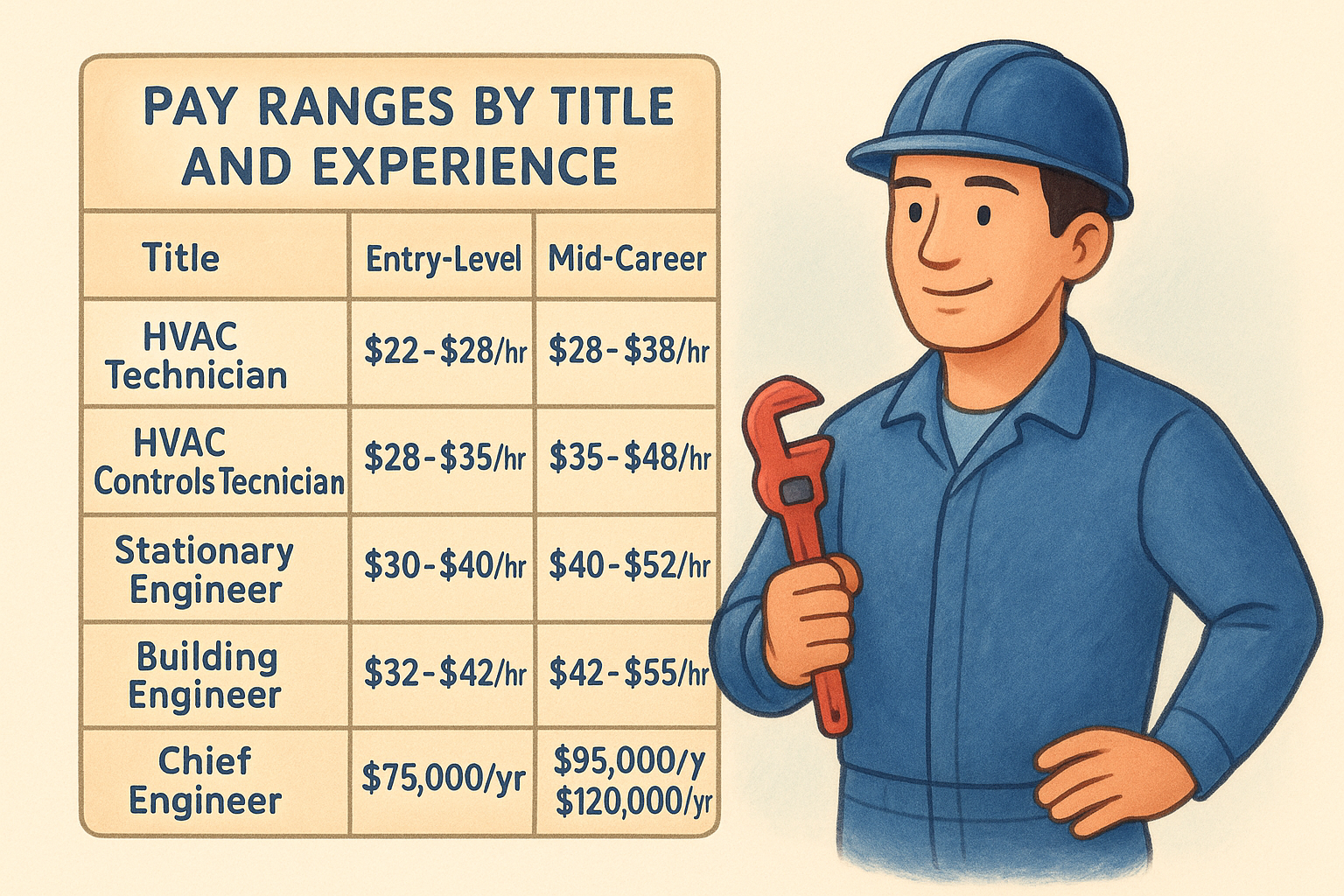
| Title | Entry-Level | Mid-Career | Senior/Lead |
|---|---|---|---|
| HVAC Technician | $22 – $28/hr | $28 – $38/hr | $38 – $48/hr |
| HVAC Controls Technician | $28 – $35/hr | $35 – $48/hr | $48 – $60/hr |
| Stationary Engineer | $30 – $40/hr | $40 – $52/hr | $52 – $65/hr |
| Building Engineer | $32 – $42/hr | $42 – $55/hr | $55 – $70/hr |
| Chief Engineer | N/A | $75,000/yr | $95,000 – $120,000/yr |
Your certifications and specialty knowledge directly move you up these ranges. A journeyman who also holds EPA 608, a CFC license, and experience with building automation systems can negotiate well above the mid-career median. When you’re reviewing postings, pay close attention to whether the salary listed is for a 40-hour week or includes overtime, since many hospital roles offer significant overtime pay on top of the base rate.
Credentials hospitals look for
Hospitals screen HVAC candidates more carefully than most commercial employers because the stakes are higher. Before you apply for hospital HVAC jobs, you need to know exactly what credentials will move your application forward and which gaps could hold you back. Getting this right before you apply saves time and helps you target roles where you’re already competitive.
Licenses and certifications that matter most
Your EPA 608 Universal certification is the baseline requirement for nearly every hospital HVAC role. Without it, most facilities departments won’t look at your application. Beyond 608, hospitals prioritize candidates who hold a Journeyman or Master HVAC license issued by their state, since healthcare facilities carry regulatory liability and need technicians who can legally sign off on system work.
If your state license is expired or inactive, renew it before you apply. Hospitals run background and license verification checks, and an expired credential can disqualify you even when your skills are solid.
Here’s a breakdown of the credentials that come up most frequently in hospital HVAC postings:
| Credential | Why Hospitals Want It |
|---|---|
| EPA 608 Universal | Required to handle refrigerants legally |
| State HVAC Journeyman or Master License | Regulatory compliance and liability coverage |
| OSHA 10 or OSHA 30 | Workplace safety competency |
| Building Operator Certification (BOC) | Demonstrates facility management knowledge |
| Stationary Engineer License | Often required for central plant or boiler roles |
| ASHRAE 170 Familiarity | Knowledge of healthcare ventilation standards |
Experience and skills that set you apart
Technical certifications open doors, but your hands-on experience determines how far you go in the hiring process. Hospitals look specifically for candidates who have worked on building automation systems (BAS) or direct digital controls, since most large facilities rely on these platforms to monitor critical spaces around the clock. If you’ve worked with Johnson Controls Metasys, Siemens Desigo, or Honeywell systems, list those by name on your resume.
Facilities managers also prioritize technicians who have preventive maintenance experience with AHUs, chillers, and VAV systems. General repair experience is valuable, but PM experience tells a hospital that you understand their compliance-driven maintenance schedules. If you’ve worked in a commercial building with strict uptime requirements, frame that experience in terms of the systems you maintained and the schedules you followed, not just the repairs you made.
Build your target list of employers
Most people searching for hospital HVAC jobs start on a job board and wait for results to come to them. A smarter approach is to build a list of target employers first, then monitor those specific organizations for openings. This gives you control over your search and lets you prepare for each facility before a role even appears.
Where to find hospitals and health systems near you
Your first step is mapping out every major healthcare employer within a reasonable commute. Start with the American Hospital Association’s hospital directory, which lists facilities by state and city. You can also search your state’s department of health website for licensed hospital facilities in your area. Large health systems like HCA Healthcare, CommonSpirit Health, and Ascension each operate dozens of campuses across the country, so one system could represent multiple job opportunities within a single region.

Use this format to track what you find:
| Facility Name | System/Network | Location | Bed Count | Careers Page URL |
|---|---|---|---|---|
| St. Mary’s Medical Center | CommonSpirit Health | Phoenix, AZ | 350 | careers.commonspirit.org |
| Regional Medical Center | HCA Healthcare | Dallas, TX | 500 | hcahealthcarecareers.com |
| University Hospital | Standalone | Columbus, OH | 800 | [facility careers URL] |
Bed count matters because larger hospitals run more complex mechanical systems and hire more facilities staff. A 500-bed hospital is far more likely to have dedicated HVAC technicians on payroll than a 100-bed community facility that outsources maintenance.
How to research each facility before you apply
Once you have your list, spend 10 to 15 minutes researching each facility. Check their Joint Commission accreditation status at qualitcheck.jointcommission.org, since accredited hospitals operate under stricter environmental standards and tend to hire more qualified trades staff. Look at their careers page to see how frequently they post facilities roles, which tells you how often their team turns over or grows.
A hospital that posts multiple facilities roles every few months is either expanding or struggling with retention. Both create real opportunities for the right candidate.
You should also check LinkedIn company pages for each facility to see how large their engineering and facilities departments are. If a hospital lists 20 or more people in facilities operations, they run a serious in-house team. That’s the kind of employer who invests in their technicians, offers structured advancement, and posts regularly when roles open up.
Search smarter with filters and alerts
Browsing job boards without a system wastes time and causes you to miss strong openings. When you search for hospital HVAC jobs, the platform you use and the filters you apply directly determine the quality of results you see. Spending 20 minutes building a structured search process now pays off every week without additional effort on your part.
Choose filters that match hospital roles
General job boards like Indeed or LinkedIn let you filter by job title, location, and industry, but most people stop there. Start by setting your industry filter to "Healthcare" or "Hospitals and Health Systems" to cut out commercial HVAC results that don’t fit your target. Then filter by experience level to match your license and background. A journeyman with eight years of commercial work belongs in mid-level or senior filters, not entry-level, since those roles pull lower pay and involve simpler systems.
Use the keyword field strategically. Instead of searching only "HVAC technician," run separate searches for each title listed in the earlier section of this guide. Try "building engineer," "stationary engineer," and "facilities maintenance technician" as individual searches within the healthcare industry filter. This approach surfaces roles that a single broad search would consistently bury.
Running five targeted searches takes ten extra minutes upfront and returns far better results than one broad search repeated daily.
Build job alerts that run automatically
Most major job boards let you save a search and receive email notifications when new postings match your criteria. Set up a separate alert for each title you’re targeting so you receive updates within 24 hours of a new posting going live. Responding to a hospital facilities role within the first 48 hours of it being posted puts your application ahead of the majority of submissions.
Here’s a simple alert setup template you can apply on most platforms:
| Alert Name | Search Term | Location Radius | Industry Filter | Frequency |
|---|---|---|---|---|
| Hospital HVAC Tech | "HVAC Technician" | 30 miles | Healthcare | Daily |
| Building Engineer | "Building Engineer" | 30 miles | Healthcare | Daily |
| Stationary Engineer | "Stationary Engineer" | 50 miles | Healthcare | Daily |
| Controls Tech | "HVAC Controls" | 50 miles | Healthcare | Daily |
Check your alerts folder at least three times per week and clear out stale listings that no longer match your targets. Keeping your alert list clean lets you act fast on roles that fit your actual experience and license level, rather than sifting through mismatched results every time you log in.
Read postings like a facilities engineer
Most people read a job posting to find the title, pay, and apply button. A facilities engineer reads a posting to extract information about the facility’s systems, compliance culture, and what the day-to-day role actually demands. When you apply for hospital HVAC jobs, the language in a posting tells you far more than the bullet points suggest on the surface.
Decode the requirements section
Hospitals write requirements sections based on their actual operational needs, not generic templates. When a posting lists "ASHRAE 170 compliance experience" or "familiarity with infection control protocols", that signals the facility runs a tightly regulated environment and expects you to hit the ground running. A posting that only lists generic certifications like EPA 608 with no mention of healthcare-specific standards often means the facilities department is smaller or less structured.
Pay close attention to the systems listed in the technical requirements. If a posting mentions Johnson Controls, Siemens, or Trane by name, the facility runs those specific platforms and wants someone who can navigate them without a lengthy onboarding period. Write those systems down and be ready to speak to your experience with each one during the interview.
The systems a hospital names in a posting are the systems they’re actively struggling to staff, which gives you leverage if your background matches.
Identify shift expectations and on-call language
Shift structure and on-call requirements affect your quality of life more than almost anything else in a hospital HVAC role, and most postings bury this information in the final paragraph. Look for phrases like "rotating shifts," "on-call availability," or "weekend coverage required" to understand the real schedule before you apply. A 12-hour rotating shift looks very different from a standard day shift with occasional on-call, even when both appear under the same title and pay range.
Use this checklist when reviewing any hospital HVAC posting:
- Does the posting name specific systems (BAS, chillers, AHUs)?
- Is a state HVAC license explicitly required or just preferred?
- Does it reference Joint Commission, CMS, or ASHRAE standards?
- What shift structure does it describe, and is on-call listed?
- Does it separate "required" qualifications from "preferred" ones?
Working through this checklist on every posting takes less than three minutes and immediately tells you whether the role matches your license level, system experience, and schedule availability before you invest time in a full application.
Apply with a hospital-ready resume
A generic HVAC resume won’t get you far when you’re targeting hospital HVAC jobs. Facilities managers at hospitals screen applications looking for specific systems experience, compliance knowledge, and licensed credentials, and your resume needs to surface that information immediately. Treat your resume as a technical document, not a career summary.
Lead with healthcare-relevant experience
Place a skills and systems section at the top of your resume, directly below your contact information. List specific platforms by brand name: Johnson Controls Metasys, Trane Tracer, Siemens Desigo, Honeywell. Include every relevant certification on its own line, and note your EPA 608 Universal, state license level, and any OSHA credentials before a hiring manager reads a single bullet point about your work history.
Facilities managers spend less than 30 seconds on an initial resume scan, so the top third of your document determines whether they read the rest.
When you describe past roles, frame each bullet around systems maintained and compliance standards followed, not just tasks completed. Instead of writing "repaired AHUs," write "performed preventive maintenance on 12 AHUs per ASHRAE 170 ventilation schedules in a 300,000 sq ft commercial facility." That phrasing tells a hospital reviewer exactly how your background maps onto their operation.
Use a resume template built for facilities roles
Structure your resume in this order to match what healthcare facilities departments expect to see:
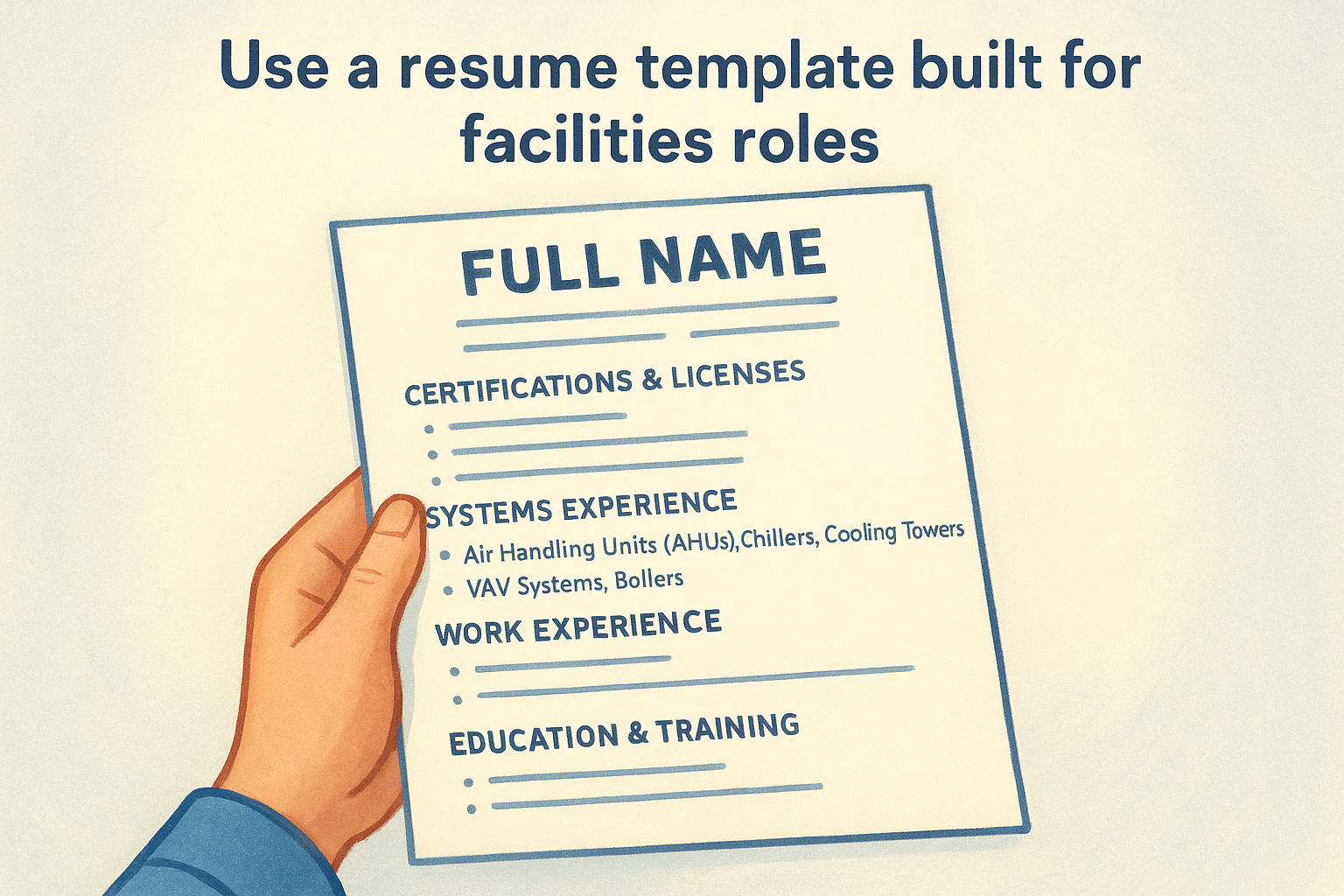
[Full Name]
[Phone] | [Email] | [City, State]

CERTIFICATIONS & LICENSES
- EPA 608 Universal
- [State] HVAC Journeyman License #[Number]
- OSHA 10 / OSHA 30
- [Any BAS certifications]

SYSTEMS EXPERIENCE
- Air Handling Units (AHUs), Chillers, Cooling Towers
- VAV Systems, Boilers
- DDC/BAS: [Specific platforms by brand]
- Infection Control (ICRA) Protocols

WORK EXPERIENCE
[Title] | [Employer] | [Dates]
- [Systems maintained + scale of facility]
- [Compliance standards followed]
- [Specific outcomes or uptime metrics]

EDUCATION & TRAINING
[Apprenticeship program or trade school, year completed]
Keep your resume to one or two pages maximum, and tailor the systems and certifications section to reflect what each posting specifically calls out. If a facility lists Trane or Siemens by name, those platforms should appear prominently in your resume for that application. Generic resumes get filtered out; targeted ones get interviews.
Interview and prove you can work in healthcare
Hospital interviews for HVAC positions go deeper than standard trade interviews. Facilities managers want to know you can handle live systems under pressure, work around patients, and follow compliance protocols from your first week on the job. Going in without preparation for healthcare-specific questions will cost you the role even if your technical skills are strong.
Prepare for technical and compliance questions
Expect the interviewer to ask you directly about ASHRAE 170 standards, pressurization requirements, and filtration ratings. If you can’t answer what air change rates are required in an operating room, or why an isolation room runs negative pressure, that gap signals you haven’t worked in a regulated healthcare environment. Study those specifics before your interview so you can answer confidently without hesitation.
Here are common technical questions asked in hospital hvac jobs interviews, along with the core points your answers should cover:
| Question | Key Points to Cover |
|---|---|
| "How do you handle a failed AHU in a surgical suite?" | Notify charge nurse, notify engineering supervisor, confirm backup system status, document |
| "What’s your experience with ICRA protocols?" | Barrier setup, dust containment, coordination with infection control team |
| "How do you maintain pressurization in an isolation room?" | Monitor differential pressure gauges, inspect seals, verify exhaust vs. supply balance |
| "Have you worked with DDC or BAS systems?" | Name the specific platform, describe what you monitored and adjusted |
Naming the exact BAS platform you’ve worked on and describing a real situation where you caught an issue through the system tells an interviewer more than a generic answer ever will.
Show you understand the healthcare environment
Beyond technical knowledge, hospital facilities managers want to see that you understand what it means to work around patients. Bring up ICRA barriers unprompted. Mention that you know to coordinate with nursing staff before opening ceilings near patient rooms. These details show situational awareness that most commercial technicians don’t have walking in.
Your communication style also matters in a healthcare interview. Hospitals run on coordination between departments, and a facilities technician who can clearly explain a system issue to a non-technical nurse manager is far more valuable than one who can’t. Practice explaining a mechanical problem in plain language before your interview. Walk in ready to demonstrate that you’re technically sharp, compliance-aware, and easy to work alongside in a high-stakes environment.
Negotiate pay, shift, and benefits
Getting an offer for a hospital HVAC job doesn’t mean the first number on the table is the final one. Hospitals, especially large health systems, have more flexibility in compensation than most hiring managers let on during the initial offer conversation. Knowing what to push on, and how to frame it, puts more money in your pocket from day one.
Know your number before the conversation
Before you respond to any offer, look up current market rates for your title and region using the Bureau of Labor Statistics Occupational Employment and Wage Statistics database at bls.gov. Cross-reference that data with the pay ranges from postings you’ve collected during your search. Walk into the negotiation with a specific target number backed by data, not a range. Giving a range signals that you’ll accept the lower end.
Your EPA 608 Universal license, state journeyman or master credentials, and any BAS platform experience each carry real market value. If the offer doesn’t reflect those qualifications, say so directly. A simple script that works:
"Based on my journeyman license, eight years of AHU and chiller experience, and familiarity with [specific BAS platform], I was expecting something closer to $X. Is there room to move in that direction?"
Push back on shift and on-call terms
Shift structure and on-call compensation deserve as much attention as your hourly rate. Some hospital HVAC roles list rotating shifts or weekend coverage without specifying what the on-call pay rate looks like. Ask for that number explicitly before you sign anything. If the shift rotation is non-negotiable, you still have room to negotiate differential pay for overnight or weekend hours, which many facilities offer but don’t volunteer upfront.
If you prefer a day shift and the facility posts a rotating role, ask whether seniority-based shift selection applies after your first year. Many hospital facilities departments allow senior technicians to select preferred shifts as openings occur, which gives you a concrete timeline for getting to a schedule that works for you.
Benefits worth negotiating beyond base pay
Healthcare facilities typically offer strong benefits packages, but not every item is fixed. Use this checklist to identify what’s negotiable before you accept:
- Tool and uniform allowances: Some facilities cover these; others don’t unless you ask
- Tuition reimbursement: Many hospital systems fund trade certifications and continuing education
- Signing bonus: More common in markets with HVAC technician shortages
- Licensure renewal reimbursement: Ask if the facility covers your state license renewal fees
- Paid on-call hours: Clarify whether on-call time is paid even when you aren’t called in
Document any verbal commitments in writing before your start date.
Start strong in your first 90 days
Landing one of the better hospital HVAC jobs in your area is only half the work. Your first 90 days determine whether you build a long career at that facility or find yourself looking for the next opportunity inside a year. Hospitals move fast, hold technicians to strict compliance standards from the start, and form opinions about new hires quickly. Use the structure below to show up prepared, earn trust early, and set yourself up for advancement.
Learn the systems before you need to fix them
Your first priority is understanding the facility’s specific equipment before an emergency forces you to figure it out under pressure. Ask your supervisor for access to mechanical drawings, equipment schedules, and the BAS platform during your first week, not your second month. Walk every mechanical room, air handling unit, and chase in the building with a notebook and document what you see. Learning the layout of a hospital’s mechanical infrastructure before something breaks is what separates technicians who react from technicians who lead.
Use this simple tracking format in your notebook or phone notes as you walk the building:
Location: [Floor / Wing]
Equipment Type: [AHU / Chiller / Boiler / VAV]
Equipment ID: [Tag number from equipment]
BAS Point Name: [How it appears in the control system]
Last PM Date: [If visible on equipment log]
Notes: [Anything unusual you observe]
Technicians who map the building in their first two weeks become the person everyone calls when something goes wrong at 2 a.m.
Build relationships with nursing and facilities staff
Clinical staff and facilities coordinators are your daily working partners, and how you show up in those relationships affects your job more than most technical skills do. Introduce yourself to charge nurses on the units you support. Learn which areas are highest priority for temperature and pressure control, and let those nurses know you’re the person to call if something feels off. That relationship creates goodwill and gives you early warning on system issues before they escalate to formal complaints.
On the facilities side, find out how work orders are submitted and prioritized in your department’s system. Whether your facility uses IBM Maximo, Accruent, or a simpler platform, processing your work orders accurately and on time shows your supervisor that you’re reliable and organized, which matters during every performance review cycle.
Track your accomplishments from week one
Keep a running log of every preventive maintenance task completed, system issue resolved, and compliance action documented starting on day one. This log becomes your evidence base when you request a pay increase or promotion at your six-month or one-year review. A short weekly entry in a notes app is enough: date, equipment worked on, action taken, outcome. Facilities managers and chief engineers who see candidates with documented results rather than vague claims consistently promote those people faster.
Next steps
You now have everything you need to find and land hospital HVAC jobs near you. You know which titles to search, what pay to expect, which credentials move applications forward, and how to negotiate once an offer lands. The path from your current position to a healthcare facilities role is clear: build your target employer list, set up your search alerts, tailor your resume to each posting, and walk into every interview ready to speak to compliance standards and specific systems.
Start with three concrete actions this week. Map out every hospital and health system within your commute range, set up daily job alerts for each title covered in this guide, and update your resume to lead with your certifications and systems experience. The demand for qualified technicians in healthcare is strong right now. Browse open trade roles on bluecollarjobs.com and apply to the ones that match your license level and target facilities.

Start earning instantly—become our affiliate and earn on every sale!
https://shorturl.fm/yVznO