
How To Become An HVAC Technician: Steps, Training & Certs
HVAC technicians install, maintain, and repair the heating and cooling systems that keep homes and commercial buildings running. It’s hands-on work with real demand, the Bureau of Labor Statistics projects steady growth through 2032, and experienced techs often earn $70,000 or more annually. If you’re exploring how to become an HVAC technician, you’re considering one of the most reliable career paths in the skilled trades.
This guide walks you through every step of the process: education options, trade school programs, apprenticeships, EPA certification, NATE credentials, state licensing requirements, and job search strategies. You’ll find a clear roadmap whether you’re fresh out of high school or making a mid-career switch.
At bluecollarjobs, we connect skilled tradespeople with employers across all 50 states. HVAC positions are among the most frequently posted jobs on our platform, and companies are actively searching for qualified technicians. Here’s how to join their ranks.
What HVAC technicians do and what to expect
HVAC technicians install, troubleshoot, and repair heating, ventilation, and air conditioning systems in residential homes, commercial buildings, and industrial facilities. Your day-to-day work involves reading blueprints, running diagnostics with specialized meters, replacing faulty components like compressors or thermostats, and performing preventive maintenance to keep systems running efficiently. You’ll work with refrigerants, ductwork, electrical circuits, and control systems that require both mechanical skill and problem-solving ability.
Daily responsibilities
Your typical workday starts with a service call or installation job. You’ll arrive at a customer site, assess the system issue, and explain the problem in clear terms the property owner can understand. Installation jobs require you to measure spaces, cut and fit ductwork, mount outdoor condensers, wire control panels, and test the entire system before sign-off. Service calls might involve anything from replacing a blower motor to diagnosing a refrigerant leak or recalibrating a thermostat.
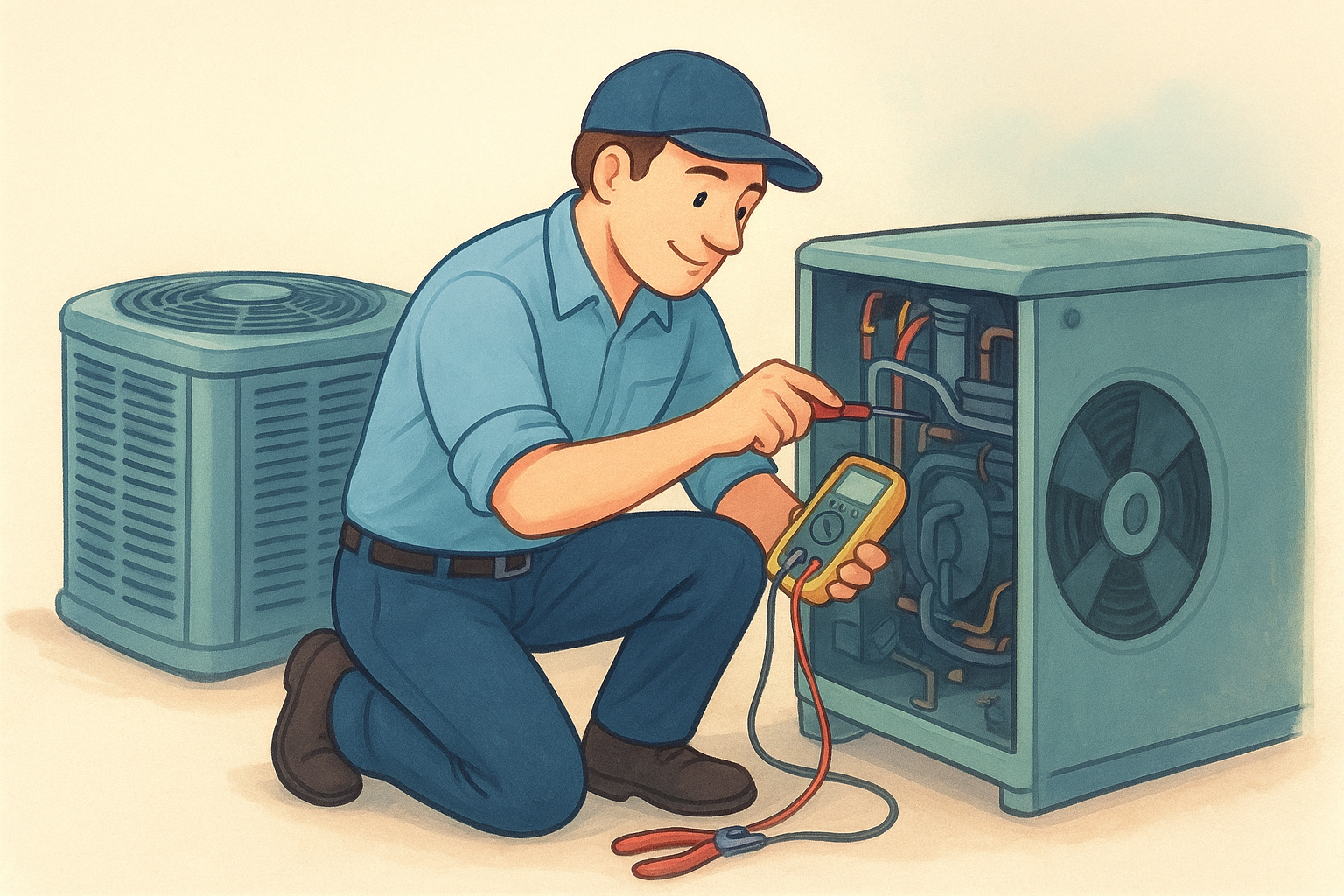
Expect to handle these core tasks regularly:
- Install new HVAC units in residential and commercial properties
- Diagnose mechanical and electrical failures using multimeters and pressure gauges
- Replace worn components like capacitors, contactors, and fan motors
- Clean coils, change filters, and perform seasonal tune-ups
- Recharge refrigerant systems and repair leaks
- Test airflow, temperature differentials, and system efficiency
- Complete service reports and order replacement parts
Work environment and conditions
You’ll spend most of your time in crawl spaces, attics, basements, and rooftops where HVAC equipment is housed. Summer months can be brutal when you’re working in a 120-degree attic, and winter service calls often mean diagnosing a failed furnace in freezing conditions. The work demands physical stamina: you’ll lift 50-pound units, crouch in tight spaces, climb ladders, and work on your feet for eight to ten hours straight.
Most technicians split their time between scheduled maintenance appointments and emergency service calls. Residential HVAC companies often require on-call rotation, which means you might respond to a no-heat emergency at 2 AM in January. Commercial technicians typically work regular business hours but handle larger systems in office buildings, hospitals, and retail centers.
Pay and career growth
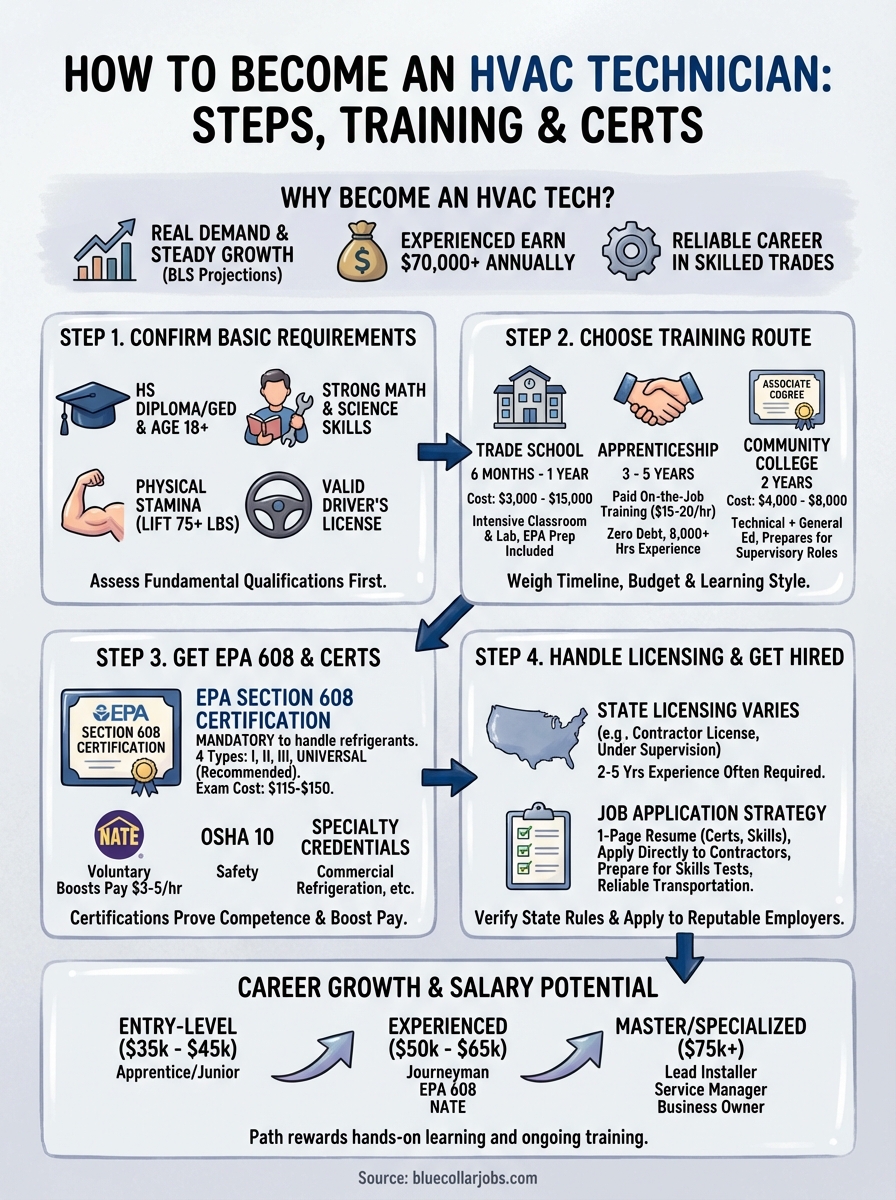
Entry-level HVAC technicians earn $35,000 to $45,000 annually while they build experience and complete certifications. Once you hold EPA 608 certification, NATE credentials, and two to three years of field experience, your earning potential jumps to $50,000 to $65,000. Master technicians and those with specialized skills in commercial refrigeration or building automation systems can clear $75,000 or more.
Career advancement follows a clear path: apprentice, journeyman, master technician, lead installer, service manager, or business owner.
Understanding how to become an HVAC technician means recognizing that this trade rewards hands-on learners who can handle physical work, solve complex problems under pressure, and commit to ongoing training as systems evolve. The demand for skilled technicians continues to outpace supply, which translates to job security and competitive wages for those who complete proper training.
Step 1. Confirm you meet the basic requirements
Before you invest time and money into training, verify that you meet the baseline qualifications that employers and training programs expect. Most HVAC companies and technical schools have non-negotiable entry requirements that filter candidates before they start. Understanding how to become an HVAC technician begins with an honest assessment of whether you meet these fundamental standards.
Age and education minimums
You must be at least 18 years old to enroll in most HVAC programs and obtain EPA certification to handle refrigerants. Technical schools occasionally accept 17-year-olds who will turn 18 before graduation, but you cannot work independently with refrigerants until you reach the legal age requirement. A high school diploma or GED is mandatory for apprenticeships, trade school admission, and employment with reputable HVAC contractors.
Strong performance in math and science courses gives you a significant advantage. You’ll use algebra to calculate heat load, geometry to measure ductwork, and basic physics to understand thermodynamics and electrical circuits. If your high school transcript shows gaps in these areas, consider completing a refresher course at a community college before applying to HVAC programs.
Physical fitness requirements
HVAC work demands genuine physical stamina that goes beyond occasional heavy lifting. You need the ability to carry 75-pound equipment up stairs, work in cramped attics during summer heat, and spend hours crouching or kneeling on concrete floors. Most employers require you to pass a pre-employment physical that tests your ability to lift, bend, climb, and work at heights.
Technicians with unmanaged joint problems, severe back issues, or cardiovascular conditions often struggle with the physical demands of daily service calls.
You’ll also need normal color vision to identify wire colors in electrical circuits and refrigerant pressure readings on gauge manifolds. Some companies test for this during the interview process. A valid driver’s license with a clean record is essential since you’ll operate company vehicles between job sites multiple times per day.
Step 2. Choose the right training route
You have three primary training pathways to enter the HVAC field, and your choice depends on your timeline, budget, and learning style. Trade schools offer intensive classroom instruction combined with hands-on lab work, apprenticeships provide paid on-the-job training alongside experienced technicians, and community colleges deliver associate degrees that blend theory with practical skills. Each route leads to the same destination, but they differ significantly in cost, duration, and how quickly you start earning.
Technical and trade schools
Trade schools complete your HVAC education in six months to one year through accelerated programs that focus exclusively on heating, cooling, and refrigeration systems. You’ll spend mornings in classrooms learning electrical theory, refrigeration cycles, and building codes, then move to lab spaces where you wire control panels, braze copper lines, and troubleshoot live equipment. Programs cost $3,000 to $15,000 depending on location and equipment quality.
Graduates leave with EPA 608 certification (required to handle refrigerants) and often earn OSHA 10 safety credentials before their first job interview. This speed-to-employment advantage makes trade schools the preferred choice for career changers who need income quickly.
Apprenticeship programs
Union and non-union contractors offer apprenticeships that combine classroom instruction with paid fieldwork over three to five years. You’ll earn $15 to $20 per hour as an apprentice while learning directly from journeyman technicians on real service calls and installations. Local HVAC contractors, union halls (like UA Local pipefitters), and state apprenticeship agencies coordinate these programs.
Apprentices graduate with zero student debt and 8,000+ hours of documented field experience that accelerates career advancement.
Community college associate degrees
Two-year HVAC associate degree programs cost $4,000 to $8,000 and provide the most comprehensive technical education. You’ll study HVAC fundamentals alongside general education courses in business communication and basic management. This broader education prepares you for supervisory roles and business ownership faster than trade school graduates typically achieve.
Understanding how to become an HVAC technician through the right training route means weighing your financial situation against how quickly you need to start working.
Step 3. Get EPA Section 608 and other certifications
Certifications separate qualified technicians from unlicensed handymen and directly impact your starting salary and job opportunities. The EPA legally requires certification before you touch refrigerants, while voluntary credentials like NATE prove your technical competence to employers who pay $3 to $5 more per hour for certified technicians. Understanding how to become an HVAC technician means recognizing that these credentials are non-negotiable if you want legitimate employment with reputable contractors.
EPA Section 608 certification process
You must pass the EPA Section 608 exam to legally purchase, handle, or dispose of refrigerants in any HVAC system. The test covers four certification types: Type I (small appliances), Type II (high-pressure systems), Type III (low-pressure systems), and Universal (all types). Most technicians pursue Universal certification from the start since it qualifies you for any residential or commercial work.
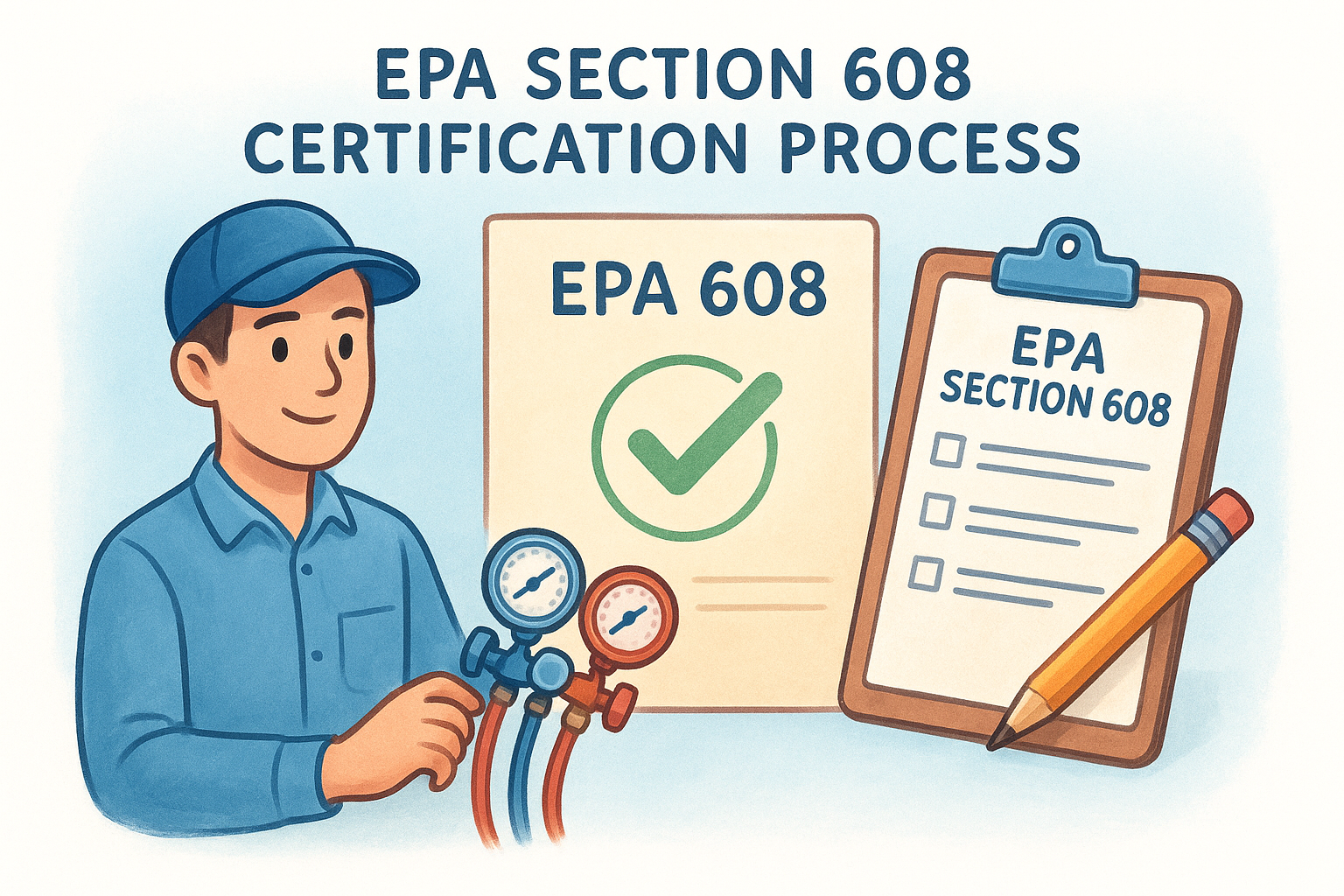
The exam costs $115 to $150 through approved testing organizations, and you can take it at trade schools, union halls, or independent testing centers. You’ll answer multiple-choice questions about refrigerant properties, recovery procedures, leak repair requirements, and environmental regulations. Study materials are available online, and most candidates pass after two weeks of focused preparation using practice tests and EPA guidebooks.
Trade schools typically include EPA 608 prep and testing as part of their curriculum, saving you separate exam fees.
NATE and specialty credentials
NATE (North American Technician Excellence) certification validates your knowledge in specific HVAC specialties like air conditioning, heat pumps, or gas furnaces. Employers view NATE credentials as proof of real competence since the exams test practical troubleshooting scenarios rather than just theory. Each specialty exam costs $116, and you’ll need to recertify every two years.
Additional credentials that boost your marketability include OSHA 10 safety training ($75-$125), manufacturer-specific certifications from Carrier or Lennox, and specialty credentials in building automation or commercial refrigeration.
Step 4. Handle licensing and get hired
State licensing requirements vary dramatically across the country, and you need to verify your specific state’s regulations before applying for jobs. Some states like California and Texas require state-issued contractor licenses for anyone working independently, while others allow technicians to work under a licensed contractor’s supervision without their own credential. Final steps in understanding how to become an HVAC technician include navigating these regulatory requirements and landing your first position with a reputable employer.
State licensing requirements
Check your state’s contractor licensing board website to determine whether you need an individual technician license or can work under a master contractor’s oversight. States like Florida require registered apprentices to document training hours before testing for journeyman status, while Arizona mandates specific classroom hours and a state exam. You’ll typically need two to five years of documented experience plus EPA certification before qualifying for an independent license.
Application fees range from $50 to $300 depending on license type, and most states require proof of liability insurance before issuing contractor credentials. Keep detailed records of your work hours, training certificates, and employer verification letters throughout your apprenticeship since licensing boards audit these documents during the application process.
Job application strategy
Start your job search on specialized platforms that connect HVAC technicians with contractors actively hiring in your area. Build a one-page resume that lists your EPA 608 certification, NATE credentials, trade school completion, and any hands-on experience from internships or apprenticeships. Include specific skills like brazing, electrical troubleshooting, and equipment types you’ve worked on.
Employers prioritize candidates who can start immediately and have reliable transportation to multiple job sites daily.
Apply directly to established HVAC contractors in your region rather than relying solely on general job boards. Call the company after submitting your application to express interest and ask about their hiring timeline. Expect practical skills tests during interviews where you’ll wire a thermostat, diagnose a pressure issue, or identify refrigerant types. Dress professionally but practically since many employers conduct same-day ride-alongs to assess your work ethic and communication skills with customers.
Next steps
You now have a complete roadmap for how to become an HVAC technician, from confirming basic requirements through training options, EPA certification, and state licensing. The path typically takes six months to two years depending on whether you choose trade school, apprenticeship, or community college programs. Your earning potential grows steadily as you accumulate certifications and field experience, with experienced technicians clearing $65,000 to $75,000 annually.
Start by researching EPA 608 testing centers in your area and identifying trade schools or apprenticeship programs that fit your schedule. Apply to multiple HVAC contractors simultaneously to maximize your chances of landing that first position. Document every training hour, certification, and work experience since you’ll need this paper trail for future licensing applications.
BlueCollarJobs connects skilled tradespeople with employers actively hiring across all 50 states. Browse our blue collar career resources for more guides on trade certifications, salary expectations, and job search strategies in the skilled trades industry.
Want blue collar jobs delivered to your inbox?
Want blue collar jobs delivered to your inbox?
