
A local union welding apprenticeship is one of the most reliable paths into a skilled trade career that pays well from day one. Union programs, mostly run through the United Association (UA) and the International Brotherhood of Boilermakers, combine paid on-the-job training with classroom instruction, and they cover tuition costs that would otherwise come out of your pocket.
But finding open programs and figuring out the application process isn’t always straightforward. Requirements vary by local chapter, application windows are narrow, and the steps aren’t always posted in obvious places. That’s exactly the kind of gap we built bluecollarjobs to fill, connecting trade workers with real opportunities across every state, including apprenticeships and entry-level positions in welding and other skilled trades.
This guide breaks down how union welding apprenticeships work, what you need to qualify, and how to find a program accepting applications near you. We’ll walk through the timeline, the training structure, and the specific steps to get your application in front of the right local chapter.
What a local union welding apprenticeship is
A local union welding apprenticeship is a structured training program where you earn a wage while learning the trade from the ground up. Unlike trade school, you don’t pay tuition while sitting in a classroom full-time. Instead, you work alongside licensed journeymen on real job sites, get paid for every hour, and attend related technical instruction (RTI) classes in the evenings or on weekends.
Apprentices typically start at 50-60% of a journeyman’s hourly rate, with automatic raises tied to each program level they complete.
How the training is structured
Most union welding apprenticeships span four to five years, split between field hours and classroom instruction. You’ll log roughly 8,000 hours of on-the-job work over the course of the program, alongside several hundred hours of RTI annually. The program moves in tiers, and your hourly rate increases at each step. By the time you finish, you hold a journeyman card recognized on job sites across the country.
Your RTI classroom hours cover technical subjects you’ll use on every job site, including blueprint reading, metallurgy, welding codes like AWS D1.1, and OSHA safety standards. These topics are tested requirements for advancing in the program, not optional add-ons.
Who runs these programs
The United Association (UA) and the International Brotherhood of Boilermakers sponsor the majority of union welding apprenticeships in the United States. The UA focuses on pipefitters and welders working on piping systems, while the Boilermakers train workers specializing in pressure vessels, tanks, and industrial construction. Both organizations run programs through local chapter offices, which means your application goes to the chapter covering your area rather than to a national body.
Each local chapter controls its own application windows and entry requirements, so the specific steps vary by location. That’s why your first move is identifying which local covers your zip code and contacting them directly.
Step 1. Find the right local and training center
Your first move in pursuing a local union welding apprenticeship is locating the specific chapter that covers your geographic area. Both the UA and the Boilermakers run through a local chapter system, meaning your zip code determines which office handles your application. Contacting the wrong local wastes time, so pin down your chapter before you take any other steps.
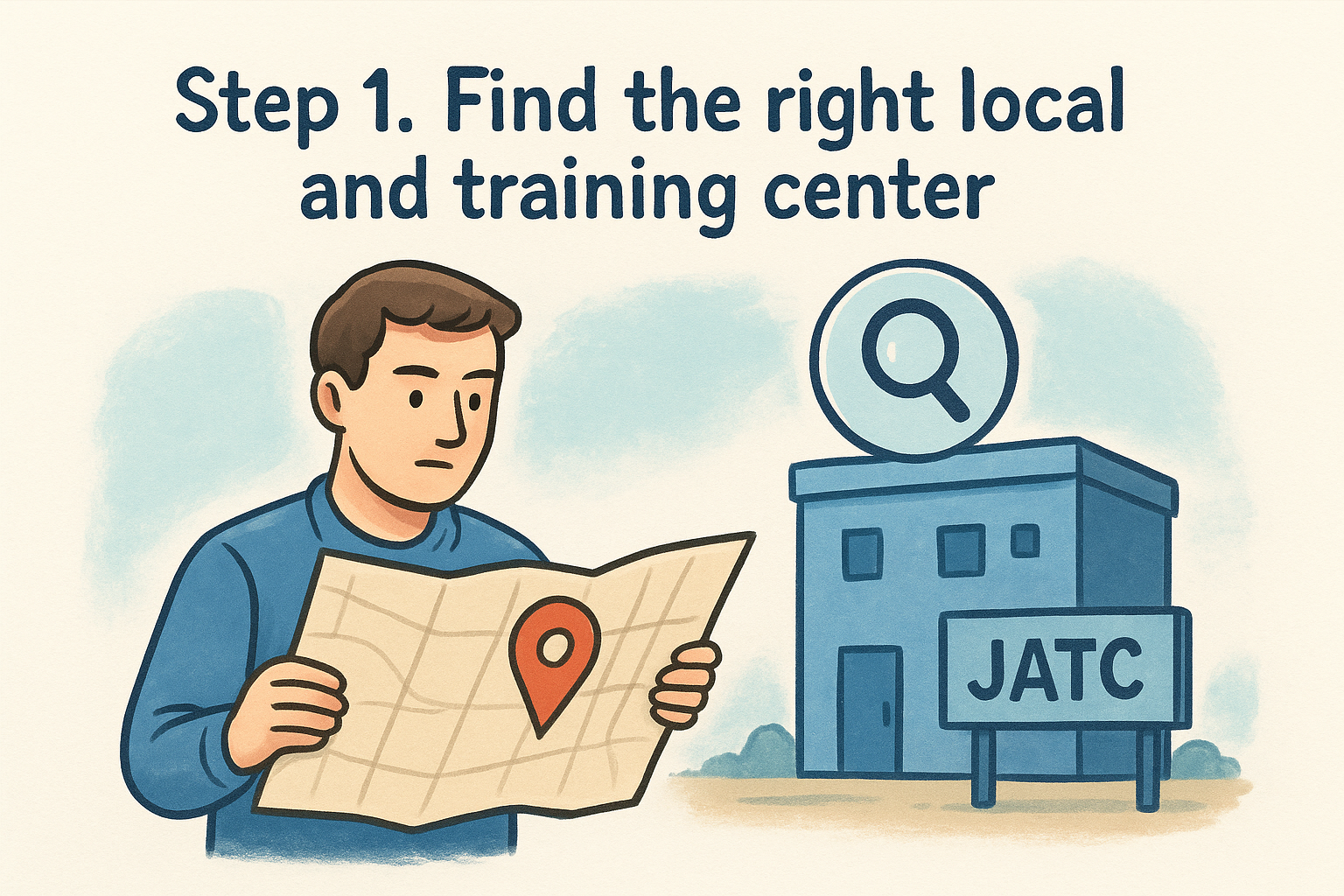
The UA’s official website lets you search for locals by state and city, making it the fastest way to confirm which chapter covers your area.
How to locate your local chapter
Once you identify your state, use the union’s official directory to pull the local number, phone contact, and physical address for your chapter. Call the hall directly and ask two things: whether the apprenticeship program is currently active, and when the next open enrollment window opens. Many locals only accept applications once or twice a year, so missing that window means waiting another full cycle.
- Visit ua.org and use the "Find a Local" search tool
- Call the hall and ask specifically for the JATC office (Joint Apprenticeship Training Committee), which runs the actual training program
- Confirm the application open date and request the checklist of required documents
Step 2. Check requirements and eligibility
Before you submit anything to your local JATC, confirm that you meet the baseline eligibility criteria. Most union welding apprenticeship programs share a common set of requirements, but specific locals can add conditions such as a valid driver’s license or documented work history in a related field.
Meeting the minimum age and education requirements doesn’t guarantee entry, but failing to meet them disqualifies you before the process even starts.
Standard entry requirements
Most local union welding apprenticeship programs require applicants to meet the following criteria before their application is accepted:
- Age: 18 years old at the time of application
- Education: High school diploma or GED equivalent
- Math: Proof of one semester (or equivalent) of algebra, either completed or currently enrolled
- Physical fitness: Ability to perform the physical demands of the trade
- Legal work authorization: Eligible to work in the United States
Some locals also require a valid government-issued photo ID and a copy of your birth certificate at the time you submit your paperwork. Pull these documents together before the application window opens so you are not scrambling at the deadline.
Step 3. Prepare your application and testing
Once you confirm your eligibility and application window, start gathering your paperwork well before the deadline. Most locals in a local union welding apprenticeship program require the same core documents, but having everything organized ahead of time prevents last-minute delays that could push you to the next cycle.
What documents to gather
Your JATC office will give you a specific checklist, but the following documents are standard across most programs:
- High school diploma or GED transcript
- Government-issued photo ID (driver’s license or passport)
- Birth certificate or proof of legal work authorization
- Algebra coursework documentation (transcript or enrollment confirmation)
- Completed application form from your local JATC
The aptitude test
Nearly every local requires applicants to pass a written aptitude test before they move forward in the selection process. The test covers two areas: reading comprehension and algebra. You do not need advanced math, but you need to work confidently through linear equations and basic problem-solving under timed conditions.

Reviewing a standard algebra workbook for two to three weeks before your test date gives you a measurable edge over applicants who show up cold.
Study the mechanics of solving for variables, working with fractions, and interpreting word problems. Both subject areas are scored, and a strong combined score moves your ranking up on the selection list.
Step 4. Apply, interview, and start work
Submit your completed application packet to the JATC office by the posted deadline. Confirm receipt in person or by phone and get a reference number as proof your paperwork was logged.
The interview
Applicants who score high enough move to a ranked interview, where the committee evaluates your work history, attitude, and commitment. Dress appropriately, show up early, and bring a second copy of your application documents as backup.
- Be direct about your motivation for pursuing a local union welding apprenticeship
- Mention any prior hands-on experience, even if informal
- Ask about the dispatch process and expected start dates
Your ranking combines your aptitude test score and your interview score, so a strong interview can lift your standing even if your test score was average.
Starting your apprenticeship
After you receive your acceptance letter, the JATC dispatches you to a signatory contractor in your area. Your first day on the job is paid, and your wage increases follow a fixed schedule tied to program milestones.
You also register with your local union hall at this stage, which activates your health and retirement benefits and begins your official record of union hours.
What to do next
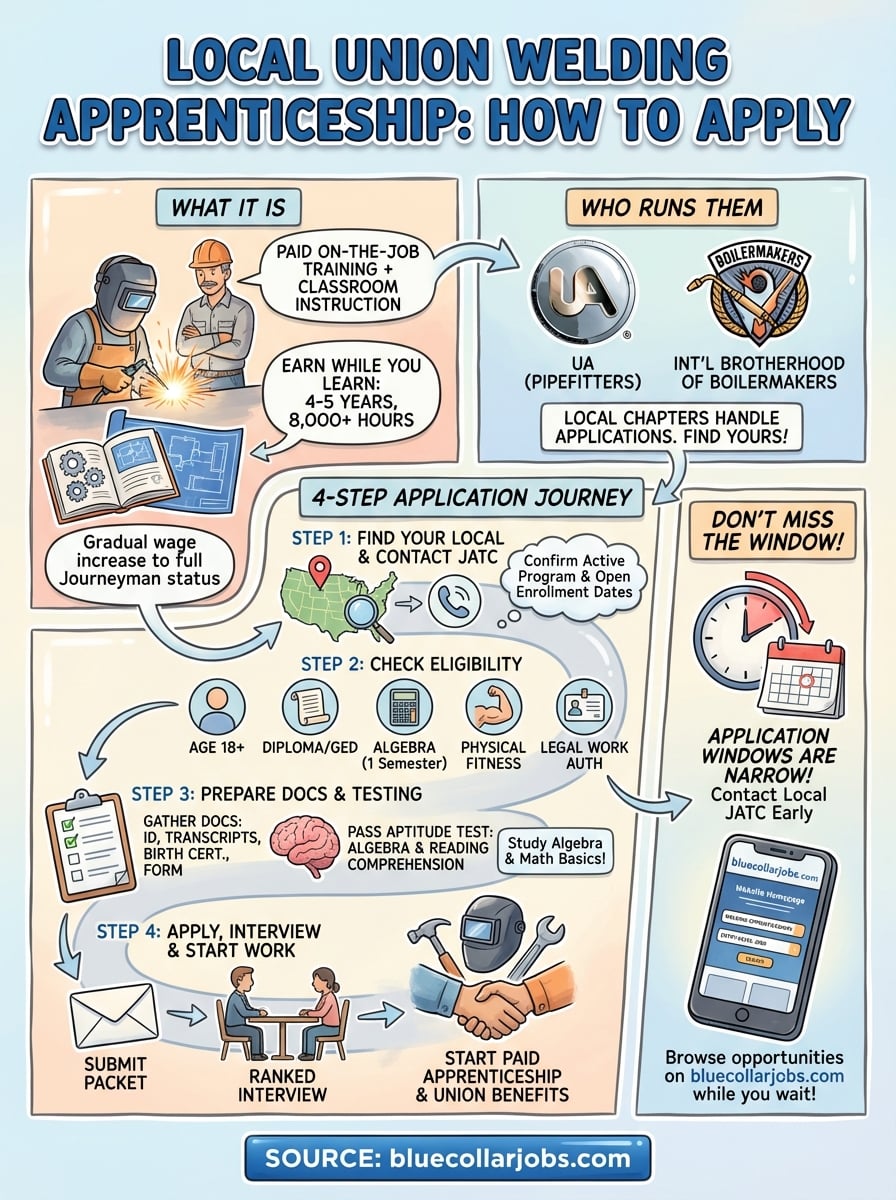
You now have a clear roadmap for pursuing a local union welding apprenticeship: find your chapter, confirm eligibility, prepare your documents, pass the aptitude test, and show up to the interview ready to compete. The process takes preparation, but every step is manageable if you tackle them in order. The biggest mistake applicants make is waiting too long and missing the application window by a few days.
Start by calling your local JATC office this week to get the exact open enrollment date and a copy of their required documents checklist. That call takes five minutes and tells you everything you need to know about your specific timeline.
If you are also looking for entry-level welding jobs or helper positions to build experience while you wait for the next enrollment cycle, browse the current listings at bluecollarjobs.com for trade-specific opportunities posted by employers actively hiring near you.

1 thought on “Local Union Welding Apprenticeship: How To Apply Near You”