

Welding pays well, offers real job security, and doesn’t require a four-year degree, but choosing a welding career path isn’t as simple as picking up a torch. Between pipe welding, underwater welding, structural work, and robotic welding operations, the specializations alone can shape whether you’re earning $40,000 or $100,000+ a year. And that’s before factoring in certifications, union vs. non-union routes, and where you decide to work.
The problem is that most career guides either oversimplify the options or bury the practical details. If you’re trying to figure out which welding specialty fits your goals, what kind of training you actually need, and how to move from entry-level to foreman or inspector, you need specifics, not motivational filler. That’s exactly what this guide covers: real salary ranges, certification requirements, and advancement steps based on where the industry stands right now.
At bluecollarjobs, we connect skilled trades workers with employers actively hiring across the U.S. We built this resource because welding job seekers on our platform consistently ask the same thing, what’s the best path forward? Below, you’ll find a clear breakdown of specialties, pay, and next steps to help you answer that question for yourself.
Why welding career paths look so different
A welder working on an offshore oil rig and a welder fabricating parts in a manufacturing plant share the same job title, but their day-to-day work, pay, physical demands, and advancement options are almost completely different. Your welding career path depends on at least four major variables: the industry you work in, the process you specialize in, the certifications you hold, and whether you pursue a union or non-union route. Change any one of those variables and your salary ceiling, schedule, and promotion timeline all shift.
Industry sector shapes everything
The industry you enter is probably the single biggest factor in how your welding career plays out. Structural welding on bridges and buildings keeps you outdoors, often on large projects with fixed timelines, and exposes you to union pay scales that can push hourly wages well above the national average. Manufacturing and fabrication shops offer steadier hours and more predictable environments but tend to have narrower pay ranges and slower advancement unless you cross-train on equipment operation or quality inspection.
Offshore and underwater welding sits at the extreme end of pay and risk. Commercial divers who weld underwater can earn $100,000 or more annually, but the physical demands and certification requirements are steep. Pipeline welding, especially on long-haul natural gas or oil lines, moves you across states for stretches at a time, which pays well for those willing to travel but creates lifestyle trade-offs that not every welder wants.
The industry you choose often matters more than the welding process you master when it comes to long-term earning potential.
Welding process and position certifications
Which process you weld with also splits career paths in a significant way. SMAW (stick welding) is widely used in structural and maintenance work and relatively easy to learn. TIG welding requires far more precision and dominates aerospace, pharmaceutical, and high-purity piping work, which translates to higher pay and stricter certification demands. MIG welding covers a broad range of fabrication and automotive work but faces growing competition from automated systems, so adding a second process certification to your resume matters more every year.
Your position certifications further determine which jobs you can legally bid on. A welder certified only in flat and horizontal positions cannot take work requiring overhead or vertical welds. Expanding your position qualifications through AWS certifications directly expands the number of job postings you qualify for on any given search, which is something you’ll notice immediately when browsing active listings.
Common welding roles and specialties
Not every welding career path looks the same on paper, and understanding the most common roles upfront saves you from training for a specialty that doesn’t match your actual goals. The roles below represent the clearest and most active segments of the current U.S. welding job market.

Structural, pipe, and fabrication welders
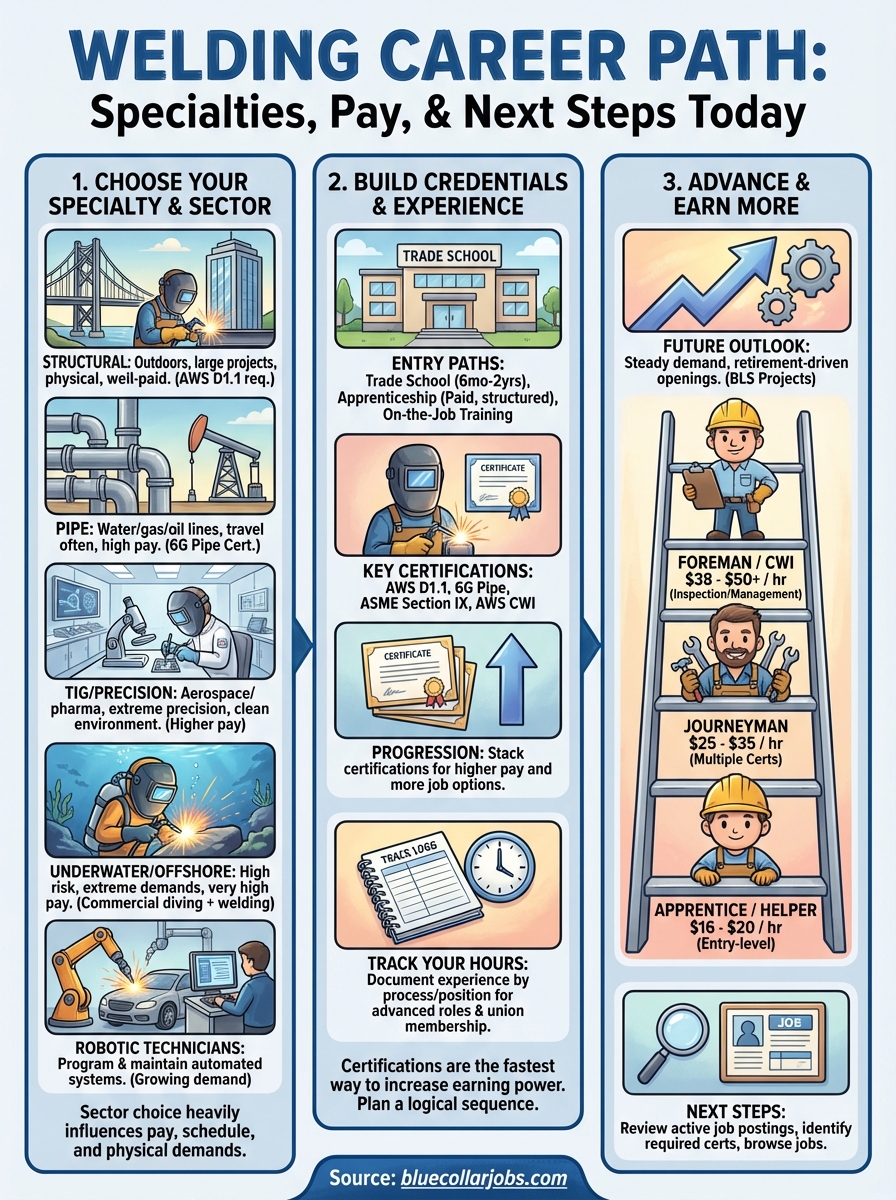
Structural welders work on bridges, buildings, and heavy infrastructure, typically outdoors and on large-scale projects. The work is physically demanding, often involves working at height, and pays well because the conditions and AWS certifications required filter out a large portion of applicants. Pipe welders operate in a related but distinct space, working on water, gas, and oil lines in both residential and industrial settings. Fabrication welders, by contrast, spend most of their time indoors building metal components in a shop environment, which attracts workers who prefer consistent schedules over project-based travel.
Pipe and structural welders consistently rank among the highest-paid welding roles in the U.S. because the certification requirements are strict and the working conditions are demanding.
Specialty and high-skill welding roles
Some welding roles require additional training beyond standard certifications, and they pay accordingly. TIG welders working in aerospace or pharmaceutical piping handle materials like titanium and stainless steel that require extreme precision, which pushes their hourly rates well above general fabrication work. Underwater and hyperbaric welders combine commercial diving credentials with welding skill and earn among the highest wages in any trade, though the physical risk is significant. Robotic welding technicians sit at a different end of the spectrum: you’re programming and maintaining automated systems rather than welding by hand, and demand for this role is growing fast as manufacturers add automation to their shop floors.
Pay and job outlook for welders in the US
Pay in welding spans a wide range, and understanding where you fall on that scale depends directly on your specialty, certifications, and location. According to the Bureau of Labor Statistics, the median annual wage for welders sits around $47,000, but that number alone tells you very little. Underwater welders, certified pipe welders, and TIG specialists working in aerospace regularly clear $70,000 to $100,000+ once they accumulate experience and the right credentials.

What welders earn at each experience level
Your position on the pay scale ties directly to how many years you’ve worked and which certifications you’ve passed. Entry-level welders and apprentices typically earn $16 to $20 per hour, while journeyman-level welders with multiple process certifications move into the $25 to $35 per hour range depending on the sector. Foremen, supervisors, and certified welding inspectors (CWIs) commonly cross $40 per hour, and that’s before overtime or per diem on travel jobs.
Earning potential in welding climbs faster when you add certifications than when you simply add years on the job.
| Experience Level | Typical Hourly Range |
|---|---|
| Apprentice / Helper | $16 – $20 |
| Journeyman | $25 – $35 |
| Foreman / CWI | $38 – $50+ |
Where the job market is heading
The BLS projects steady demand for welders through the next decade, driven by infrastructure investment and manufacturing activity returning to the U.S. Mapping out your welding career path now also works in your favor because a large share of experienced welders are approaching retirement age, which is opening senior roles faster than new workers are entering the field.
Training, certifications, and skills that raise pay
Your training choices set the ceiling on what you can earn, and you don’t need a four-year degree to access the highest-paying roles in the trade. Welding programs at community colleges and technical schools typically run six months to two years, covering core processes and preparing you for entry-level certification tests. The route you choose into the field shapes how quickly you start earning real money.
Entry paths: trade school, apprenticeship, or on the job
Most welders enter the trade through one of three routes: a formal trade school program, a union or non-union apprenticeship, or direct on-the-job training with an employer. Apprenticeships combine paid work with structured classroom hours, so you earn while you learn and graduate with documented hours that count toward journeyman certification. If you’re starting with no experience, an apprenticeship through a union hall or a contractor willing to train gives you the strongest combination of pay and credential-building from day one.
Certifications that directly increase your earning power
Certifications are the fastest lever on your welding career path for moving up the pay scale. Each additional process or position certification qualifies you for more job postings and gives you real negotiating power when employers compete for experienced welders. The certifications below consistently add the most value:
- AWS D1.1 Structural Welding Certification: required for most structural and bridge work
- AWS Certified Welding Inspector (CWI): opens inspection and QC roles paying $38 to $50+ per hour
- 6G Pipe Certification: the most recognized all-position pipe test, accepted across most industries
- ASME Section IX: required for pressure vessel and power piping work
Stacking a CWI credential on top of field experience is one of the most reliable ways to move into management-track roles without leaving the trade entirely.
Plan your welding career path step by step
Mapping out your welding career path before you start training saves you from spending time and money on certifications that don’t match your actual goal. The steps below give you a practical sequence you can follow from where you are now to where you want to be, without overcomplicating a process that mostly comes down to deliberate choices made in the right order.
Start with a clear specialty target
Before enrolling in any program, decide which sector and specialty actually appeals to you. Structural, pipe, TIG, and robotic welding each require different entry paths and lead to different long-term options. Spend time reviewing active job postings in your area to understand what certifications local employers require most, because that data tells you exactly where to focus your training dollars rather than guessing.
Build credentials progressively
Once you identify your target specialty, stack your certifications in a logical order. Start with the process certifications entry-level roles require, then add position qualifications that open higher-paying jobs. Most experienced welders earn their 6G pipe cert or AWS D1.1 structural cert before pursuing inspection credentials like the CWI, since documented field hours strengthen your test performance significantly.
Adding one targeted certification per year is a realistic pace that keeps your skills sharp without burning you out on testing fees and prep time.
From your first day on the job, track your documented hours by process and position carefully. Many journeyman-level requirements and AWS certifications ask for specific hour counts in defined processes, so keeping a personal log from day one gives you a clear record when you apply for advanced roles or union membership. That record also strengthens your negotiating position when you push for pay increases tied to your growing credentials.
Your next steps
Your welding career path comes down to three things: picking a specialty that fits your goals, building the right certifications in order, and tracking your hours from day one. The good news is that the job market is actively working in your favor right now. Retirements are opening senior roles, infrastructure spending is pushing demand higher, and employers across the country are competing for welders who hold the right credentials.
The next practical move is simple: get in front of real job postings. Reviewing active listings in your target specialty tells you exactly which certifications and experience levels employers in your area value most, which beats guessing based on general advice. Use that information to prioritize your training and position yourself ahead of applicants who don’t do that research.
Start browsing welding jobs hiring now at bluecollarjobs.com and see what employers in your state are actively looking for today.
