

Whether you’re hiring your next welder or preparing to land a welding gig, a solid MIG welder job description matters more than most people think. It’s the difference between attracting qualified candidates and wasting everyone’s time, or, on the flip side, knowing exactly what an employer expects before you walk through the door. MIG welding remains one of the most in-demand skilled trades across manufacturing, construction, and fabrication shops nationwide.
This guide breaks down the core duties, required skills, certifications, and typical pay ranges for MIG welders at every experience level. We built it using real job listing data from employers posting on bluecollarjobs, where thousands of trade-specific roles, including welding positions, are listed with transparent salary ranges and clear requirements. Whether you’re writing a posting or reading one, you’ll walk away with a practical understanding of what this role actually looks like in 2026.
What a MIG welder does day to day
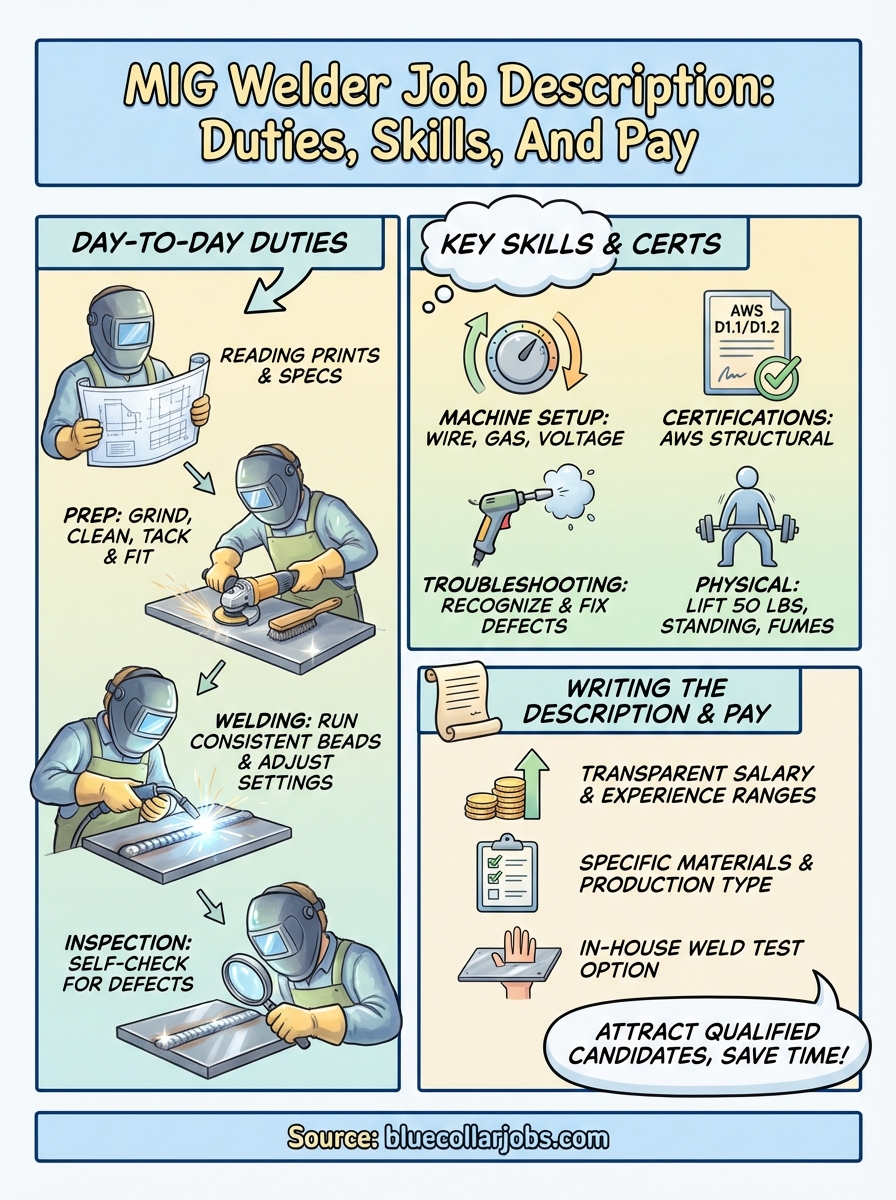
A MIG welder’s day starts well before the torch ever fires up. Most of the actual work involves reading technical drawings, measuring materials, and preparing metal surfaces before any arc is struck. The welding itself is only one piece of the role, and understanding the full scope is useful whether you’re building a mig welder job description from scratch or trying to figure out what a typical shift looks like on the shop floor.
Core welding tasks
Once prep is done, a MIG welder runs consistent beads along joints, seams, and structural connections using a wire-feed process that makes MIG one of the faster and more versatile welding methods in production and fabrication environments. You’re responsible for selecting the correct wire gauge, shielding gas mixture, and voltage and wire speed settings for each job. The base metal type matters: welding aluminum requires completely different parameters than mild steel or stainless. Getting those settings wrong wastes material and creates defects that don’t show up until a part fails under real-world stress.

The ability to dial in machine settings quickly and accurately is what separates a reliable MIG welder from one who requires constant oversight on the floor.
Welders also inspect their own work throughout the shift. You check for porosity, incomplete fusion, undercutting, and burn-through after each weld pass. Quality control is built into the role at most shops, not handed off to a separate inspector. That’s particularly true in fabrication environments where your weld goes directly into a finished structural or mechanical product.
Prep work and non-welding responsibilities
Before you weld anything, you grind, clean, and fit parts together. Surface contamination like rust, oil, paint, and mill scale causes weld defects, so thorough prep is never optional. Depending on the base metal and shop standards, you use angle grinders, wire brushes, and chemical degreasers to get the material ready. You also tack-weld pieces into position before running full passes, which requires reading blueprints and assembly drawings with accuracy.
After welding, your responsibilities shift again. You grind and finish weld seams, remove spatter, and sometimes prepare parts for coating or paint. Many production environments require you to document your work, logging weld parameters, material heat numbers, or inspection results. Equipment care is also part of the daily routine. You clean the MIG gun, inspect liner and contact tip condition, and verify gas flow at the start of each shift to keep the process running without interruption.
Why a clear MIG welder job description matters
A vague mig welder job description creates problems on both sides of the hiring process. Employers end up screening unqualified applicants, and candidates waste time applying to roles that don’t match their experience level or certifications. Getting specific from the start saves hours during sourcing and keeps the entire hiring process moving efficiently.
For employers
When you write a detailed job description, you filter out noise before it reaches your inbox. Specificity around certifications, such as AWS D1.1 structural qualification or experience with aluminum versus mild steel, signals to serious candidates that you know your trade and expect the same from them. You also set clear pay and experience benchmarks upfront, which reduces back-and-forth during offer negotiation and lowers the chance a candidate drops off late in the process.
The more specific your requirements, the less time you spend reviewing applications from welders who’ve never touched a MIG gun outside of a high school shop class.
A well-written description also protects you legally by documenting the physical demands and safety requirements tied to the role, such as lifting capacity, PPE requirements, and environmental conditions like working in confined spaces or outdoor settings.
For job seekers
If you’re on the candidate side, a detailed job listing gives you a realistic picture of what the day-to-day looks like before you apply. You can quickly assess whether your experience with specific metals and joint types matches what the employer needs, and whether the listed salary range fits where you are in your career. Roles that clearly list certifications, shift schedules, and production expectations are generally posted by employers who have thought through what they actually need, which tends to mean a better work environment overall.
Core duties and responsibilities
When you list duties in a mig welder job description, precision matters. Generic language like "performs welding tasks" tells a candidate nothing useful. The actual responsibilities vary depending on the industry and base materials involved, but most production and fabrication roles share a consistent set of core expectations that you need to document clearly so the right candidates self-select before you ever open an application.
Production and fabrication tasks
The bulk of a MIG welder’s responsibilities center on producing sound, repeatable welds across a range of joint types and positions. You’re expected to read and interpret blueprints and weld symbols accurately, set up the wire feeder and shielding gas correctly for each base metal, and run welds that meet dimensional tolerances and visual inspection standards. In higher-volume production settings, speed and consistency both matter, so welders also track cycle times and adjust machine parameters between runs to reduce rework and material waste.
If a welder can’t read a weld symbol or set up their own machine, they slow down every person around them on the floor.
Common production duties include:
- Fitting and tacking assemblies per engineering drawings
- Running flat, horizontal, vertical, and overhead weld passes
- Inspecting finished welds visually and with basic gauges
- Grinding and finishing weld seams to specification
Safety and documentation
Beyond the welding itself, safety compliance is a daily requirement, not an optional add-on. You’re expected to follow lockout/tagout procedures, wear appropriate PPE for each task, and maintain a clean workstation to reduce fire and arc flash hazards. Many shops also require welders to complete shift-level documentation, including logging weld parameters, recording material traceability numbers, and flagging nonconforming parts before they move further down the line.
Accurate recordkeeping also supports quality audits and warranty claims for manufacturers. Welders who document their work consistently become significantly more valuable to employers who operate under industry standards or government contracts.
Skills, certifications, and requirements
When you build a mig welder job description, listing required skills clearly is what separates applications from qualified candidates versus those who simply know what MIG stands for. Technical ability and physical readiness both belong in this section because the role demands consistent performance under real shop conditions, not just familiarity with the equipment.
Technical skills
The core technical skills every MIG welder needs include reading weld symbols and engineering drawings, setting machine parameters for different base metals, and controlling travel speed and gun angle to produce consistent bead profiles. You also need solid troubleshooting ability: recognizing porosity, spatter, and incomplete fusion on sight and knowing how to adjust your settings to correct each issue before it creates scrap or rework.
Welders who can self-correct without supervisor input keep production lines moving and reduce material waste across every shift.
Common technical skills to include in a job posting:
- Setting wire feed speed, voltage, and shielding gas for each material type
- Welding mild steel, stainless, and aluminum in multiple positions
- Fitting and tacking parts to drawing tolerances
- Operating grinders and finishing tools post-weld
Certifications and physical requirements
AWS certification, particularly D1.1 for structural steel or D1.2 for aluminum, is the most recognized credential employers reference in welding job postings. Some roles require a journeyman card or documented test plate qualification specific to the shop’s inspection standard. Entry-level positions may hire candidates without formal certification but still expect them to pass an in-house weld test before starting production work.
Physical requirements matter just as much. You should expect to stand for extended periods and lift materials up to 50 pounds, and work in environments with heat, fumes, and noise. Documenting these conditions honestly in your listing sets accurate expectations and reduces early turnover.
How to write a MIG welder job description
Writing a strong mig welder job description comes down to specificity and honesty. You want candidates to read your posting and immediately know whether they qualify, what the work actually involves, and what they’ll earn. Vague language attracts volume; precise language attracts the right people.
Start with the role specifics
Open your description with the base materials and joint types the welder will work with most often. Mild steel, stainless, and aluminum each require different setups, and experienced welders know immediately whether they’ve done that work. Include the production environment as well: Is this a high-volume fabrication shop, a custom job, or field installation? That context shapes whether someone with the right certifications will actually want the role.
Candidates who read a clear, specific description and still apply are far more likely to pass your in-house weld test on the first attempt.
Follow the environment description with a short list of primary duties drawn from your actual workflow, not a generic template. Include weld positions required, materials handled, documentation expectations, and any equipment-specific experience you need.
Set clear expectations on pay and experience
Salary range and experience level belong near the top of your posting, not buried at the bottom. Welders with AWS certification or years of production experience know their market value. If you list a pay range upfront, you avoid wasting interview time with candidates who would never accept your offer.
Specify whether you require formal certification or an in-house weld test for hire. If you accept candidates who will test on-site, say that directly. Many qualified welders without paperwork will skip your listing entirely if they assume credentials are mandatory. Clear language here widens your qualified applicant pool without lowering your actual standards.
Next steps
A strong mig welder job description does real work before you ever schedule your first interview. It filters out unqualified applicants, sets clear expectations around pay and certifications, and gives serious candidates the context they need to decide whether your role fits their skills. Everything covered in this guide, from daily duties to required certifications to how you structure the posting itself, points toward the same outcome: less time wasted and better hires.
If you’re an employer ready to put this into practice, the next move is straightforward. Write your posting using the framework above and get it in front of the skilled welders who are actively searching. Bluecollarjobs.com connects trade-specific employers directly with qualified candidates who are looking for exactly the kind of work you have available. Post your welding job today and reach experienced MIG welders who know the work and are ready to show up on day one.
