

Union Welder Jobs: How To Find Openings And Get Hired Fast
Union welder jobs offer some of the best pay and benefits in the skilled trades, but landing one requires knowing where to look and what employers expect. With strong demand across construction, shipbuilding, manufacturing, and infrastructure projects, union welders often earn 20-40% more than their non-union counterparts, plus health insurance, retirement plans, and consistent work.
The challenge? These positions don’t always show up on mainstream job sites, and competition can be fierce. You need a clear strategy: understanding which unions hire in your area, meeting certification requirements, and positioning yourself as a qualified candidate before openings even hit the market.
This guide breaks down exactly how to find union welder openings, what the hiring process looks like, and practical steps to get hired quickly. Whether you’re a seasoned welder looking to go union or just starting your career, bluecollarjobs connects skilled trade professionals like you with employers actively hiring across the country. Let’s get you into that welding booth.
Know what makes a welding job union
Union welder jobs operate under collective bargaining agreements that guarantee wages, benefits, and working conditions. When you work as a union welder, you’re employed through a union hiring hall or referral system, not directly applying to individual contractors. The union acts as your representative, negotiating pay scales based on skill level, overtime rates, and job site conditions. This means your hourly wage, health coverage, and pension contributions are standardized across similar projects in your region.
What you get from union membership
Your union membership brings premium wages that typically range from $28 to $55 per hour depending on your classification and location. Beyond base pay, you receive employer-funded health insurance for you and your family, retirement contributions that can exceed $8 per hour worked, and access to apprenticeship programs that cost you nothing. Union welders also get guaranteed safety standards, grievance procedures if disputes arise, and predictable job placements through the hiring hall system. When work slows down, you’re placed on an out-of-work list rather than scrambling to find your next gig.
Union welders earn benefits that can add 50% or more to their effective hourly compensation beyond just wages.
What unions expect in return
You’ll pay monthly dues (usually 1-2.5% of gross wages) and initiation fees when you join. Unions require you to maintain current certifications, show up on time, and work professionally on every job site. Your reputation matters because contractors request welders by name or skill level, and poor performance reflects on the entire union. You must also accept job assignments through the hiring hall in order of your list position, which means sometimes taking work that’s farther from home or on less desirable shifts. Refusing assignments without valid reasons can move you down the list.
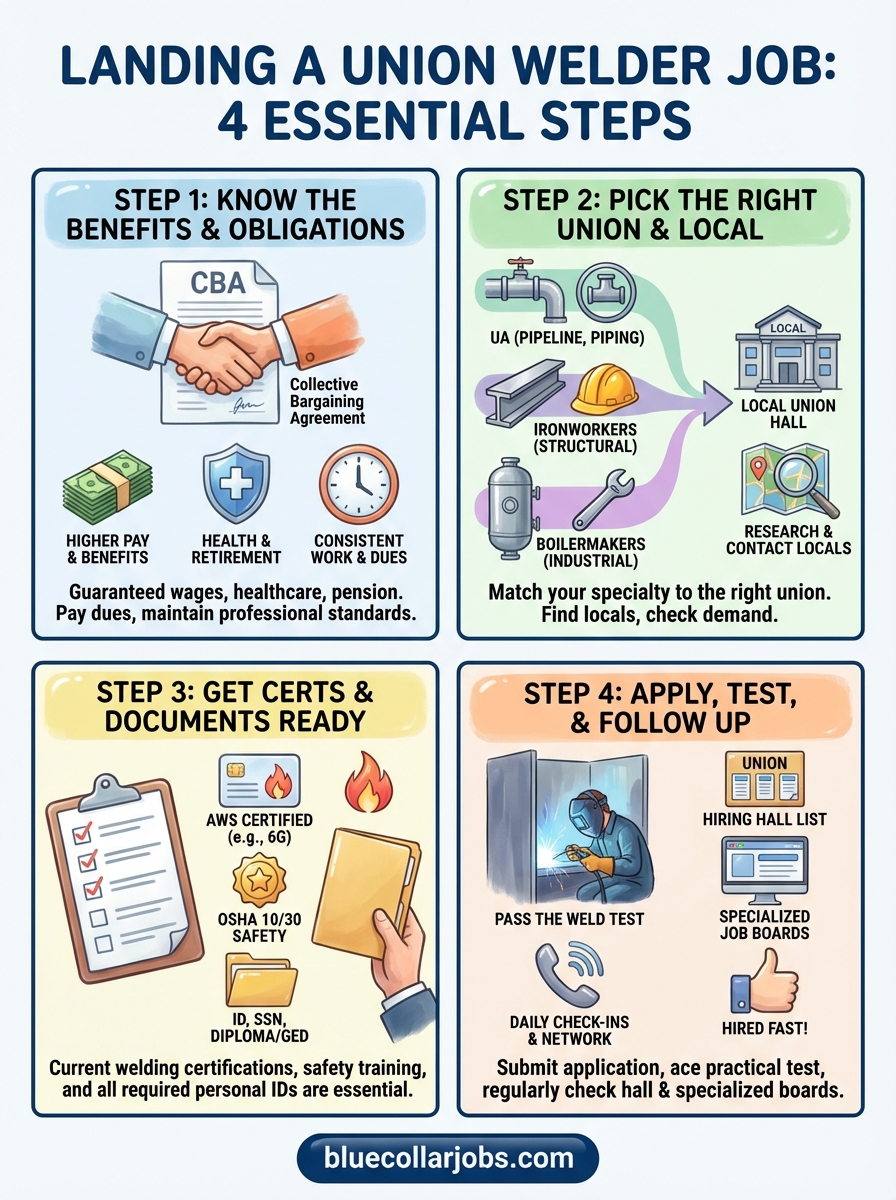
Step 1. Pick the right union and local
Your first move is identifying which union represents welders in your region and the specific local chapter that covers your area. The three main unions hiring welders are the United Association of Journeymen and Apprentices of the Plumbing and Pipe Fitting Industry (UA), the International Association of Bridge, Structural, Ornamental and Reinforcing Iron Workers, and the International Brotherhood of Boilermakers. Each union specializes in different welding work, so your choice affects the projects you’ll work on.
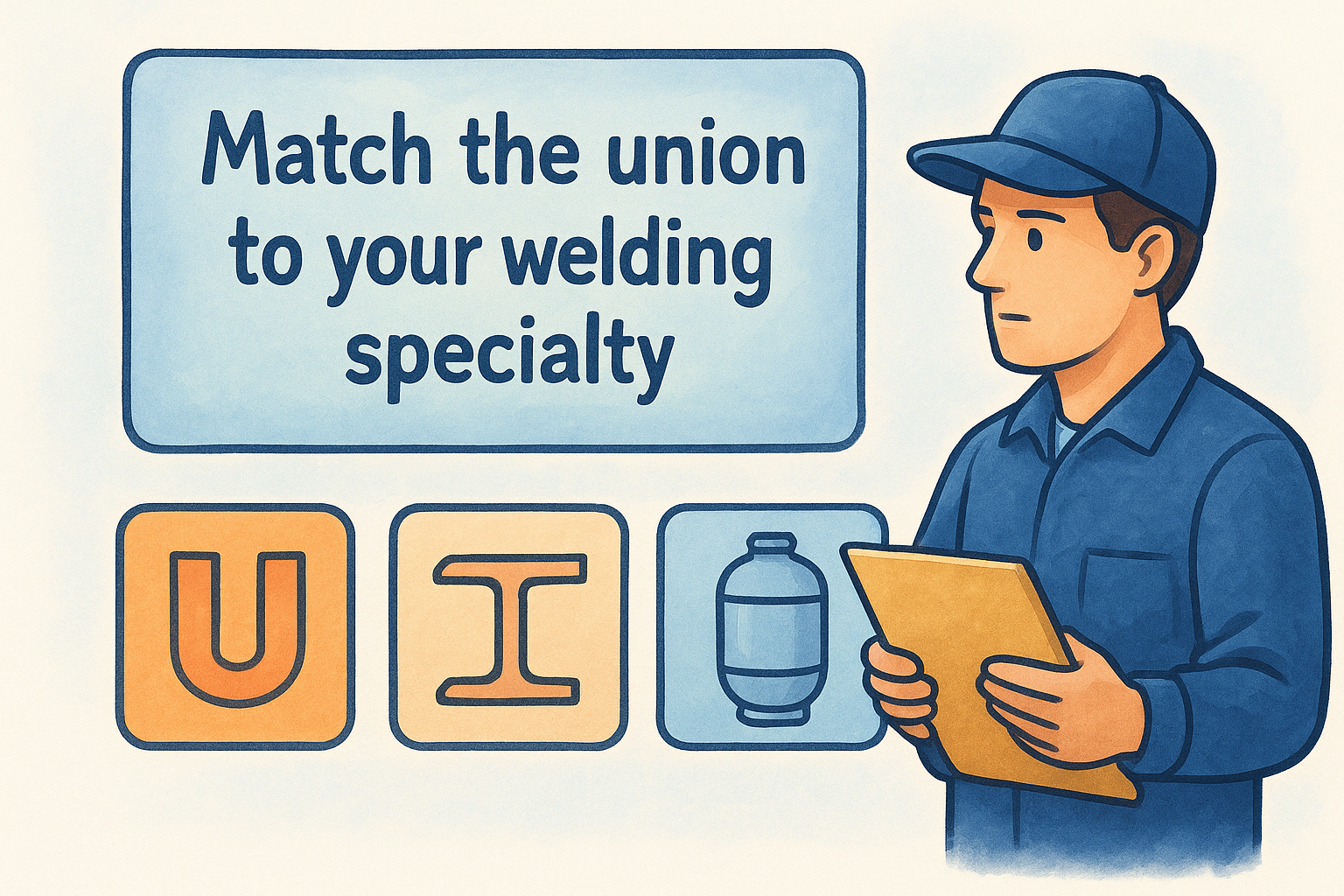
Match the union to your welding specialty
The UA locals handle pipeline welding, industrial piping, HVAC systems, and process work in refineries and power plants. If you want structural steel and high-rise construction, Ironworkers locals are your target. Boilermakers focus on pressure vessels, tanks, and heavy industrial maintenance.
Research which locals operate in your state by visiting each union’s website and using their local finder tools. Call the local hall directly and ask about their current membership size, typical job placements, and how often they dispatch welders. Smaller locals might have shorter wait lists but fewer job calls, while large metro locals offer more work but higher competition for union welder jobs.
Choosing the right union local based on your specialty and location directly impacts how quickly you’ll start working.
Step 2. Get the certs and documents ready
Unions require documented proof of your welding skills before they’ll put you to work, and gathering everything ahead of time speeds up your placement. You need current welding certifications, valid identification, and supporting paperwork that proves you can perform the work safely and legally. Missing even one document can delay your acceptance into the union or push you down the referral list when union welder jobs get posted.
Essential welding certifications
Your primary certification should be an AWS (American Welding Society) certificate in the processes most relevant to your target union: typically SMAW, GMAW, FCAW, or GTAW. Pipeline welders need 6G pipe certifications, while structural welders require plate and groove certifications. Unions verify these directly with AWS or through practical weld tests at their facility. Keep your original certification cards and bring copies for your file.
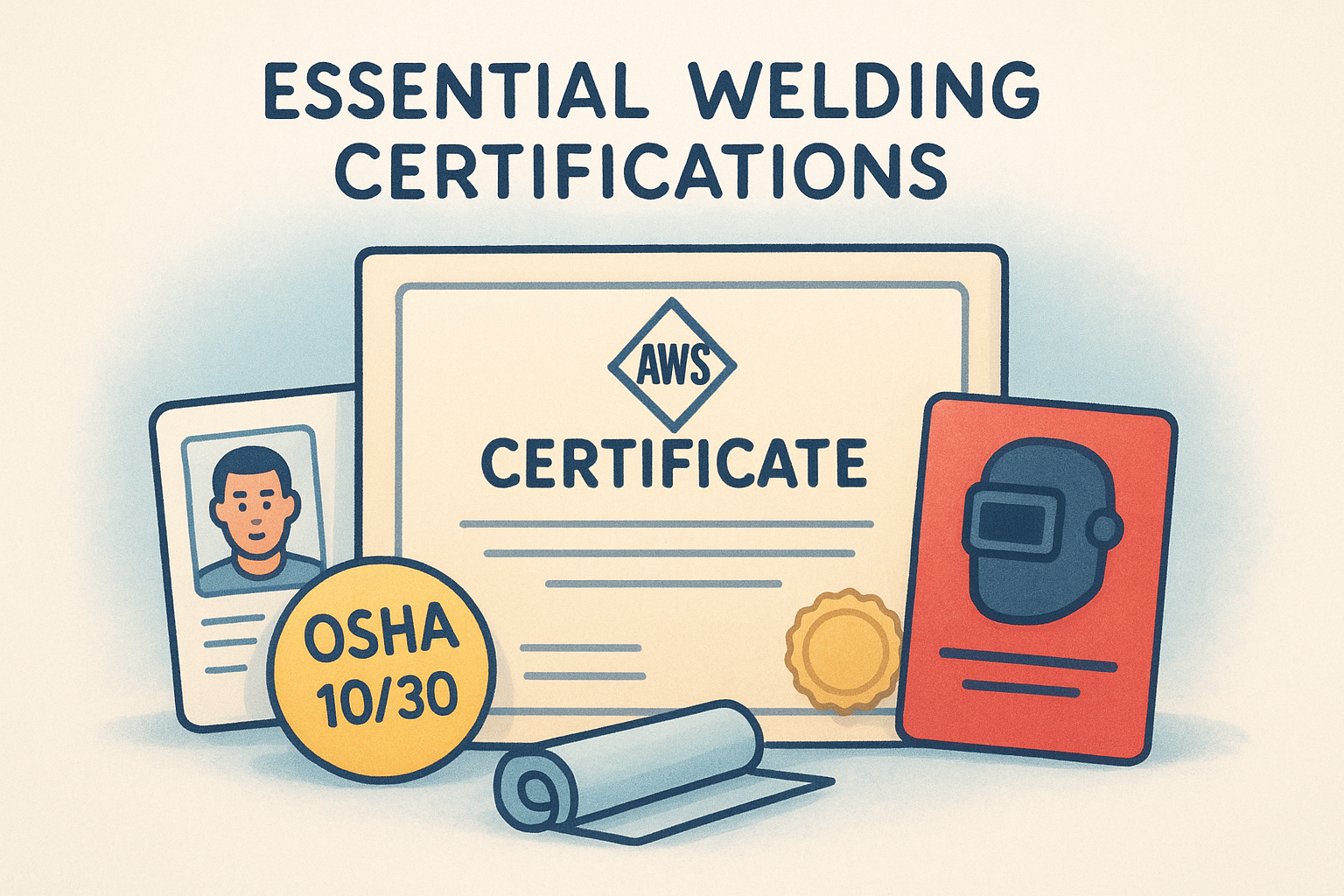
Most locals also require OSHA 10 or OSHA 30 safety training completion cards. If you lack safety credentials, complete the online OSHA 10 course before applying.
Arriving with current certifications in hand puts you ahead of candidates who need to test or train first.
Required personal documents
Bring your government-issued photo ID (driver’s license or passport), Social Security card, and high school diploma or GED certificate. Unions need proof you’re legally eligible to work in the United States, so have your birth certificate or naturalization papers ready. If you completed an apprenticeship elsewhere, gather transcripts or completion certificates showing your training hours. Veterans should bring DD-214 forms because many unions offer preferential placement for military service.
Step 3. Find openings on job boards and halls
Union welder jobs don’t get posted on typical job sites the way non-union positions do. Your primary source for openings is the union hiring hall itself, where contractors call when they need welders. Beyond the hall, specialized trade job boards list union positions directly from employers who work with union labor. Checking both channels daily gives you the widest access to available work.
Check union hiring halls first
Visit your local union hall in person at least twice per week to check the job board and sign the out-of-work list. Halls post contractor requests on physical bulletin boards, and some now use text message systems or apps to notify members about calls. Ask the dispatcher about upcoming projects and which contractors typically request your skill level. The more visible you are at the hall, the better your chances when rush calls come in requiring immediate welder placement.
Search specialized job boards
Platforms like bluecollarjobs.com aggregate union welder jobs from contractors across multiple states, letting you filter by trade, location, and certification requirements. Union contractors post openings here because they know qualified welders check these boards regularly. Set up daily email alerts for your trade and location so you see new postings within hours of them going live.
Step 4. Apply, test, and follow up like a pro
Union applications require precise documentation and strong test performance to move from applicant to working member. When a union welder jobs opening matches your skills, you need to act within hours, not days. The halls that move fastest get first choice of qualified welders on major projects.
Submit your application packet
Fill out the union application completely with no blank fields or crossed-out sections. Attach copies of your certifications, not originals, because the union keeps everything you submit. Include a one-page resume listing your welding processes, materials you’ve worked with, and total years of experience. Hand-deliver your packet to the hall during business hours and ask the clerk to confirm they received everything needed.
Nail the weld test
Expect a practical welding test in the position and process the union uses most. You’ll typically weld a 6-inch pipe section or structural plate joint while a certified welding inspector watches your technique. Bring your own welding hood, gloves, and tools because unions rarely provide personal equipment during testing. Practice the exact test parameters beforehand so you work confidently under observation.
Passing the weld test on your first attempt moves you directly onto the out-of-work list without delays.
Next steps to land a union welding job
Your action plan starts today with contacting your local union hall and requesting an application packet. Schedule your certification tests if any credentials have expired, and update your resume with recent projects and processes you’ve mastered. Sign the out-of-work list as soon as your paperwork clears so contractors can request you by name when union welder jobs open up.
Check job boards daily for postings that match your skill level and location. Set aside two hours each week to visit the hall, talk with dispatchers, and network with other welders who can tip you off about upcoming projects. The faster you respond to calls, the more likely you’ll secure steady placement on high-paying jobs.
If you’re an employer looking to fill welding positions with union-qualified candidates, post your job openings on BlueCollarJobs to connect directly with certified welders actively seeking work. Our platform puts your listings in front of skilled trade professionals across all 50 states.
Want blue collar jobs delivered to your inbox?
Want blue collar jobs delivered to your inbox?
