
How To Become An Electrician Apprentice In The U.S. (2026)
Electricians earn a median salary of over $60,000 per year, and the field is projected to grow faster than average through the next decade. Learning how to become an electrician apprentice is the first step toward joining this in-demand trade, and it doesn’t require a four-year degree or mountains of student debt.
An apprenticeship combines paid on-the-job training with classroom instruction, letting you earn while you learn the craft. Whether you’re fresh out of high school, transitioning careers, or looking for a more hands-on profession, this path offers a clear route to a stable, well-compensated career.
This guide breaks down everything you need to know: the basic requirements, how to find and apply for programs, the differences between union and non-union apprenticeships, and what to expect once you’re in. At bluecollarjobs, we connect aspiring tradespeople with employers actively hiring apprentices across the country, so once you’re ready to take the next step, we can help you find the right opportunity.
What an electrician apprenticeship is in 2026
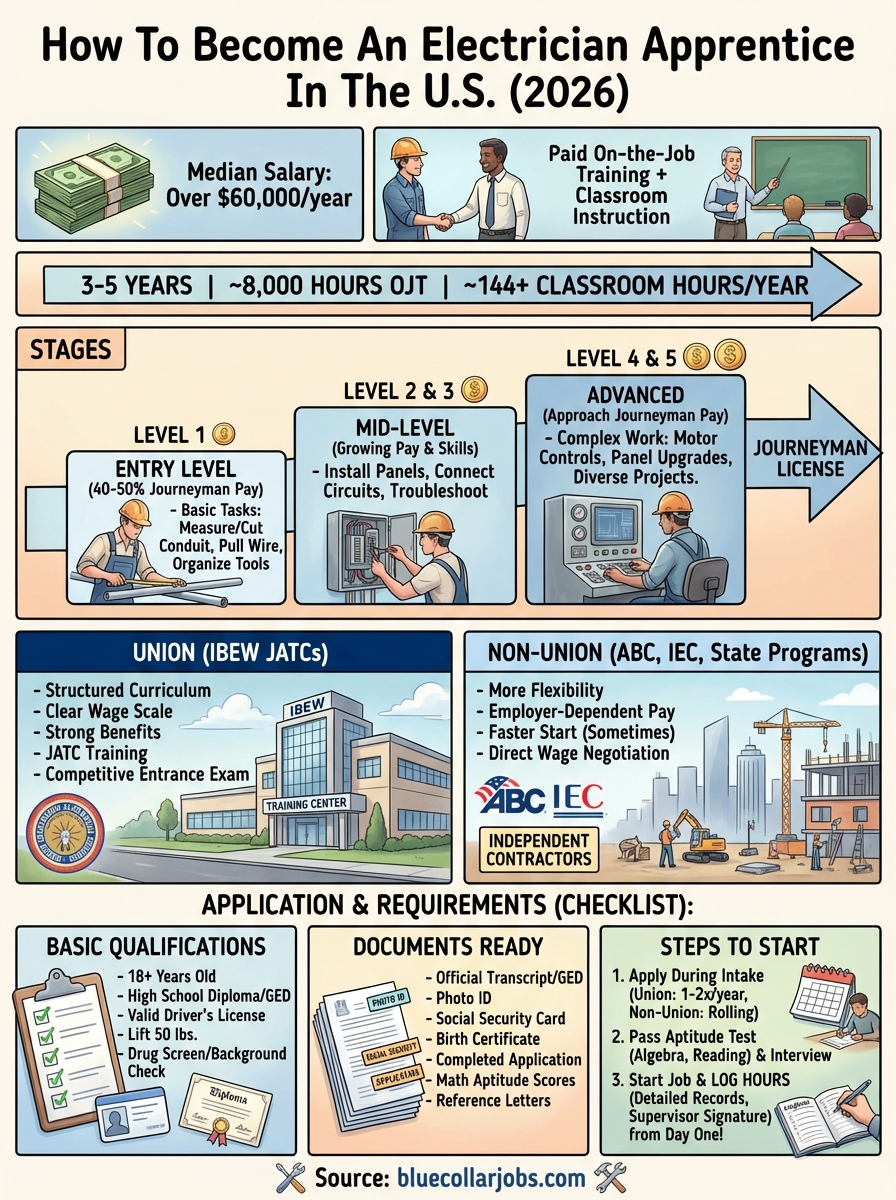
An electrician apprenticeship is a structured training program that typically runs three to five years, depending on your state and the specific program you enter. You work full-time under the supervision of licensed electricians while also attending classroom instruction in the evenings or on designated days. This dual approach lets you apply what you learn in theory to real-world electrical installations, repairs, and troubleshooting the very next day on the job site.
Your employer pays you an hourly wage during this time, and that wage increases as you accumulate hours and advance through the program. Most apprenticeships require you to complete 8,000 hours of on-the-job training and at least 144 hours of classroom education per year. The National Electrical Code, safety protocols, blueprint reading, and hands-on skills like conduit bending make up the core curriculum.
An apprenticeship isn’t traditional school where you sit in lectures all day. You’re earning a paycheck while gaining the skills that matter most to employers.
The structure you’ll follow
Apprenticeship programs divide training into levels, usually four or five stages. At each level, your wage increases as your skill set expands. Entry-level apprentices often start at 40 to 50% of a journeyman’s hourly rate, which might translate to $15 to $22 per hour. By your final year, you could be earning 80% or more of full journeyman pay.
Programs track your progress through documented work hours and successful classroom completion. You’ll maintain a logbook that records the types of tasks you perform each day, from running wire in residential settings to installing commercial lighting systems. Supervisors sign off on these hours, and the sponsoring organization reviews them to confirm you’re meeting requirements.
What you’ll actually do
Your daily tasks will vary based on the projects your employer takes on and your stage in the program. Early on, you’ll handle basic tasks like measuring and cutting conduit, pulling wire through walls, and organizing tools at job sites. These foundational activities teach you proper technique before you move on to more complex work.
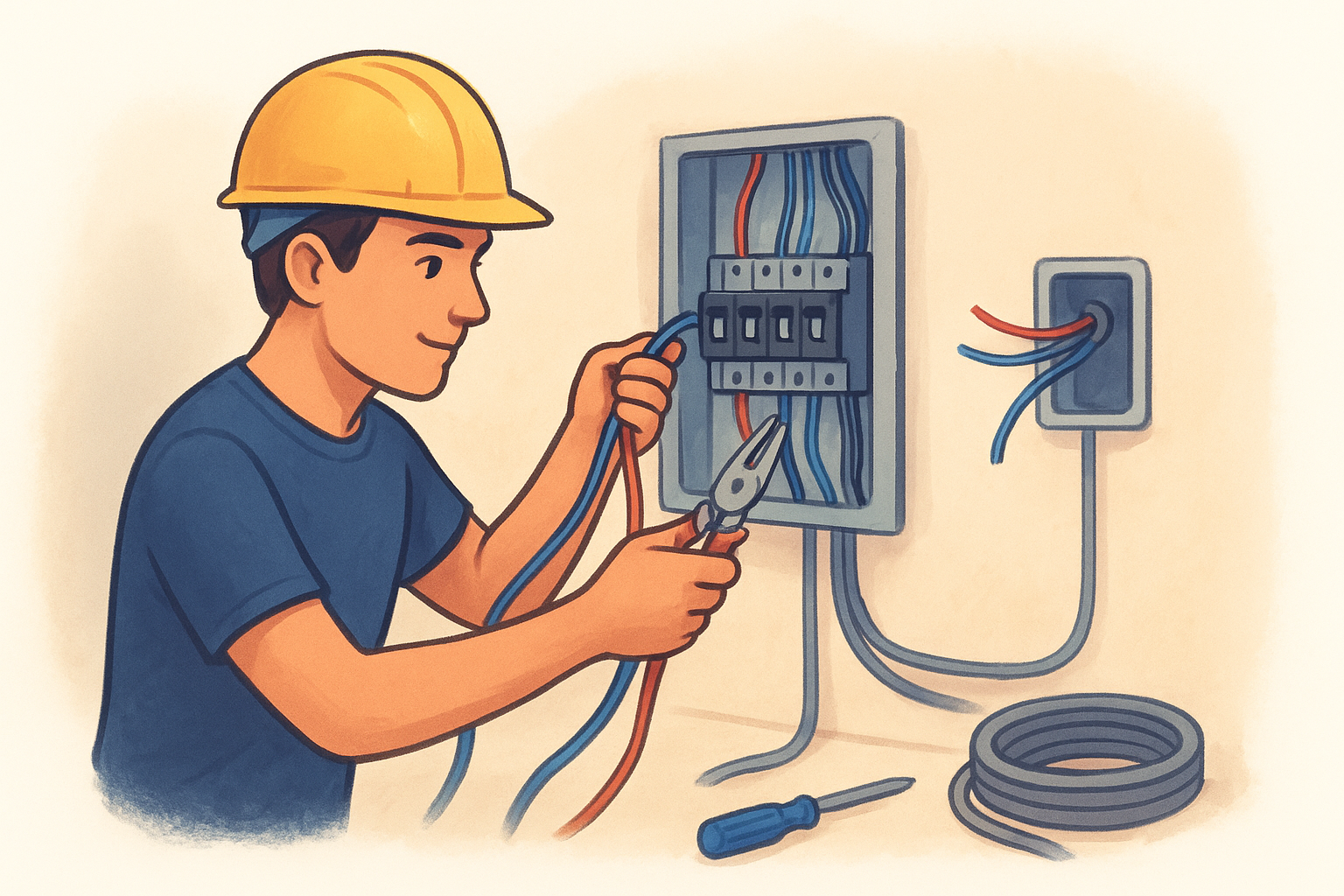
As you gain experience, you’ll start installing electrical panels, connecting circuits, troubleshooting faults, and working with control systems. Residential, commercial, and industrial settings each present different challenges, and most apprenticeships expose you to at least two environments. The variety builds a versatile skill set that makes you more valuable once you earn your journeyman license.
Before you apply, check the requirements
Most apprenticeship programs set minimum qualifications that you must meet before they’ll review your application. These requirements vary slightly between union and non-union programs, but the basics remain consistent across the country. Knowing what you need before you start the process saves you time and helps you focus on programs where you’re actually eligible.
Basic qualifications most programs require
You need to be at least 18 years old and hold a high school diploma or GED. Some programs accept candidates at 17 if they’re enrolled in a pre-apprenticeship or high school vocational program. A valid driver’s license is often required because you’ll travel between job sites, and public transit doesn’t always reach construction locations on time.
Physical ability matters in this trade. Programs typically ask for proof that you can lift 50 pounds and work on ladders or in confined spaces. A drug screening and background check are standard, since you’ll work in residential homes and commercial buildings where trust and safety are priorities.
Meeting the basic requirements is just the entry point. Strong math skills and mechanical aptitude will separate you from other applicants during the selection process.
Documents you’ll need ready
Gather these items before you begin applications:

- Official high school transcript or GED certificate
- Government-issued photo ID (driver’s license or passport)
- Social Security card
- Proof of age (birth certificate if ID doesn’t show date of birth)
- Completed application form specific to each program
- Math aptitude test scores (if the program requires pre-testing)
Some programs also ask for reference letters from teachers, previous employers, or community leaders who can speak to your work ethic and reliability.
Step 1. Pick your pathway and program
You have two main routes when learning how to become an electrician apprentice: union programs through the International Brotherhood of Electrical Workers (IBEW) or non-union programs run by independent contractors, trade schools, or state agencies. Each pathway leads to the same goal (a journeyman license), but the structure, pay progression, and application process differ significantly.
Union apprenticeships through IBEW
The IBEW operates Joint Apprenticeship and Training Committees (JATCs) in partnership with the National Electrical Contractors Association. These programs offer structured curriculum, strong benefits from day one, and clear wage scales that increase predictably as you complete each level. Union apprenticeships often provide better starting wages and retirement contributions compared to non-union options.
You’ll attend classes at the JATC training center in your region and work for contractors who are part of the union network. The application process is competitive, and you’ll likely face an entrance exam covering algebra and reading comprehension.
Union programs typically guarantee consistent work through the contractor network, but you may have less control over which specific jobs you’re assigned to.
Non-union programs and alternatives
Non-union apprenticeships run through organizations like Associated Builders and Contractors (ABC) or Independent Electrical Contractors (IEC). Some states also operate their own apprenticeship programs through workforce development boards. These options give you more flexibility in choosing your employer and sometimes allow you to start working faster than union programs.
Pay structures vary by employer rather than following a standardized scale. You’ll complete the same hour requirements and classroom training, but your wage negotiations happen directly with the contractor who hires you.
Step 2. Apply and pass the screening
Once you’ve identified programs that match your goals, you’ll submit applications during their designated intake periods. Union programs often accept applications once or twice per year, while non-union programs may offer rolling admissions. Missing an application window means waiting months for the next opportunity, so mark deadlines on your calendar and gather materials early.
Submit your application package
Your application needs to be complete and accurate the first time. Programs receive hundreds of applications for limited spots, and incomplete submissions go straight to the rejection pile. Double-check that you’ve included every required document, signed all forms, and answered questions clearly. Some programs charge an application fee between $25 and $75.
Fill out the application form with attention to detail. List all work experience that shows responsibility and physical capability, even if it’s not construction-related. Include any math or science courses you took in high school or college. Programs look for candidates who demonstrate reliability and basic technical aptitude.
A clean, thorough application that follows instructions exactly sets you apart before you even take the entrance exam.
Pass the aptitude test and interview
Most programs require an algebra and reading comprehension test before they’ll interview you. Study basic algebra (fractions, decimals, percentages, simple equations) and practice reading technical passages. The IBEW aptitude test covers these areas specifically, and you need to score above their minimum threshold to advance.
Interviews focus on work ethic and commitment. Expect questions about why you want to join the electrical trade, how you handle physical work, and whether you can commit to several years of training. Answer directly and avoid rehearsed responses that sound generic.
Step 3. Start the job and build hours fast
Your first day as an apprentice marks the beginning of your 8,000-hour journey toward a journeyman license. You’ll report to a job site where a licensed electrician assigns you tasks and monitors your work. Most programs require you to log every hour you work in an official record book or digital tracking system, so understanding how to become an electrician apprentice means also mastering the documentation that proves your progress.
Track every hour from day one
Programs require detailed records of the work you perform, not just the total hours you clock in. You’ll categorize tasks by type (residential wiring, commercial installations, service calls, etc.) and get your supervisor’s signature weekly or monthly to verify accuracy. Missing signatures or incomplete logs can delay your advancement to the next level.
Use a simple format to log daily work:
- Date and total hours worked
- Task type (install fixtures, run conduit, troubleshoot circuits)
- Location or project name
- Supervising electrician’s name
- Supervisor signature and date
Accurate hour tracking isn’t just paperwork. It’s your proof of competency when you apply for your journeyman exam.
Focus on diverse experience
Programs look for well-rounded skills across different environments and electrical systems. You need hours in residential, commercial, and ideally industrial settings to meet most state requirements. Ask your employer to rotate you through different project types rather than spending years doing only one kind of work.
Actively pursue tasks that challenge you. Installing basic outlets builds foundational skills, but learning motor controls, panel upgrades, and troubleshooting makes you more valuable and accelerates your learning curve.
Your next steps
You’ve now learned how to become an electrician apprentice through the complete process: checking requirements, choosing between union and non-union programs, applying through screening steps, and building your hours on the job. The apprenticeship itself requires commitment and consistent effort over several years, but the payoff is a skilled trade career that provides financial stability without the burden of student loan debt.
Start by researching programs in your area this week. Contact the IBEW local nearest you and check for non-union options through ABC or IEC chapters. Most programs post their application windows several months in advance, giving you time to prepare for entrance exams and gather all required documents before deadlines hit.
Once you’re ready to enter the workforce, explore our blog for more insights on building a successful career in the electrical trade and other skilled professions. The path ahead demands dedication and physical work, but thousands of electricians prove every year that the apprenticeship system delivers measurable results for those who commit to the journey.
Want blue collar jobs delivered to your inbox?
Want blue collar jobs delivered to your inbox?
