
What Do Welders Do? Duties, Daily Work, Pay, And Hours Today
Welders join metal parts together using intense heat, creating everything from skyscrapers to ships to surgical instruments. But what do welders do on a daily basis, and is this career path right for you?
At bluecollarjobs, we connect skilled tradespeople with employers across the country, and welding remains one of the most sought-after trades. Whether you’re considering a career change or starting fresh out of high school, understanding the real demands of this profession matters before you commit.
This guide breaks down the welder’s job description, typical daily tasks, current pay ranges, and working hours. You’ll get an honest look at what the work actually involves, from the physical requirements to the career progression opportunities available in 2026.
What welding is and what welders build
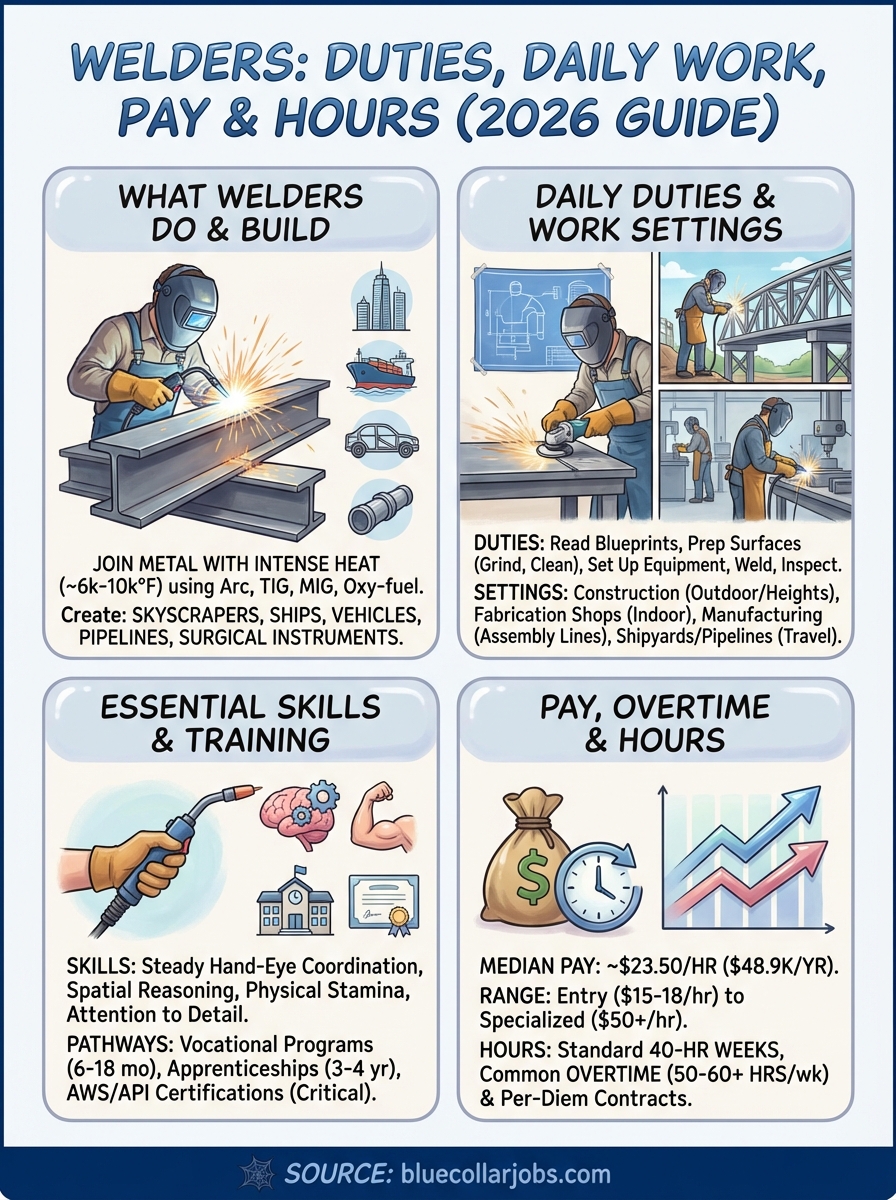
Welding permanently joins metal pieces by melting their edges together under extreme heat, typically between 6,000 and 10,000 degrees Fahrenheit. You apply this heat through various methods like electric arcs, gas flames, or laser beams, depending on the material type and job requirements. The molten metal cools and solidifies into a fusion that’s often stronger than the original pieces.
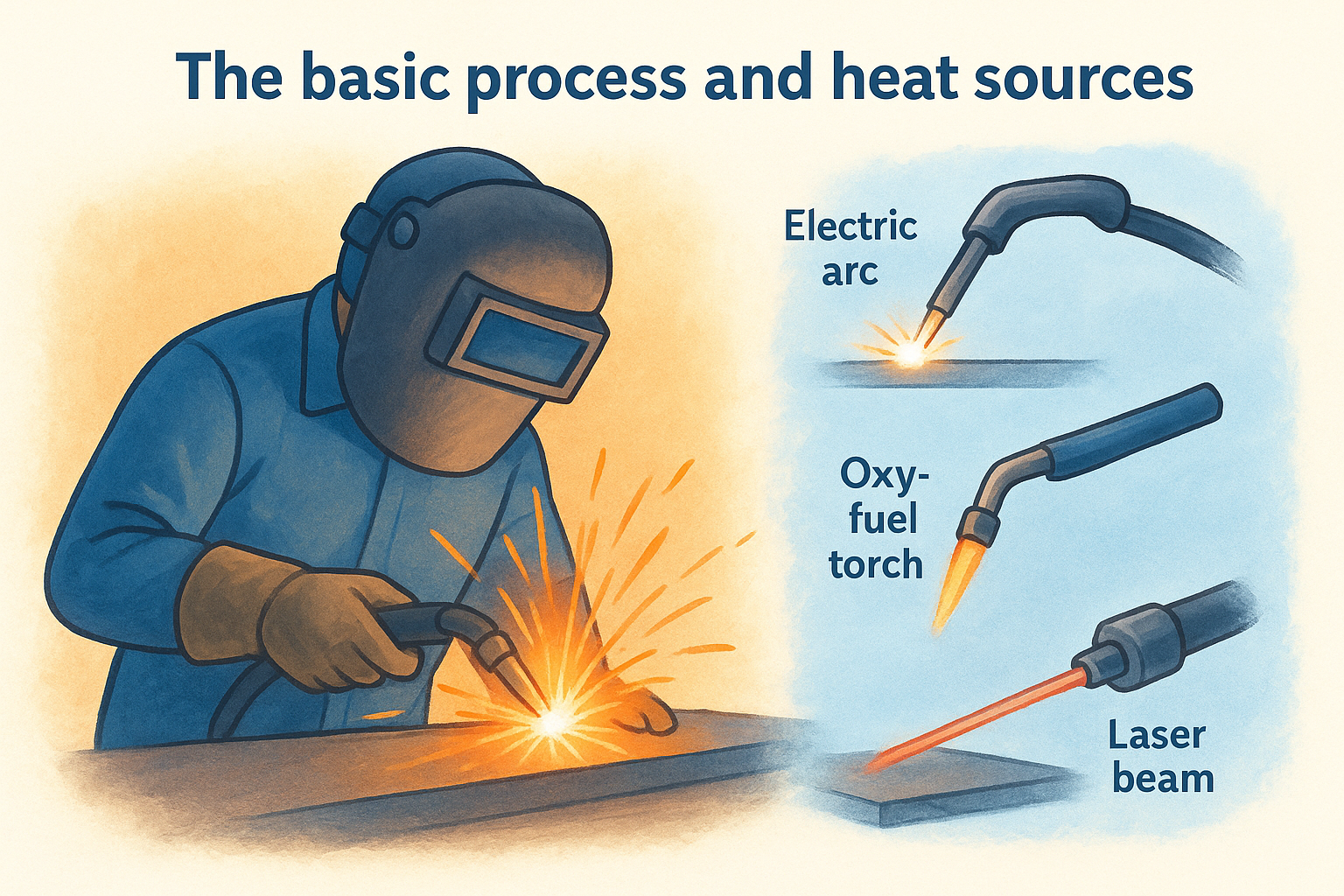
The basic process and heat sources
The most common welding method uses an electric arc that jumps between an electrode and the base metal, creating temperatures hot enough to melt steel instantly. You’ll also find welders using oxy-fuel torches that mix oxygen and acetylene gas to produce a flame for cutting and joining thinner materials. More specialized work requires TIG (Tungsten Inert Gas) or MIG (Metal Inert Gas) processes that protect the weld from contamination with shielding gases like argon or carbon dioxide.
Each process demands different skill levels and serves specific purposes. Stick welding (SMAW) works well for outdoor construction and rusty materials, while TIG welding produces cleaner results for stainless steel or aluminum in controlled environments. What do welders do with these various techniques? They match the method to the metal, environment, and structural requirements of each project.
Modern welders must understand metallurgy, heat effects, and material properties to choose the right technique for each job.
What welders actually build
Your work as a welder touches nearly every industry. In construction, you’ll build the steel frameworks for bridges, office towers, and shopping centers that define city skylines. Manufacturing plants need welders to assemble automobile frames, appliances, and industrial equipment on production lines where precision and speed both matter.
Shipbuilders rely on welders to construct cargo vessels, military ships, and offshore oil platforms that can withstand decades of saltwater exposure. You might also work in aerospace fabricating aircraft components where a single bad weld could have catastrophic consequences. Pipeline welders travel across states joining sections of natural gas and oil transmission lines that span thousands of miles underground.
Infrastructure projects constantly need welders for water treatment facilities, power generation plants, and public transportation systems. Even smaller operations require your skills for custom metal fabrication, artistic metalwork, and equipment repair across farms, warehouses, and maintenance shops. The variety means you can specialize in one sector or move between industries throughout your career depending on pay rates, location preferences, and personal interests.
Core welder duties and responsibilities
Your primary responsibility as a welder centers on creating strong, precise metal joints that meet engineering specifications and safety standards. You’ll spend your shift interpreting technical drawings, preparing surfaces, operating welding equipment, and inspecting your finished work for defects. What do welders do beyond just melting metal? You constantly evaluate material thickness, joint configurations, and environmental factors to adjust your technique and maintain quality throughout each project.
Reading blueprints and technical drawings
Every job starts with understanding the blueprint or schematic that shows exactly where welds need to go and what specifications they must meet. You’ll identify weld symbols that indicate the type of joint, size, length, and finishing requirements before you strike the first arc. This interpretation skill separates amateur welders from professionals because a misread dimension or missed detail can compromise an entire structure’s integrity.
Your ability to translate two-dimensional drawings into three-dimensional welds directly impacts project timelines and structural safety.
Preparing materials and setting up equipment
Surface preparation consumes a significant portion of your day since contaminants like rust, paint, or oil create weak welds that fail inspection. You’ll grind, sand, or wire-brush metal surfaces until they’re clean enough to fuse properly. Setting up your welding machine parameters requires matching amperage, voltage, and wire speed to the metal type and thickness you’re joining.
You also handle positioning and clamping workpieces so they align correctly before welding begins. This setup work includes selecting the right electrode or filler material, adjusting shielding gas flow rates, and arranging your work area for safe access to all weld locations. Many failed welds result from rushed preparation rather than poor welding technique, which makes this responsibility critical to your success rate.
A day in the life and common work settings
Your typical workday as a welder starts with reviewing job assignments and safety requirements before gathering materials and equipment for the tasks ahead. Most welders clock in between 6:00 and 7:00 AM, spending the first hour preparing workstations, checking equipment functionality, and organizing materials according to the day’s schedule. What do welders do during the remaining hours? You alternate between welding, grinding, repositioning materials, and inspecting completed joints while managing physical fatigue from working in awkward positions.
Typical daily schedule and tasks
Morning shifts usually focus on high-precision work when your concentration peaks and temperatures stay cooler in outdoor settings. You’ll tackle complex joints, structural welds, or projects requiring multiple passes before the afternoon heat makes protective gear more uncomfortable. Mid-shift breaks give you time to hydrate, rest strained muscles, and adjust equipment settings based on how materials respond to changing environmental conditions.
Afternoon tasks often shift toward production welding, repairs, or finishing work that demands less mental intensity but consistent output. You might spend two hours on repetitive welds for a manufacturing line, then switch to grinding and cleaning completed sections before final inspection. Documentation and quality control checks fill the last 30 minutes of your shift as you record completed work and note any material or equipment issues for the next crew.
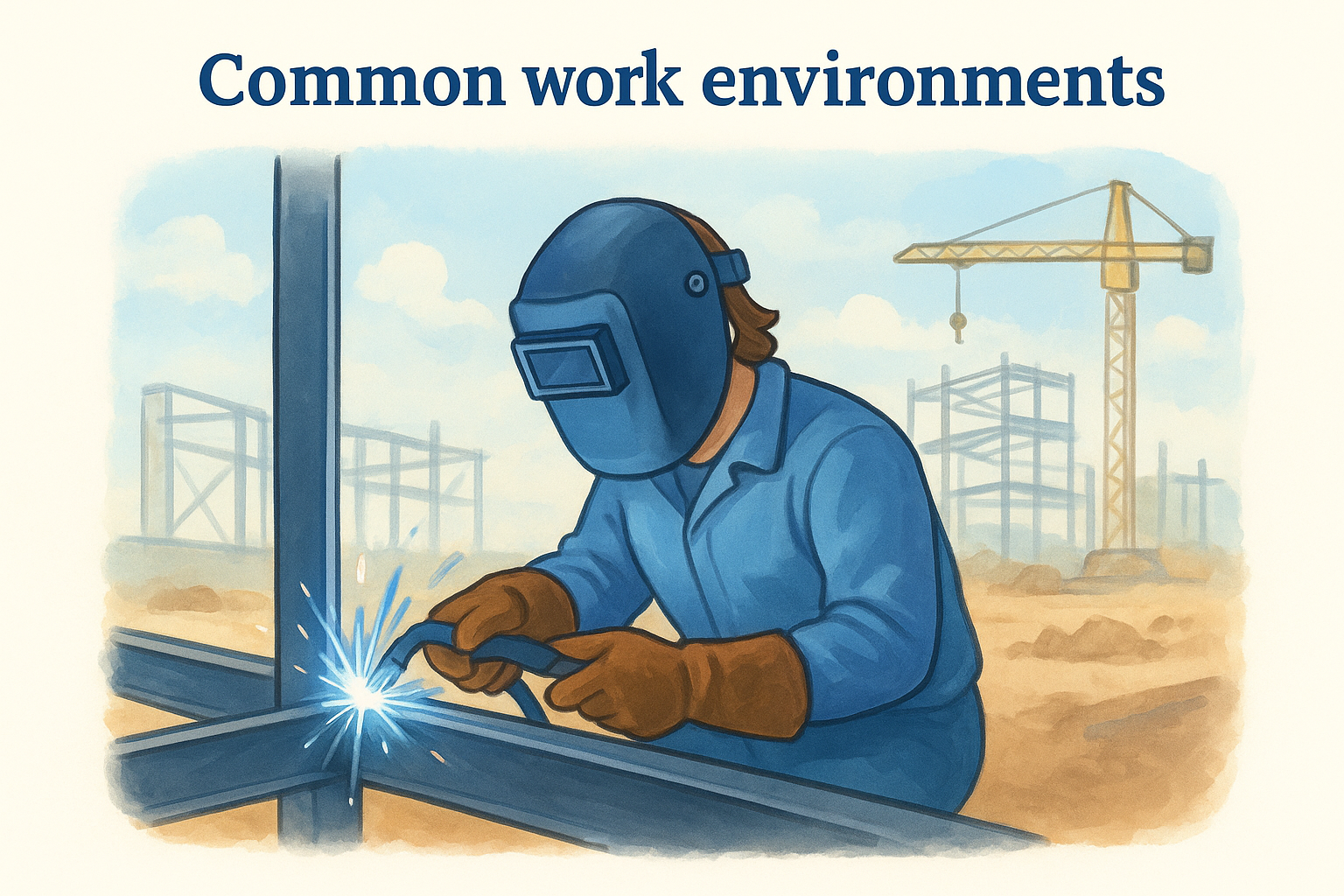
Common work environments
Construction sites put you outdoors working on building frames, bridges, and infrastructure projects where weather directly impacts your comfort and welding conditions. You’ll adapt techniques for wind, rain, or extreme temperatures while navigating uneven ground and working at various heights on scaffolding or lifts.
Fabrication shops offer controlled indoor environments with consistent temperatures, proper ventilation, and stable work surfaces that improve weld quality.
Manufacturing facilities keep you at stationary workstations performing repetitive welds on assembly lines with predictable schedules and climate control. Shipyards and pipeline projects require extended travel to remote locations where you might work 60-hour weeks during peak construction seasons before returning home between contracts.
Pay, overtime, and hours for welders in the US
Welders in the United States earn a median hourly wage of $23.50, translating to approximately $48,880 annually for full-time work based on 2025 Bureau of Labor Statistics data. Your actual earnings vary significantly based on industry, location, certification level, and specialization. What do welders do to maximize their income? They pursue advanced certifications, work in high-demand sectors like aerospace or underwater welding, and accept positions in states with higher prevailing wages like Alaska, Hawaii, or metropolitan areas with significant manufacturing or construction activity.
Current salary ranges and factors
Entry-level welders typically start between $15 and $18 per hour during apprenticeships or in basic production welding roles. Experienced welders with multiple certifications command $28 to $35 per hour in specialized fields like pipeline welding or structural steel fabrication. Top earners in niche areas like underwater welding or nuclear power plant work can exceed $50 per hour plus hazard pay and per diem allowances for remote assignments.
Industry choice dramatically affects your paycheck. Manufacturing plants offer steady work at moderate pay rates with predictable schedules, while construction and pipeline projects provide higher wages but seasonal employment patterns. Union positions generally include better benefits and pension contributions compared to non-union shops, though both paths offer viable career trajectories.
Geographic location impacts your earning potential as much as skill level, with coastal states and energy-producing regions consistently paying 20-30% above national averages.
Standard hours and overtime expectations
Most welding positions operate on 40-hour weekly schedules with shifts ranging from traditional 8-hour days to compressed 10-hour shifts over four days. Overtime becomes routine during project deadlines, with many welders working 50 to 60 hours weekly at time-and-a-half pay rates. Pipeline and construction welders often accept per-diem contracts involving 60 to 84-hour weeks for 2-3 months straight before taking extended time off between projects.
Skills, training, and certifications that matter
You need a combination of technical precision, physical stamina, and specific certifications to succeed as a welder. Employers prioritize candidates who demonstrate proficiency in multiple welding processes, maintain steady hand-eye coordination under demanding conditions, and hold recognized credentials that verify their capabilities. Understanding what do welders do in terms of skill development helps you focus training efforts on competencies that directly impact your employability and earning potential.
Essential technical and physical skills
Hand steadiness separates acceptable welders from excellent ones since maintaining consistent electrode angles and travel speeds determines weld quality across hundreds of joints daily. You’ll develop spatial reasoning to visualize three-dimensional structures from flat drawings and translate those mental images into precise physical welds that meet engineering tolerances. Strong math skills help you calculate material dimensions, mixing ratios, and heat settings without relying solely on automated equipment.
Physical demands include sustained overhead work, crouching in confined spaces, and handling equipment that weighs 20 to 40 pounds throughout your shift. Vision clarity matters for spotting defects, reading fine print on blueprints, and monitoring weld pools through darkened helmet lenses that protect against ultraviolet radiation.
Employers consistently rank attention to detail as the single most valuable trait because one overlooked defect can compromise an entire structure’s safety rating.
Training pathways and certification requirements
Most welders complete vocational programs lasting 6 to 18 months through community colleges or technical schools that combine classroom metallurgy instruction with hands-on welding practice. Apprenticeships offer an alternative path where you earn wages while training under experienced welders for 3 to 4 years until reaching journeyman status.
AWS (American Welding Society) certifications validate your competency in specific processes like SMAW, GMAW, GTAW, or FCAW for different material types and positions. These credentials require passing practical welding tests where inspectors evaluate your work against industry standards. Pipeline welders often pursue additional API 1104 certification, while structural welders need certifications matching building code requirements in their region.
Where to go from here
Understanding what do welders do gives you the foundation, but launching your welding career requires concrete action steps. Research vocational programs in your area that offer hands-on training with industry-standard equipment, and seek out working welders willing to share their daily experiences and career advice. Many community colleges provide evening and weekend classes that let you explore welding fundamentals while maintaining your current job and income stream.
Consider visiting local fabrication shops or construction sites to observe welders in action and ask about apprenticeship opportunities. If you’re ready to transition into welding or advance your existing skills, BlueCollarJobs.com connects you with employers hiring across all fifty states and multiple specializations. Browse our blue collar career resources for detailed guides on certification pathways, salary negotiations, and finding the right welding niche for your goals.
Want blue collar jobs delivered to your inbox?
Want blue collar jobs delivered to your inbox?
