
9 Welding Interview Questions Hiring Managers Ask (Answers)
Landing a welding position takes more than technical skill, you also need to walk into that interview room prepared. Whether you’re applying for your first shop job or moving up to a specialized fabrication role, knowing the common welding interview questions ahead of time gives you a real advantage. Hiring managers want to see that you can handle the torch and communicate clearly about your work.
At bluecollarjobs, we connect welders with employers across the country, and we’ve seen what separates candidates who get hired from those who don’t. Preparation makes the difference. Employers ask a mix of technical questions to test your knowledge and behavioral questions to gauge how you’ll fit on their team.
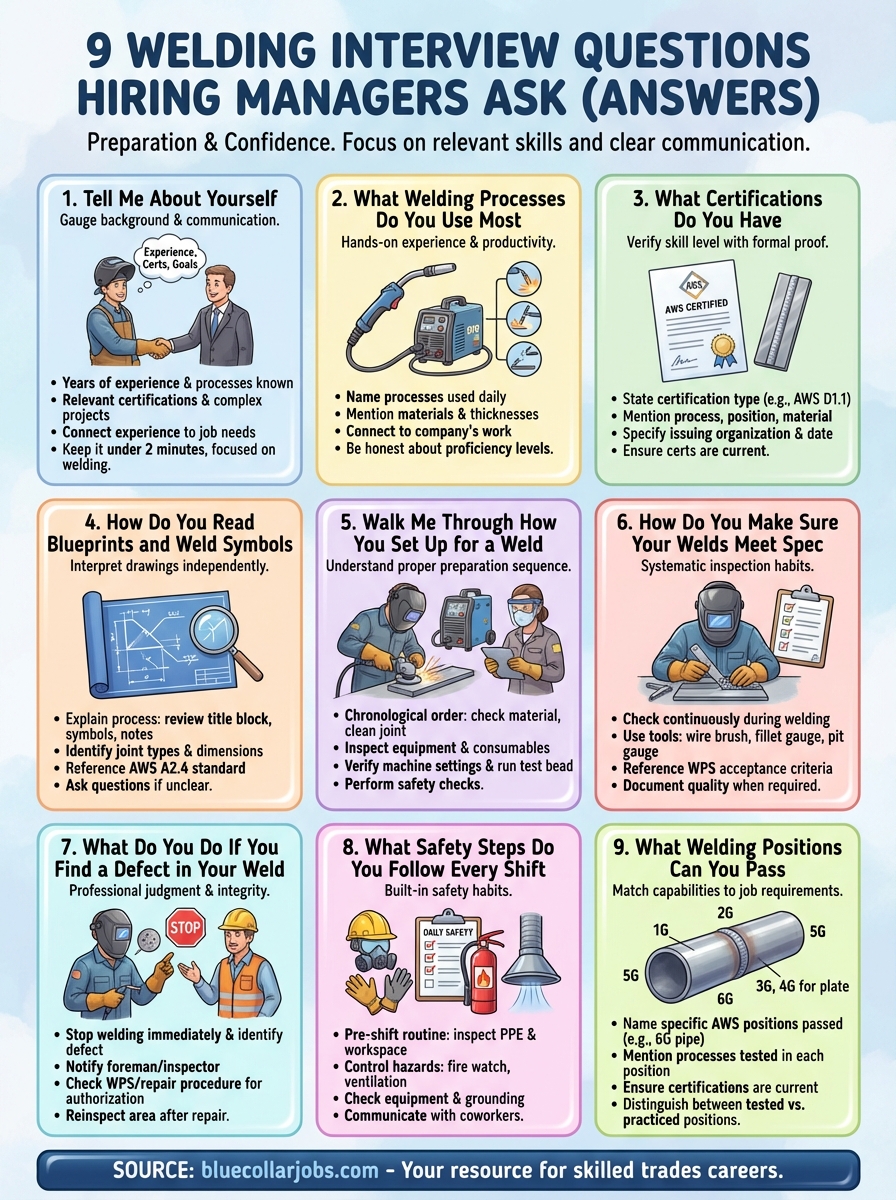
Below, you’ll find 9 questions hiring managers commonly ask during welding interviews, along with sample answers you can adapt to your own experience. Use these to practice your responses and walk in confident.
1. Tell me about yourself
This opening question appears in almost every welding interview, and your answer sets the tone for everything that follows. Hiring managers use it to get a quick read on your background, gauge your communication skills, and see if you understand what matters in the role. You need to deliver a clear, focused response that highlights your welding experience without rambling through your entire work history.
Why hiring managers ask this
Hiring managers want to hear how you talk about your work and whether you focus on relevant skills that match the position. This question tells them if you can organize your thoughts under pressure and if you understand what matters in welding work. They’re listening for confidence, clarity, and signs that you take your craft seriously.
What to cover in your answer
Structure your response around three core areas: your welding background, the types of work you’ve done, and why you’re interested in this specific position. Start with how long you’ve been welding and what processes or industries you know best. Then mention one or two accomplishments that show your skill level, like certifications you’ve earned or complex projects you’ve completed. Wrap up by connecting your experience to what the employer needs.
Keep your answer under two minutes and stay focused on welding-specific experience, not unrelated jobs.
Sample answer
“I’ve been welding for six years, starting as an apprentice in a structural steel shop where I learned MIG and stick welding on carbon steel. I earned my AWS D1.1 certification three years ago and moved into pipeline work, where I’ve been running TIG on stainless and carbon steel pipe in the 2G through 6G positions. Last year I passed my 6G pipe test with X-ray, and I’m looking to bring that experience to a fabrication shop like yours that values quality and precision on pressure vessel work.”
Good details to mention
Include specific certifications you hold, especially AWS or ASME credentials that match the job posting. Name the welding processes you’re proficient in and the materials you’ve worked with most. Mention the industries you’ve served, like construction, manufacturing, or oil and gas, and any specialized skills like blueprint reading or fitting.
Red flags to avoid
Don’t spend time on jobs unrelated to welding or talk about personal details that don’t connect to the work. Avoid vague statements like “I’m a hard worker” without backing them up with concrete examples. Never badmouth previous employers or coworkers, even if you left on bad terms. Keep your answer professional and relevant to the welding role in front of you.
2. What welding processes do you use most
This question cuts straight to your hands-on experience and helps hiring managers figure out if your skill set matches their shop’s daily work. Different welding jobs require different processes, and employers need to know which ones you can run without additional training. Your answer shows whether you’ll be productive from day one or need weeks of practice before you’re useful on their floor.
Why hiring managers ask this
Employers ask this to determine if you can handle their current workload and equipment setup. They want to know which processes you’ve used frequently enough to work fast and produce quality welds under normal production conditions. This question also reveals whether you understand the differences between processes and can choose the right one for different materials and applications.
What to cover in your answer
Name the welding processes you use most often and explain where you’ve applied them. Mention the materials and thicknesses you typically work with using each process. Connect your experience to what you know about the company’s work, and be honest about processes you’ve tried but don’t use regularly.
Focus on the processes you run daily, not ones you touched briefly in training.
Sample answer
“I run MIG and flux-core every day on structural steel from 1/8 inch up to half-inch plate. I’ve done production welding with MIG on sheet metal parts and heavy fabrication with dual-shield flux-core on structural beams. I also have solid experience with stick welding for field repairs and overhead positions, and I’ve done some TIG on stainless steel pipe, though that’s not my strongest process.”
Good details to mention
Specify the materials you weld with each process, like carbon steel, stainless, or aluminum. Note whether you work in specific positions like overhead or vertical. Mention production environments versus repair work, and any specialized applications like pipe welding or thin-gauge fabrication.
Red flags to avoid
Don’t claim expertise in processes you’ve barely used or list every process you’ve heard of without explaining your actual experience level. Avoid generic answers that don’t specify materials or applications, and never exaggerate your abilities on processes the job requires daily.
3. What certifications do you have
Certifications prove you can pass formal tests under real inspection conditions, and hiring managers use this question to verify your skill level before they put you to work. This comes up in every serious welding interview because most jobs require documented qualifications, not just claims about what you can weld. Your answer needs to be specific about which certifications you hold and when you earned them.
Why hiring managers ask this
Employers ask about certifications because they need welders who can work on jobs that require documented qualifications for inspectors, insurance, or customer contracts. Many fabrication shops and construction projects won’t let you touch critical welds without proper AWS or ASME certifications on file. Your answer tells them whether they can assign you to certified work immediately or if you’ll need testing before you’re fully productive.
What to cover in your answer
State your certification type clearly, including the issuing organization like AWS, ASME, or a state-specific credential. Mention the process, position, and material your certification covers, plus when you earned it and whether it’s still current. If you hold multiple certifications, list the most relevant ones first based on the job requirements.
Keep certification names accurate and don’t round up your qualifications.
Sample answer
“I hold an AWS D1.1 certification for FCAW on carbon steel plate in all positions, which I earned two years ago and renewed last spring. I also passed my 6G pipe certification for GTAW on stainless steel pipe using the ASME Section IX standard about eight months ago. Both certifications are current and I can provide copies of my test coupons and paperwork.”
Good details to mention
Include the specific code or standard your certification follows, like AWS D1.1 for structural steel or ASME Section IX for pressure piping. Note the welding position abbreviations like 3G, 4G, or 6G if applicable. Mention whether your certs cover visual inspection, X-ray, or ultrasonic testing, and clarify if they’re still valid or need renewal.
Red flags to avoid
Don’t claim certifications you don’t actually hold or confuse company-specific weld tests with formal third-party certifications. Avoid vague statements like “I’m certified in welding” without naming the organization or standard. Never lie about expiration dates or testing methods, since most employers will verify your credentials before hiring.
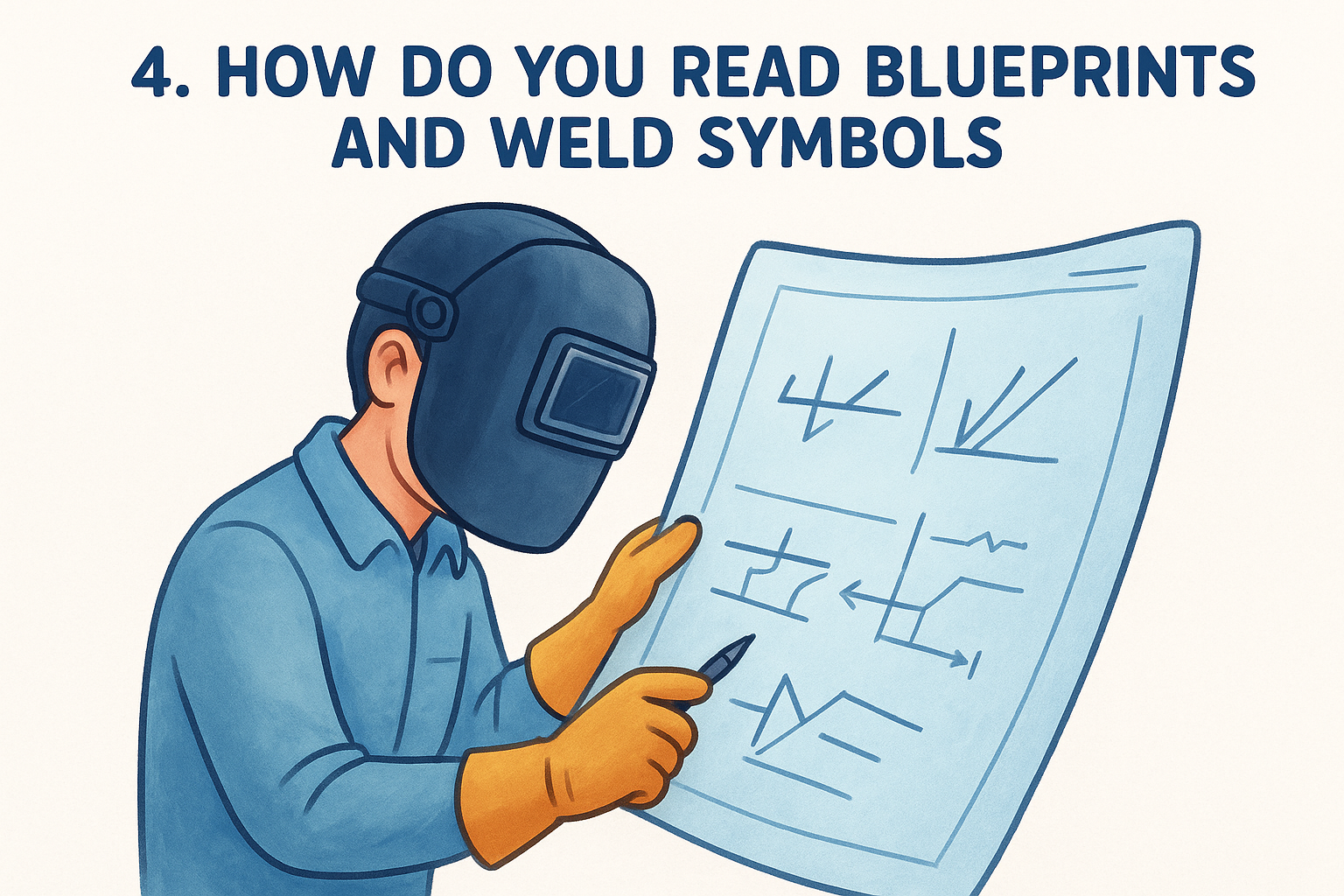
4. How do you read blueprints and weld symbols
Blueprint reading separates welders who can work independently from those who need constant supervision, and hiring managers ask this question to verify you can interpret drawings without guessing. Most fabrication and construction jobs require you to read specifications, identify weld symbols, and understand dimensions before you strike an arc. Your answer shows whether you’ll waste time asking for help or can work from prints like a professional.
Why hiring managers ask this
Employers want welders who can look at a drawing and know exactly what type of weld, what size, and what finish the job requires. This question tests whether you understand AWS A2.4 weld symbols and can read technical drawings well enough to produce parts that match specifications. They’re checking if you’ll make expensive mistakes because you misread a print or need a foreman to explain every detail.
What to cover in your answer
Explain your process for reviewing a blueprint before you start welding. Mention how you identify weld symbols, joint types, and dimensions on drawings. Talk about reading notes and specifications that control welding procedures, and describe how you verify your work matches what the print shows.
Focus on the practical steps you take when handed a new drawing.
Sample answer
“I start by checking the title block for the material spec and revision number, then I look at the weld symbols to identify the joint type, weld size, and any special notes like backing or finish requirements. I use the dimension lines to confirm fit-up measurements and check for welding procedure specifications referenced in the notes. If anything’s unclear, I ask before I start rather than assume what the engineer meant.”
Good details to mention
Reference the AWS A2.4 standard for weld symbols if you learned it formally. Mention specific symbols you work with regularly, like fillet welds, groove welds, or plug welds. Note whether you read structural, piping, or mechanical drawings, and explain how you use dimensions and tolerances to check your work.
Red flags to avoid
Don’t claim you never need help reading prints or act like blueprint reading doesn’t matter in welding work. Avoid vague answers that don’t demonstrate real understanding of weld symbols and technical drawings. Never admit you ignore specifications or guess at what symbols mean instead of asking questions.
5. Walk me through how you set up for a weld
This question tests your understanding of proper preparation and whether you follow a logical sequence when you work. Hiring managers want to see that you don’t just grab a torch and start burning metal, you actually prepare your workspace, check your equipment, and verify everything before you strike an arc. Your answer reveals whether you work methodically or create problems through sloppy preparation habits.
Why hiring managers ask this
Employers ask this because setup mistakes cause weld defects, safety hazards, and wasted materials that cost them money. They want to know if you understand that quality welds start long before you pull the trigger. This question shows whether you’ve developed professional habits or if you skip critical steps that lead to failed inspections.
What to cover in your answer
Describe your setup process in chronological order from start to finish. Cover how you verify the base material, prepare the joint, select and inspect your equipment, and confirm your machine settings before welding. Mention safety checks and any quality control steps you take during setup.
Walk through your actual process, not just what you think they want to hear.
Sample answer
“I start by checking the base material against the print to verify I have the right spec and thickness. Then I clean the joint area with a grinder or wire wheel to remove any mill scale, rust, or contamination. I inspect my consumables to make sure my wire and gas are correct for the material, check my machine settings against the WPS, and run a test bead on scrap to confirm my parameters. Before I weld the actual part, I verify my work angles and travel speed with a practice pass.”
Good details to mention
Reference specific preparation steps like joint fit-up, backing installation, or tack welding sequence. Mention how you verify welding procedures, check gas flow rates, or confirm preheat requirements. Talk about inspecting your electrode or wire for damage and setting proper work clamp placement.
Red flags to avoid
Don’t skip over material preparation or act like you never need to practice your settings. Avoid answers that suggest you rush through setup to start welding faster. Never claim you can set up any weld in seconds without checking specifications or testing your parameters first.
6. How do you make sure your welds meet spec
Quality control separates professional welders from those who produce scrap, and this question reveals whether you have systematic inspection habits built into your work routine. Hiring managers need welders who can verify their own work meets specifications before an inspector finds problems. Your answer demonstrates whether you understand acceptance criteria and take responsibility for quality instead of relying on others to catch your mistakes.
Why hiring managers ask this
Employers ask this because failed welds cost them money through rework, scrapped materials, and delayed schedules. They want welders who inspect their work continuously and know what quality looks like according to relevant codes. This question tests whether you understand inspection methods and take ownership of producing code-compliant welds every time.
What to cover in your answer
Explain the inspection methods you use during and after welding. Describe how you reference welding procedure specifications and acceptance standards to verify your work. Mention specific checks you perform and how you document quality when required.
Focus on the inspection steps you actually perform on every weld.
Sample answer
“I check my welds continuously by watching my puddle and bead appearance as I go, making sure I maintain proper penetration and avoid undercut or porosity. After each pass, I use a wire brush to clean slag and inspect for surface defects like cracks or incomplete fusion. I measure fillet weld sizes with a gauge to verify they match the print, and I reference the WPS acceptance criteria to confirm profile, reinforcement, and finish meet requirements. On critical welds, I mark my work with my welder ID and document it per the quality plan.”
Good details to mention
Reference specific inspection tools like fillet gauges, pit gauges, or bridge cams that you use regularly. Mention visual inspection techniques for identifying common defects. Note any experience with dye penetrant testing or preparing welds for radiographic inspection. Talk about how you track welding parameters against procedure requirements.
Red flags to avoid
Don’t claim you never produce defects or suggest that inspection is someone else’s job. Avoid vague answers that don’t describe actual inspection methods or acceptance criteria you follow. Never admit you skip quality checks when supervisors aren’t watching or that you hide defects instead of reporting them.
7. What do you do if you find a defect in your weld
Defect response procedures reveal your professional judgment and whether you understand that hiding problems creates bigger issues down the line. This question appears in welding interview questions because hiring managers need to know you’ll catch and correct mistakes instead of covering them up or hoping inspectors miss them. Your answer shows whether you have the integrity and technical knowledge to handle quality issues properly.
Why hiring managers ask this
Hiring managers ask this because unrepaired defects lead to structural failures, safety hazards, and liability problems that put their business at risk. They want welders who understand that stopping work to fix a defect costs less than letting bad welds reach the field. This question tests whether you know proper repair procedures and will communicate problems to supervisors instead of making decisions that violate code requirements.
What to cover in your answer
Describe your process for identifying the defect type, stopping work, and notifying the appropriate person. Explain how you determine whether you can repair the weld yourself or need engineering approval before proceeding. Mention following documented repair procedures and re-inspecting your work after correction.
Always emphasize that you report defects rather than hide them.
Sample answer
“If I find a defect, I stop welding immediately and identify what caused it, whether it’s porosity, undercut, or cracking. I notify my foreman or quality inspector right away and document the location. I check the WPS or repair procedure to see if I’m authorized to grind out and reweld the defect, or if it needs engineering review first. After I complete any approved repair, I reinspect the area to verify it meets acceptance criteria before moving on.”
Good details to mention
Reference specific defect types you’ve identified and repaired like porosity, slag inclusions, or incomplete fusion. Mention grinding techniques for removing defective metal without creating undercut. Talk about heat input control during repairs to avoid additional cracking or distortion. Note any experience with repair documentation or tracking systems.
Red flags to avoid
Don’t suggest you rarely find defects in your work or claim you can always fix problems without telling anyone. Avoid answers that skip proper notification procedures or suggest you make unauthorized repairs. Never admit you’ve hidden defects or welded over problems without grinding them out completely first.
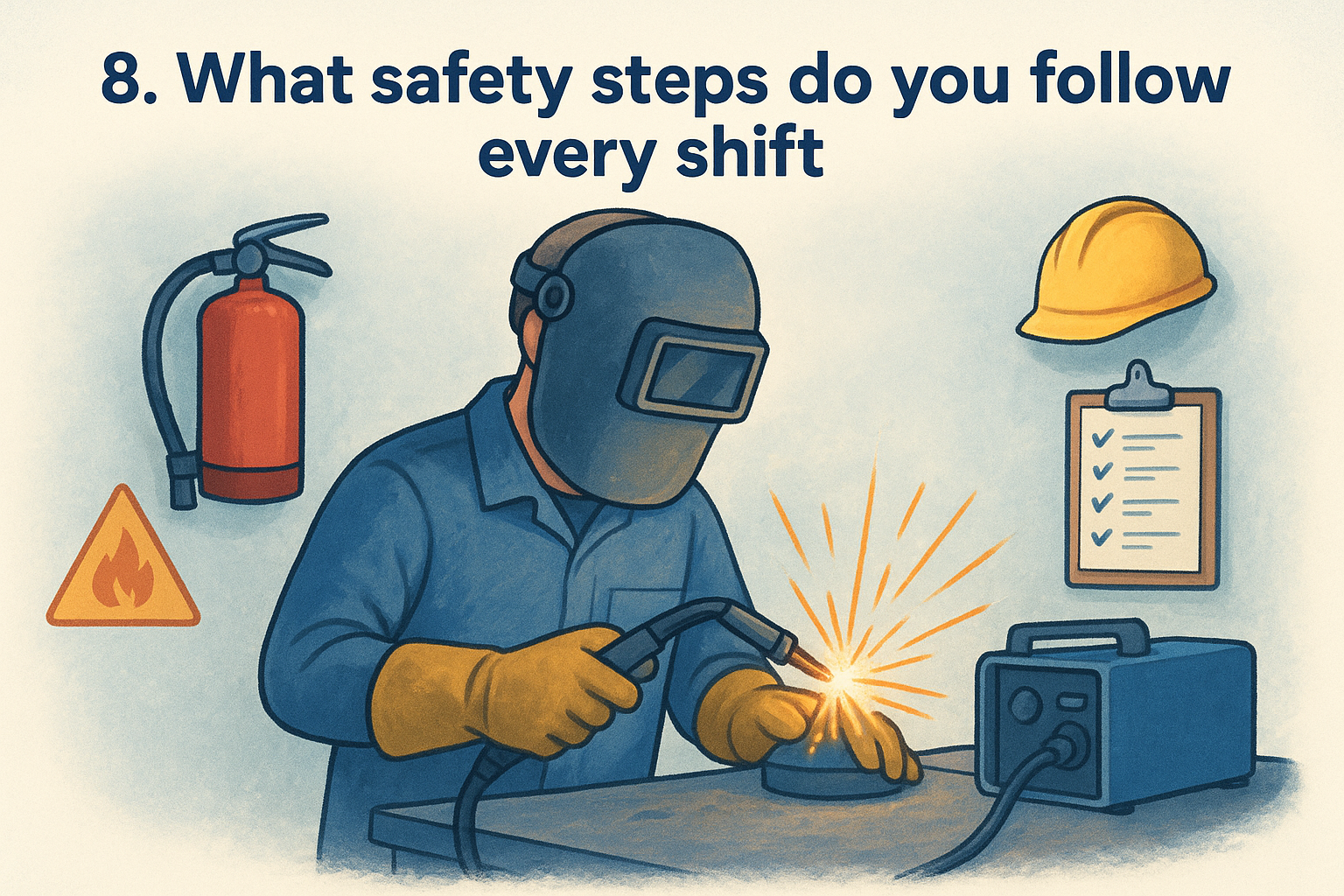
8. What safety steps do you follow every shift
This question tests whether you’ve built safety habits into your daily routine and understand that protecting yourself and coworkers isn’t optional. Hiring managers include this in welding interview questions because workplace injuries cost them money, shut down projects, and create liability problems. Your answer reveals whether you take safety seriously or treat it like a checklist item you ignore when no one’s watching.
Why hiring managers ask this
Employers ask this because welding creates serious hazards like arc flash, fumes, fire risks, and hot material burns that can injure or kill workers. They need welders who follow safety procedures automatically, not just when OSHA inspectors visit. This question shows whether you understand your responsibility to work safely and whether you’ll create dangerous situations that put their whole crew at risk.
What to cover in your answer
Describe your pre-shift safety routine in order, covering personal protective equipment inspection, workspace preparation, and equipment checks. Mention specific hazards you control before welding starts and how you maintain safe conditions throughout the day. Talk about communication practices that prevent accidents when working around others.
Focus on the safety steps you actually perform every single shift.
Sample answer
“I start every shift by inspecting my welding hood, gloves, and leathers for damage, then I check my work area for flammable materials and set up proper ventilation. I verify my machine ground is secure, test my equipment before striking an arc, and make sure I have fire watch coverage when working on anything that could ignite. Throughout the day, I keep my cables organized to prevent trip hazards, use fume extraction when working in tight spaces, and communicate with nearby workers before I start any hot work.”
Good details to mention
Reference specific PPE requirements like shade number for your hood, leather sleeve protection, or respirator use in confined spaces. Mention hot work permits, fire extinguisher placement, or lockout/tagout procedures you follow. Talk about ventilation requirements, proper cylinder storage, or grounding practices that prevent electrical hazards.
Red flags to avoid
Don’t suggest safety procedures slow you down or admit you skip steps when rushing to meet deadlines. Avoid generic answers that don’t describe actual safety practices you perform daily. Never claim accidents only happen to careless workers or that you’ve never had a close call.
9. What welding positions can you pass
Position capability determines which jobs you can handle and how much value you bring to a shop’s production schedule. This question appears frequently in welding interview questions because employers need to match your qualified positions to their actual work requirements before they make a hiring decision. Your answer tells them whether you’ll solve their staffing problems or need additional testing and training.
Why hiring managers ask this
Hiring managers ask this to find out if you can weld in the positions their jobs require, whether that’s flat production work or overhead structural welding. Position qualifications directly impact how they can use you on different projects and whether you’ll pass their pre-employment weld test. They’re checking if your certified positions match their typical work assignments or if they’ll need to limit where they can place you.
What to cover in your answer
Name the specific positions you’ve passed formal tests in using AWS position designations like 1G, 2G, 3G, 4G for plate or 2G, 5G, 6G for pipe. Mention which processes you’ve tested in each position and whether your certifications are current. Connect your qualified positions to the type of work you know the company performs.
Always distinguish between positions you’ve passed certified tests in versus positions you’ve practiced.
Sample answer
“I’ve passed 6G pipe certification for TIG welding on stainless steel, which qualifies me for all pipe positions. I also hold 3G and 4G certifications for MIG welding on plate, so I can handle vertical and overhead structural work. Most of my daily production experience is in flat and horizontal positions, but I’m comfortable welding overhead when projects require it.”
Good details to mention
Specify whether your position certifications cover open root pipe work or backing requirements. Mention if you’ve passed tests with radiographic inspection or visual inspection only. Note any specialized position work like orbital welding or hard-to-reach joint configurations that demonstrate advanced skills.
Red flags to avoid
Don’t claim you can weld all positions if you’ve only tested in flat or horizontal work. Avoid confusing position numbers or using incorrect terminology that suggests you don’t understand AWS standards. Never exaggerate your overhead or pipe welding abilities if you haven’t maintained those skills recently.
Next steps before you walk in
You now have answers to the most common welding interview questions that hiring managers ask, but preparation doesn’t stop with memorizing responses. Practice your answers out loud several times so they sound natural instead of rehearsed. Review your certifications and documentation to make sure you can provide accurate dates and details when asked. Research the company’s work beforehand so you understand their projects and can connect your experience to their specific needs.
Bring copies of your certifications, test coupons, and references in a folder so you’re ready if the interviewer requests them. Arrive fifteen minutes early wearing clean work clothes that show you respect the trade. Most shops conduct practical weld tests after the interview, so mentally prepare to demonstrate your skills under pressure.
Looking for more ways to advance your welding career? Check out our blue collar jobs blog for additional interview tips, career advice, and industry insights that help skilled trades professionals land better positions.
Want blue collar jobs delivered to your inbox?
Want blue collar jobs delivered to your inbox?
